Practise 22 exam-style questions on Energy changes in systems for AQA GCSE Combined Science (Foundation Physics Paper 1). Write your answer as you would in the exam and get it marked in seconds against the mark scheme, point by point, with the Study Helper on hand if you get stuck.
22 questions
1–6 marks each
Instant marking
No sign-up needed
20 questions, marked as you go
Sample questions with model answers
Here are 4 of the questions in this topic, each with a model answer, an explanation of why it earns the marks and the mark scheme an examiner would use.
Question 1
1 mark
A hot water bottle is filled with hot water. It keeps a person's feet warm for a long time.
Which property of water means that the water in a hot water bottle can store a lot of energy?
Choose your answer.
Water has a high specific heat capacity
Water has a low specific heat capacity
Water is a good thermal conductor
Water has a high boiling point
Model answer
Water has a high specific heat capacity
Explanation
Water has a very high specific heat capacity compared with most materials, so a kilogram of hot water stores a lot of energy in its thermal store and releases a lot as it cools by each degree. This is why water is used in hot water bottles and central heating radiators.
Mark scheme
1 mark
Water has a high specific heat capacity
If more than one option is given, 0 marks. A high specific heat capacity (about 4200 J/kg °C) means each kilogram of water stores a lot of energy for each degree of temperature rise, and releases it as it cools. A low specific heat capacity would store less. Being a good conductor would make it lose energy faster, and water is in fact a poor conductor. Its boiling point does not decide how much energy it stores.
Question 2
2 marks
A concrete paving slab is warmed by the Sun during the day. At night the slab cools down.
mass of slab = 25 kg specific heat capacity of concrete = 880 J/kg °C decrease in temperature during the night = 12 °C
Calculate the energy released from the thermal energy store of the slab during the night.
Use the equation:
change in thermal energy = mass × specific heat capacity × temperature change
Give your answer in joules.
Model answer
ΔE = 25 × 880 × 12 ΔE = 264 000 J
Explanation
The same equation works for cooling: the energy released from the thermal store is mass × specific heat capacity × temperature change = 25 × 880 × 12 = 264 000 J. The temperature change is 12 °C whether the temperature goes up or down. Large answers like this are normal, because heavy objects store a lot of energy.
Mark scheme
1 mark
ΔE = 25 × 880 × 12
1 mark
ΔE = 264 000 (J)
allow 2.64 × 10⁵ (J). A correct answer with no working scores full marks. Full marks are not awarded for a correct final answer from incorrect working.
Question 3
3 marks
A parent heats some water for a baby's bath.
mass of water = 12 kg starting temperature of water = 15 °C final temperature of water = 37 °C specific heat capacity of water = 4200 J/kg °C
Calculate the energy needed to heat the water.
Use the equation:
change in thermal energy = mass × specific heat capacity × temperature change
The equation needs the temperature change, not the final temperature: 37 °C - 15 °C = 22 °C. Then 12 × 4200 × 22 = 1 108 800 J. Using 37 °C instead of the change is the most common error.
Mark scheme
1 mark
temperature change = 37 - 15 = 22 (°C)
1 mark
ΔE = 12 × 4200 × 22
allow a correct substitution using an incorrect value of temperature change (e.g. 12 × 4200 × 37)
1 mark
ΔE = 1 108 800 (J)
allow 1 100 000 (J) / 1.1 × 10⁶ (J). allow an answer consistent with their value of temperature change: 1 864 800 (J), from using the final temperature (37 °C) as the temperature change, scores 2 marks. A correct answer with no working scores full marks. Full marks are not awarded for a correct final answer from incorrect working.
Question 4
4 marks
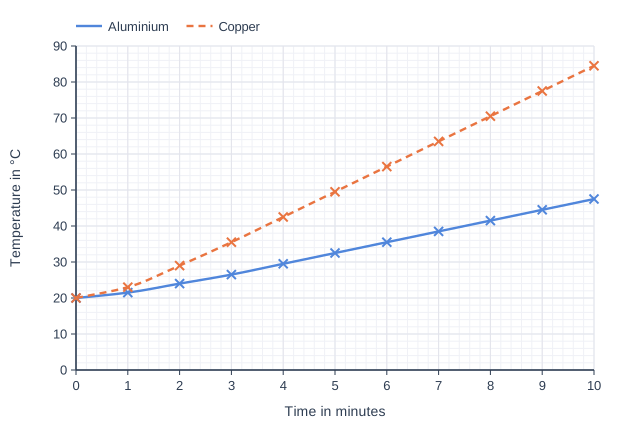
A student heated a 1.0 kg block of aluminium and a 1.0 kg block of copper. She used the same heater, with the same power, for each block. Both blocks were insulated in the same way.
The graph shows her results.
specific heat capacity of aluminium = 900 J/kg °C specific heat capacity of copper = 385 J/kg °C
Compare the temperature changes of the two blocks.
Use the graph and the specific heat capacities in your answer.
Model answer
Both blocks started at 20 °C and both temperatures increased, slowly at first and then at a steady rate. The temperature of the copper rose much faster than the aluminium: after 10 minutes the copper was at about 84 °C (a rise of about 64 °C) but the aluminium was only at about 47 °C (a rise of about 27 °C), so the copper's rise was about 2.3 times bigger. This is because copper has a lower specific heat capacity (385 J/kg °C) than aluminium (900 J/kg °C), so less energy is needed to raise 1 kg of copper by 1 °C. Both blocks had the same mass and received the same energy, so the copper's temperature rose more; 900 ÷ 385 is about 2.3, which matches.
Explanation
A compare question needs statements about both blocks together, using words like 'both', 'faster than' and 'about 2.3 times'. The best answers quote values from the graph and explain the difference using the specific heat capacities. Many students describe each line separately, or think the higher specific heat capacity means a faster temperature rise.
Mark scheme
4 marks
Levels of response (4 marks). Level 2 (3-4 marks): Scientifically relevant features are identified; the way(s) in which they are similar / different is made clear and (where appropriate) the magnitude of the similarity / difference is noted. Level 1 (1-2 marks): Relevant features are identified and differences noted. No relevant content: 0 marks.
Indicative content (not a checklist; credit other valid points): Similarities - both blocks start at 20 °C - the temperature of both blocks increases - both rise slowly at first (in the first minute or so) and then increase at a steady rate / the lines become straight Differences - the temperature of the copper block rises faster / its line is steeper - after 10 minutes the copper is at 84.5 °C and the aluminium is at 47.5 °C - the copper's temperature rise (about 64 °C) is about 2.3 times the aluminium's (about 27 °C) - because copper has a lower specific heat capacity, so less energy is needed to raise each kilogram by 1 °C - the same energy is supplied to the same mass, so the block with the lower specific heat capacity has the bigger temperature rise - 900 ÷ 385 ≈ 2.3, which matches the ratio of the temperature rises For Level 2, the answer must make a clear comparison of both blocks (not a separate description of each), give at least one value read from the graph and link the difference to the specific heat capacities. Allow readings within half a small square (± 1 °C). Common errors: describing only one block; saying aluminium heats up faster because 900 is bigger; saying copper 'absorbs more heat'. Use best fit, starting at the lowest level; full marks only if no incorrect statement contradicts a correct one.
Ready to try the rest? Every answer you write is marked against the mark scheme, so you can see exactly where the marks are.
Ctrl + Enter to check
Study HelperHints first, answers after you try
Stuck on this one? Ask for a hint and I’ll point you in the right direction, without giving the answer away. Once you’ve checked your answer, I’ll show you how the marks are awarded.