Practise 18 exam-style questions on Particle motion in gases for AQA GCSE Combined Science (Foundation Physics Paper 1). Write your answer as you would in the exam and get it marked in seconds against the mark scheme, point by point, with the Study Helper on hand if you get stuck.
18 questions
1–6 marks each
Instant marking
No sign-up needed
18 questions, marked as you go
Sample questions with model answers
Here are 4 of the questions in this topic, each with a model answer, an explanation of why it earns the marks and the mark scheme an examiner would use.
Question 1
1 mark
Container A and container B are identical and sealed. They contain the same mass of the same gas. The gas in container A is at 10 °C. The gas in container B is at 50 °C.
Which statement is correct?
Choose your answer.
Every molecule in B moves faster than every molecule in A
The molecules in A move faster on average
The molecules in B have more kinetic energy on average
The pressure in A is greater than the pressure in B
Model answer
The molecules in B have more kinetic energy on average
Explanation
Temperature is related to the average kinetic energy of the molecules, so the gas at 50 °C has molecules with more kinetic energy on average. Molecules in a gas move at a range of speeds, so it is not true that every molecule in B is faster than every molecule in A. The hotter gas also has the higher pressure, because its molecules hit the walls more often and harder.
Mark scheme
1 mark
The molecules in B have more kinetic energy on average
If more than one option is given, 0 marks. The molecules in each gas have a range of speeds, so some molecules in A can move faster than some in B: it is the average that is higher in B. The molecules in A, at the lower temperature, are slower on average. The gas at the higher temperature (B) has the greater pressure.
Question 2
2 marks
Describe the motion of the molecules in a gas.
Model answer
The molecules are in constant random motion. They move in all directions at a range of different speeds, colliding with each other and with the walls of the container.
Explanation
The molecules of a gas are in constant random motion: they never stop moving, and they travel in all directions at different speeds until they collide with each other or with the walls. A common mistake is to describe the molecules as vibrating, which is how particles move in a solid.
Mark scheme
1 mark
(they move) randomly / in random directions / in all directions
Any two points, 1 mark each, max 2. allow particles for molecules.
1 mark
(they move) constantly / they never stop moving
1 mark
(they move) at a range of different speeds
1 mark
they collide with each other and / or with the walls of the container
max 2. do not accept 'they vibrate about fixed positions' (this describes a solid). ignore 'they move quickly' on its own.
Question 3
2 marks
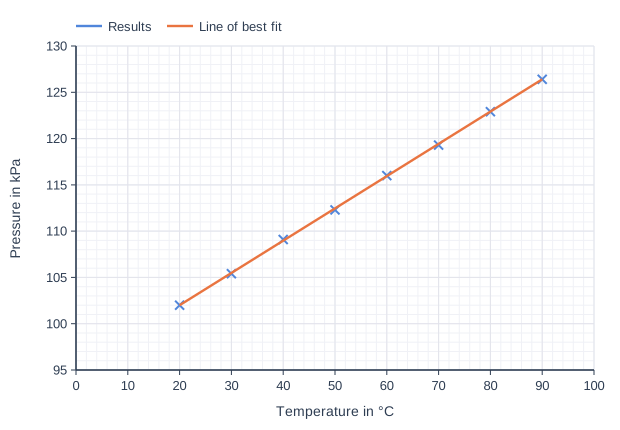
Grace sealed some air in a metal can at 20 °C. She heated the can slowly. A data logger measured the temperature and the pressure of the air in the can. The volume of the can did not change. The graph shows her results and a line of best fit.
Describe the relationship between the temperature and the pressure of the air in the can.
Model answer
As the temperature increases, the pressure of the air increases. The relationship is linear: the points lie on a straight line, and the pressure increases by about 3.5 kPa for each 10 °C rise.
Explanation
Describe the direction of the trend (both increase) and its shape (a straight line, with equal increases in pressure for equal increases in temperature). The relationship is not directly proportional, because the pressure is not zero at 0 °C; the line would not pass through the origin.
Mark scheme
1 mark
as the temperature increases, the pressure increases
allow the higher the temperature, the higher the pressure.
1 mark
the relationship is linear / the points lie on a straight line / the pressure increases by the same amount for each 10 °C rise (about 3.5 kPa)
do not accept (directly) proportional (the line would not pass through the origin). allow a correct use of data to show equal increases, e.g. the pressure rises by about 7 kPa for each 20 °C rise (102 kPa at 20 °C, 109.1 kPa at 40 °C, 116 kPa at 60 °C). Two readings alone (e.g. 102 kPa at 20 °C and 126.4 kPa at 90 °C) show only an increase and do not score this mark.
Question 4
4 marks
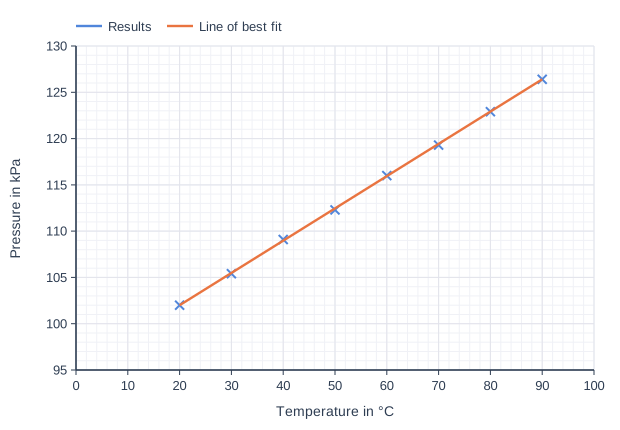
Grace measured the pressure of some air sealed in a metal can at temperatures from 20 °C to 90 °C. The graph shows her results and a line of best fit. She wants to predict the pressure of the air at 100 °C.
Use the line of best fit and the equation to predict the pressure of the air at 100 °C.
Use the equation:
increase in pressure for each 1 °C rise = change in pressure ÷ change in temperature
Model answer
From the line: change in pressure = 126.4 - 102 = 24.4 kPa; change in temperature = 90 - 20 = 70 °C increase for each 1 °C rise = 24.4 ÷ 70 = 0.35 kPa increase from 90 °C to 100 °C = 10 × 0.35 = 3.5 kPa pressure at 100 °C = 126.4 + 3.5 = 129.9 kPa
Explanation
Use two points far apart on the line of best fit to find how much the pressure rises for each 1 °C (the gradient of the line), then use it to go beyond the last result. This is called extrapolation, and it assumes the straight-line pattern continues. A common error is to add 0.35 kPa only once, or to add the increase to the wrong starting pressure.
Mark scheme
1 mark
change in pressure and change in temperature read from the line, e.g. 126.4 - 102 = 24.4 (kPa) and 90 - 20 = 70 (°C)
allow any two points on the line of best fit.
1 mark
increase for each 1 °C rise = 24.4 ÷ 70 = 0.35 (kPa)
allow any value from 0.33 to 0.37 (kPa per °C).
1 mark
increase from 90 °C to 100 °C = 10 × 0.35 = 3.5 (kPa)
allow ecf from their increase for each 1 °C. allow 80 × 0.35 = 28 (kPa) added to 102 kPa.
1 mark
pressure at 100 °C = 129.9 (kPa)
allow any value from 129.5 to 130.5 (kPa). allow ecf from their working. An answer of 129.5 to 130.5 kPa found by extending the line of best fit to 100 °C scores full marks. A correct answer with no working scores full marks. Full marks are not awarded for a correct final answer from incorrect working.
Ready to try the rest? Every answer you write is marked against the mark scheme, so you can see exactly where the marks are.
Ctrl + Enter to check
Study HelperHints first, answers after you try
Stuck on this one? Ask for a hint and I’ll point you in the right direction, without giving the answer away. Once you’ve checked your answer, I’ll show you how the marks are awarded.