Practise 21 exam-style questions on National and global energy resources for AQA GCSE Combined Science (Foundation Physics Paper 1). Write your answer as you would in the exam and get it marked in seconds against the mark scheme, point by point, with the Study Helper on hand if you get stuck.
21 questions
1–6 marks each
Instant marking
No sign-up needed
20 questions, marked as you go
Sample questions with model answers
Here are 4 of the questions in this topic, each with a model answer, an explanation of why it earns the marks and the mark scheme an examiner would use.
Question 1
1 mark
Which energy resource provides most of the energy used for transport in the UK?
Choose your answer.
Coal
Natural gas
Oil
Bio-fuel
Model answer
Oil
Explanation
Cars, lorries, ships and aircraft need a fuel that stores a lot of energy and can be carried, so almost all of them burn petrol, diesel or jet fuel made from oil. The number of electric vehicles is increasing, but electricity still provided less than 3% of the energy used for UK transport in 2025.
Mark scheme
1 mark
Oil
If more than one option is given, 0 marks. Petrol, diesel and jet fuel are all made from crude oil: in 2025 about 92% of the energy used for UK transport came from petroleum (DUKES 2026). Coal and natural gas are hardly used for transport, and bio-fuels provided only about 5%, mostly mixed into petrol and diesel.
Question 2
1 mark
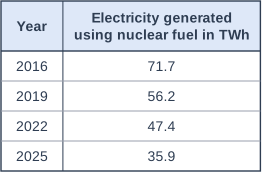
The table shows the electricity generated using nuclear fuel in the UK in four different years. The data are from the Digest of UK Energy Statistics (DUKES) 2026, published by the Department for Energy Security and Net Zero. TWh (terawatt hour) is a unit of energy.
Suggest one reason why the electricity generated using nuclear fuel decreased between 2016 and 2025.
Model answer
Some of the UK's old nuclear power stations reached the end of their working lives and were closed, and no new ones had been finished to replace them.
Explanation
Electricity generated using nuclear fuel halved between 2016 and 2025, from 71.7 TWh to 35.9 TWh, mainly because several old nuclear power stations closed, such as Dungeness B in 2021 and Hunterston B in 2022. New nuclear power stations take many years to build. The world's supply of nuclear fuel has not run out.
Mark scheme
1 mark
(some) old nuclear power stations closed / reached the end of their working life
allow fewer nuclear power stations were working; allow power stations were shut down for repairs or safety checks; allow no new nuclear power stations were finished to replace them. Do not accept 'the nuclear fuel ran out'. Ignore 'nuclear power is dangerous' unless it is linked to power stations closing.
Question 3
2 marks
Scientists have shown that a new nuclear power station would generate a large amount of electricity without releasing carbon dioxide while it is generating.
The government still has to decide whether to build it.
Suggest two reasons why the government may decide not to build the nuclear power station.
Model answer
It would be very expensive to build and would take many years before it generated any electricity. Also, many local people may object because they are worried about accidents and about where the radioactive waste would be stored.
Explanation
Science can identify the benefits and the problems of using an energy resource, but the decision also depends on economic (cost), social (what people want), political (votes and government policy) and ethical (leaving radioactive waste for future generations) considerations. Good answers give reasons that are not about the science itself.
Mark scheme
1 mark
it is very expensive to build (and to close down safely at the end of its life)
1 mark for each reason, max 2. Economic reason.
1 mark
it takes many years to build before it generates any electricity
1 mark
local people may object / do not want to live near it / are worried about an accident
Social reason.
1 mark
the radioactive waste has to be stored safely for a very long time / it leaves dangerous waste for future generations
Ethical or environmental reason.
1 mark
voters or public opinion may be against it / a new government may change the policy
Political reason.
1 mark
the money could be spent on renewable resources instead (e.g. wind or solar, which are quicker to build)
Max 2. allow building it releases a lot of carbon dioxide (making the concrete and steel) as an environmental reason. Do not accept 'it releases carbon dioxide while generating' (the question says it does not) or 'nuclear fuel is renewable'. List rule: each wrong extra answer cancels a correct one.
Question 4
3 marks
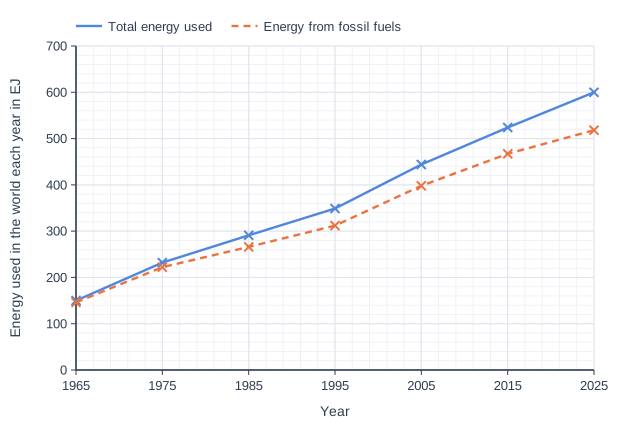
The graph shows the total energy used in the world each year, and the energy that came from fossil fuels, from 1965 to 2025. The data are from the Energy Institute Statistical Review of World Energy 2026 (via Our World in Data). EJ (exajoule) is a unit of energy.
Describe the trends shown in the graph.
Suggest one reason why the total energy used in the world has increased.
Model answer
The total energy used in the world increased from about 150 EJ in 1965 to 600 EJ in 2025, four times as much. The energy from fossil fuels also increased, from 146 EJ to 518 EJ, so most of the world's energy still comes from fossil fuels. However, the gap between the two lines grew from 4 EJ to 82 EJ, so more energy now comes from nuclear fuel and renewable resources. One reason is that the world's population has increased, and more people now use electrical appliances, vehicles and heating.
Explanation
Describe both lines and how they compare, using values from the graph. Fossil fuel use has kept rising, even though renewable resources have grown, because total demand has grown so much. A reason must say why more energy is used, for example a larger population or more industry; 'people use more energy' just repeats the trend.
Mark scheme
1 mark
the total energy used has increased (from about 150 EJ in 1965 to 600 EJ in 2025 / four times as much)
allow the total energy used increased every 10 years.
1 mark
the energy from fossil fuels has also increased (from 146 EJ to 518 EJ) / the gap between the lines has grown (so more energy now comes from other, non-fossil resources)
either trend scores the mark. allow fossil fuels still provide most of the world's energy; allow the share from fossil fuels has fallen slightly (from about 97% to about 86%); allow the gap grew from 4 EJ to 82 EJ; allow 'both lines increased' for MP1 and MP2. Do not accept 'the energy from fossil fuels decreased'.
1 mark
the world's population has increased / more people use electricity, vehicles and heating / countries have become more industrialised / people's living standards have risen
Ignore 'people use more energy' without a reason. Ignore 'it is colder'.
Ready to try the rest? Every answer you write is marked against the mark scheme, so you can see exactly where the marks are.
Ctrl + Enter to check
Study HelperHints first, answers after you try
Stuck on this one? Ask for a hint and I’ll point you in the right direction, without giving the answer away. Once you’ve checked your answer, I’ll show you how the marks are awarded.