
Level:
Correct: 0
Incorrect: 0
Marks: 0/0
Exam Practice
Course:
Topics:
AQA GCSE Combined Science (Foundation Physics Paper 1) Smart practice A mixed round aimed at your weak spots
Unit 18
Energy
Energy changes in a system, and the ways energy is stored before and after such changes
Energy stores and systems, and changes in energy
Energy changes in systems
Power
Conservation and dissipation of energy
Energy transfers in a system and efficiency
National and global energy resources
Unit 19
Electricity
Unit 20
Particle model of matter
Changes of state and the particle model
Density of materials and changes of state
Particle model and pressure
Particle motion in gases
Unit 21
Atomic structure
Avg
score:
–
Topics
done:
0/17

Isotopes and the development of the nuclear model of the atom

Practise 23 exam-style questions on Isotopes and the development of the nuclear model of the atom for AQA GCSE Combined Science (Foundation Physics Paper 1). Write your answer as you would in the exam and get it marked in seconds against the mark scheme, point by point, with the Study Helper on hand if you get stuck.

  • 23 questions
  • 1–6 marks each
  • Instant marking
  • No sign-up needed
20 questions, marked as you go

Sample questions with model answers

Here are 4 of the questions in this topic, each with a model answer, an explanation of why it earns the marks and the mark scheme an examiner would use.

Question 1

1 mark

Which statement describes the nuclear model of the atom but not the plum pudding model?

Choose your answer.

  • The atom contains negative electrons
  • The atom has no overall charge
  • Most of the mass is in a tiny positive centre
  • The positive charge is spread through the atom

Model answer

Most of the mass is in a tiny positive centre

Explanation

In the nuclear model the mass and the positive charge are concentrated in a tiny nucleus at the centre, with electrons outside it. In the plum pudding model the positive charge is a ball filling the whole atom, with electrons embedded in it. Both models have electrons and both describe a neutral atom, so those statements do not show a difference.

Mark scheme
  1. 1 mark

    Most of the mass is in a tiny positive centre

    If more than one option is given, 0 marks. Both models contain negative electrons and both describe an atom with no overall charge. A positive charge spread through the atom describes the plum pudding model, not the nuclear model.
Question 2

2 marks

Uranium has two common isotopes. They can be represented as ²³⁵₉₂U and ²³⁸₉₂U

Explain why these two atoms are isotopes of the same element.

Model answer

Both atoms have an atomic number of 92, so both have 92 protons and are atoms of the same element, uranium. They have different numbers of neutrons: uranium-235 has 235 - 92 = 143 neutrons and uranium-238 has 238 - 92 = 146 neutrons.

Explanation

Isotopes are atoms of the same element (same number of protons) with different numbers of neutrons. In the symbols, the same bottom number (92) shows the same number of protons; the different top numbers (235 and 238) show different numbers of neutrons. Saying the isotopes have different numbers of electrons is wrong: both neutral atoms have 92 electrons.

Mark scheme
  1. 1 mark

    they have the same number of protons (92)

    allow they have the same atomic number (92). ignore they have the same number of electrons. do not accept they have different numbers of protons.

  2. 1 mark

    they have different numbers of neutrons (143 and 146)

    allow they have different mass numbers (235 and 238). If numbers of neutrons are given, they must be correct. do not accept they have different numbers of electrons.

Question 3

2 marks

Inside a glowing neon lamp, some neon atoms lose one of their outer electrons.

A neon atom has 10 protons and 10 electrons.

Explain why a neon atom becomes a positive ion when it loses one electron.

Model answer

After losing one electron, the particle has 10 protons but only 9 electrons. The positive charge of the protons is now greater than the negative charge of the electrons, so the particle has an overall charge of +1: it is a positive ion.

Explanation

An atom has no overall charge because its protons and electrons are equal in number. When an atom loses an outer electron, the nucleus is unchanged, so there is one more proton than electrons and the particle is a positive ion. A common mistake is to think the atom gains a proton.

Mark scheme
  1. 1 mark

    it now has more protons than electrons / 10 protons and 9 electrons

    do not accept it gains a proton / loses a neutron.

  2. 1 mark

    so the positive charge is greater than the negative charge / the overall charge is positive (+1)

    allow the positive charge of the protons is no longer balanced by the negative charge of the electrons. allow an overall charge of 1+.

Question 4

4 marks

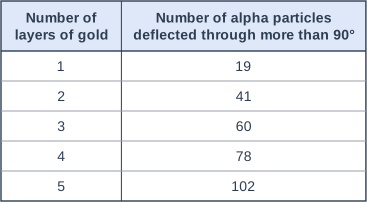
A scientist repeated part of the alpha particle scattering experiment. She fired alpha particles at gold foils made from different numbers of layers of gold. Each layer had the same thickness. She used the same source of alpha particles each time.

For each foil, she counted the number of alpha particles deflected through more than 90° in 10 minutes.

The table shows her results.

Describe the relationship between the number of layers of gold and the number of alpha particles deflected through more than 90°. Use data from the table in your answer.

Explain this relationship. Use the nuclear model of the atom in your answer.

Table with columns "Number of layers of gold", "Number of alpha particles deflected through more than 90°". Number of layers of gold: 1; Number of alpha particles deflected through more than 90°: 19 | Number of layers of gold: 2; Number of alpha particles deflected through more than 90°: 41 | Number of layers of gold: 3; Number of alpha particles deflected through more than 90°: 60 | Number of layers of gold: 4; Number of alpha particles deflected through more than 90°: 78 | Number of layers of gold: 5; Number of alpha particles deflected through more than 90°: 102.

Model answer

As the number of layers increases, the number of alpha particles deflected through more than 90° increases. The number is roughly directly proportional to the number of layers: there are about 20 more for each extra layer, and doubling the layers from 2 to 4 about doubles the number (41 to 78).
Each extra layer adds more gold nuclei. A nucleus is tiny, so an alpha particle only rarely passes close enough to one to be repelled through a large angle. With more layers, there are more nuclei in the path of each alpha particle, so there are more chances of passing close to a nucleus and being deflected through more than 90°.

Explanation

Two marks are for the pattern: an increase, then a proportional increase backed by data from the table (about 20 per layer). Two marks are for the explanation: more layers put more tiny positive nuclei in the path of the alpha particles, so more of them pass close to a nucleus and are repelled through large angles. Answers saying the alpha particles 'hit more electrons' or are 'attracted' by the nucleus do not earn the explanation marks.

Mark scheme
  1. 1 mark

    the more layers of gold, the more alpha particles are deflected through more than 90°

    allow as the number of layers increases, the number deflected increases / positive correlation. do not accept the number deflected decreases.

  2. 1 mark

    the number deflected is (approximately) directly proportional to the number of layers, supported by data, e.g. about 20 more for each extra layer / doubling from 2 to 4 layers (about) doubles the number from 41 to 78 / 5 layers gives about 5 times as many as 1 layer (102 compared with 19)

    the idea of proportion must be supported by data from the table for this mark. allow about 20 alpha particles per layer. allow 'linear' with data. ignore 'exactly proportional' (the values vary a little because the emission of alpha particles is random).

  3. 1 mark

    more layers means more gold atoms / nuclei in the path of the alpha particles

    allow each alpha particle passes more nuclei. allow a thicker foil has more nuclei.

  4. 1 mark

    so there is a greater chance of an alpha particle passing close to a (tiny, positive) nucleus and being repelled through a large angle

    allow the nucleus is tiny, so an alpha particle only rarely passes close enough to one to be deflected through a large angle; more nuclei give more chances. do not accept the alpha particles are attracted by the nucleus / bounce off electrons / hit more electrons.

Ready to try the rest? Every answer you write is marked against the mark scheme, so you can see exactly where the marks are.

Study Helper Hints first, answers after you try

Stuck on this one? Ask for a hint and I’ll point you in the right direction, without giving the answer away. Once you’ve checked your answer, I’ll show you how the marks are awarded.