Practise 25 exam-style questions on The human digestive system for AQA GCSE Combined Science (Foundation Biology Paper 1). Write your answer as you would in the exam and get it marked in seconds against the mark scheme, point by point, with the Study Helper on hand if you get stuck.
25 questions
1–6 marks each
Instant marking
No sign-up needed
20 questions, marked as you go
Sample questions with model answers
Here are 4 of the questions in this topic, each with a model answer, an explanation of why it earns the marks and the mark scheme an examiner would use.
Question 1
1 mark
An enzyme is heated to a temperature well above its optimum temperature.
What happens to the enzyme?
Choose your answer.
It is killed
Its active site changes shape
It works faster
It is used up in the reaction
Model answer
Its active site changes shape
Explanation
At high temperatures the shape of the enzyme's active site changes, so the substrate no longer fits and the enzyme is denatured. Saying the enzyme is 'killed' is a common error that never gains credit. Extreme pH values also denature enzymes.
Mark scheme
1 mark
Its active site changes shape
If more than one option is given, 0 marks. Enzymes are protein molecules, not living things, so they cannot be killed: the correct term is denatured. Above the optimum the rate falls; it does not rise. Enzymes are catalysts, so they are not used up in the reaction.
Question 2
2 marks
Lipase is an enzyme that breaks down lipids (fats). This word equation shows the reaction:
lipid → product 1 + product 2
Name product 1 and product 2.
Model answer
Glycerol and fatty acids
Explanation
Lipases break lipids down into glycerol and fatty acids, which are small soluble molecules that can be absorbed into the blood. Proteases give amino acids and carbohydrases give simple sugars. Take care with spelling: 'glycerol' must not look like 'glucose' or 'glycogen'.
Mark scheme
1 mark
glycerol
either order; allow glycerine; do not accept glucose or glycogen (phonetic spellings that could be confused with these are not accepted). If more than two products are given, each wrong one cancels a right one.
1 mark
fatty acids
do not accept amino acids; ignore 'acids' unqualified
Question 3
2 marks
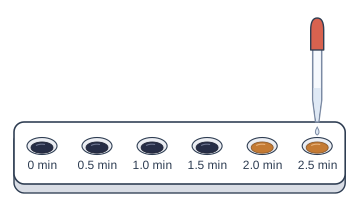
A student mixed amylase with starch solution at pH 7. Every 30 seconds she added one drop of the mixture to a new well of iodine on a spotting tile.
The diagram shows her results.
She recorded 2.0 minutes as the time taken to break down the starch completely.
Explain why the starch may really have been broken down completely in less than 2.0 minutes.
Suggest how she could find the time more precisely.
Model answer
The iodine was blue-black at 1.5 minutes, so starch was still present, but orange-brown at 2.0 minutes. The starch could have been fully digested at any time between 1.5 and 2.0 minutes, so the real time could be less than 2.0 minutes. She could take a sample every 10 seconds instead of every 30 seconds.
Explanation
With continuous sampling every 30 seconds, the recorded time is the first sample with no starch, so the true time lies somewhere in the 30 seconds before it. Sampling more often narrows this gap. Blue-black means starch is present; orange-brown means it has all been digested.
Mark scheme
1 mark
starch was still present at 1.5 minutes but not at 2.0 minutes, so the starch was all digested at some time between 1.5 and 2.0 minutes
allow the starch could have been digested at any time after the 1.5 minute sample; ignore 'human error' unqualified
1 mark
test samples more often, e.g. every 10 seconds
allow take samples at shorter time intervals; ignore 'repeat' unqualified; do not accept 'test every minute'
Question 4
4 marks
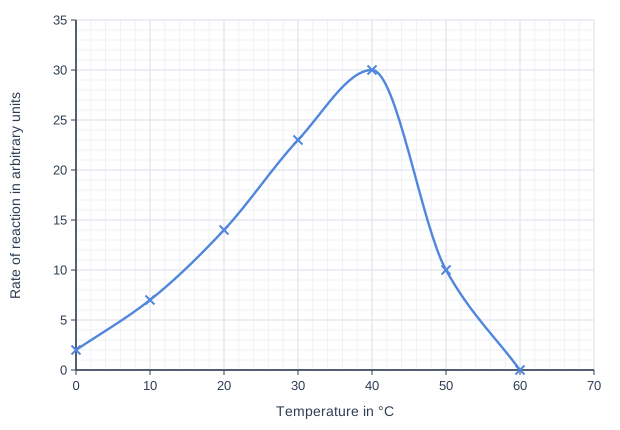
A student investigated the effect of temperature on the rate of digestion of protein by a protease.
The graph shows the results.
Describe and explain the effect of temperature on the rate of reaction.
Model answer
As the temperature increases from 0 °C to 40 °C, the rate of reaction increases, because the molecules move faster and the protein and protease collide more often. The optimum temperature is about 40 °C. Above 40 °C the rate falls quickly, to zero at 60 °C. This is because the high temperature changes the shape of the active site, so the protein no longer fits: the enzyme is denatured.
Explanation
Enzyme graphs rise to an optimum and then fall steeply. Explain the rise with faster-moving molecules and more collisions, and the fall with the active site changing shape (denaturing). Enzymes are never 'killed', and at low temperatures they are not denatured, just slower.
Mark scheme
1 mark
the rate increases as temperature increases up to an optimum of about 40 °C
allow the rate is highest at 40 °C
1 mark
above 40 °C the rate decreases quickly / falls to zero at 60 °C
allow data, e.g. from 30 at 40 °C to 10 at 50 °C
1 mark
(as temperature rises to the optimum) the molecules move faster / have more kinetic energy, so the protein and protease collide more often
allow more successful collisions / more substrate fits the active sites per second
1 mark
(above the optimum) the active site changes shape so the protein no longer fits / the enzyme is denatured
do not accept the enzyme is killed; do not accept 'denatured' for the low rate at 0 °C
1 mark
at 60 °C all the enzyme molecules are denatured, so there is no reaction
max 4
Ready to try the rest? Every answer you write is marked against the mark scheme, so you can see exactly where the marks are.
Ctrl + Enter to check
Study HelperHints first, answers after you try
Stuck on this one? Ask for a hint and I’ll point you in the right direction, without giving the answer away. Once you’ve checked your answer, I’ll show you how the marks are awarded.