
Level:
Correct: 0
Incorrect: 0
Marks: 0/0
Exam Practice
Course:
Topics:
Avg
score:
–
Topics
done:
0/17

Communicable diseases: viral, bacterial, fungal and protist

Practise 27 exam-style questions on Communicable diseases: viral, bacterial, fungal and protist for AQA GCSE Combined Science (Foundation Biology Paper 1). Write your answer as you would in the exam and get it marked in seconds against the mark scheme, point by point, with the Study Helper on hand if you get stuck.

  • 27 questions
  • 1–6 marks each
  • Instant marking
  • No sign-up needed
20 questions, marked as you go

Sample questions with model answers

Here are 4 of the questions in this topic, each with a model answer, an explanation of why it earns the marks and the mark scheme an examiner would use.

Question 1

1 mark

What type of illness does HIV cause in the first few weeks after a person is infected?

Model answer

A flu-like illness

Explanation

HIV first causes a flu-like illness. Unless it is controlled with antiretroviral drugs, the virus then attacks the body's immune cells. AIDS is the late stage of HIV infection, not the first illness.

Mark scheme
  1. 1 mark

    a flu-like illness

    Allow flu-like symptoms / symptoms like flu / named flu-like symptoms such as fever, sore throat or aching muscles. Ignore 'flu' alone. Do not accept AIDS.
Question 2

2 marks

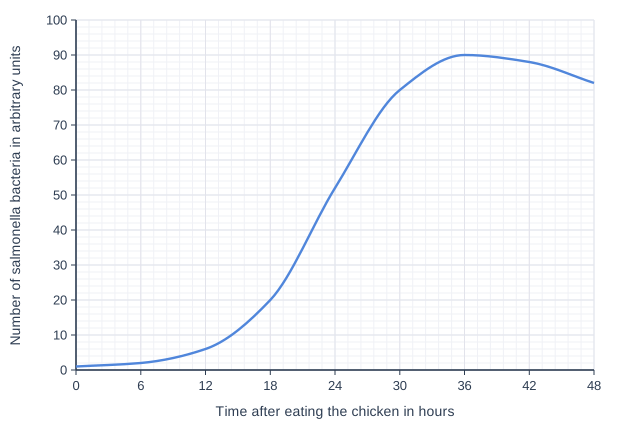
Sam ate chicken that contained salmonella bacteria. The graph shows a model of how the number of salmonella bacteria in Sam's intestine changed after he ate the chicken.

Sam began to feel ill about 24 hours after eating the chicken.

Explain why Sam began to feel ill.

Use the graph in your answer.

Line graph of number of salmonella bacteria in arbitrary units (y-axis, 0 to 100) against time after eating the chicken in hours (x-axis, 0 to 48). The line is a smooth curve through (0, 1), (6, 2), (12, 6), (18, 20), (24, 52), (30, 80), (36, 90), (42, 88), (48, 82).

Model answer

The graph shows that the bacteria reproduced rapidly inside Sam's intestine, increasing from 6 to 80 arbitrary units between 12 and 30 hours. The bacteria produce toxins, which damage tissues and make Sam feel ill.

Explanation

Bacteria can reproduce rapidly inside the body, and they may produce toxins that damage tissues and make us feel ill. The graph shows the rapid increase, so one mark needs evidence from it. The symptoms of salmonella food poisoning are caused by the bacteria and the toxins they secrete.

Mark scheme
  1. 1 mark

    the bacteria reproduced rapidly / the number of bacteria increased rapidly (between about 12 and 30 hours)

    Must use the graph: the idea of a rapid increase in the number of bacteria. Allow bacteria multiplied quickly. Allow the number of bacteria rose from 6 to 80 arbitrary units between 12 and 30 hours.

  2. 1 mark

    the bacteria produce toxins (poisons) that damage tissues (and make us feel ill)

    Allow the bacteria secrete poisons. Ignore 'the bacteria attack the body'. Do not accept references to viruses.

Question 3

2 marks

Gonorrhoea is a sexually transmitted disease caused by a bacterium.

Explain how using a condom reduces the spread of gonorrhoea.

Model answer

Gonorrhoea is spread by sexual contact, because the bacteria are in body fluids such as semen and vaginal fluid. A condom is a barrier, so the body fluids and the bacteria in them cannot pass from one partner to the other.

Explanation

The spread of gonorrhoea can be controlled by treating infected people with antibiotics and by using a barrier method of contraception such as a condom. The explanation needs the route (sexual contact, body fluids) and how the condom blocks it. A condom does not kill bacteria.

Mark scheme
  1. 1 mark

    gonorrhoea is spread by sexual contact / the bacteria are passed on in body fluids during sex

    Allow the bacteria are in semen / vaginal fluid.

  2. 1 mark

    a condom is a barrier that stops the bacteria (in body fluids) passing from one person to another

    Allow condoms are a barrier method (of contraception). Ignore 'condoms stop pregnancy'. Do not accept 'the condom kills the bacteria'.

Question 4

4 marks

Tobacco mosaic virus (TMV) and rose black spot are both diseases of plants.

Compare TMV and rose black spot.

Model answer

TMV is caused by a virus, but rose black spot is caused by a fungus. Both diseases affect the leaves: TMV causes a mosaic pattern of discolouration, whereas black spot causes purple or black spots and the leaves often turn yellow and drop early. In both diseases photosynthesis is reduced, so the growth of the plant is reduced. TMV affects many species of plant, including tomatoes, whereas black spot affects roses. TMV is spread by contact, but black spot is spread by water and wind. Black spot can be treated with fungicides and by removing and destroying the affected leaves, but fungicides do not work against TMV.

Explanation

Each point must link the two diseases, using words such as 'both', 'but' or 'whereas'. Good comparisons include the type of pathogen, the symptoms, the shared effect on photosynthesis and growth, how each spreads and how each is controlled. Writing a paragraph on each disease with no links stays in Level 1.

Mark scheme
  1. 4 marks

    Levels of response (4 marks).
    Level 2 (3-4 marks): Scientifically relevant features are identified; the way(s) in which they are similar / different is made clear and (where appropriate) the magnitude of the similarity / difference is noted.
    Level 1 (1-2 marks): Relevant features are identified and differences noted.
    No relevant content: 0 marks.

    Indicative content (not a checklist; credit other valid points):
    Pathogen
    - TMV is caused by a virus, but rose black spot is caused by a fungus
    Symptoms
    - both affect the leaves
    - TMV gives a mosaic pattern of discolouration, whereas black spot gives purple or black spots
    - black spot leaves often turn yellow and drop early
    Effect on the plant
    - both reduce photosynthesis, so both reduce the growth of the plant
    Plants affected
    - TMV affects many species (including tomatoes), whereas black spot affects roses
    Spread
    - TMV is spread by contact (e.g. on hands, clothes and tools), whereas black spot spores are spread in the environment by water and wind
    Treatment and control
    - black spot can be treated with fungicides and by removing and destroying affected leaves; fungicides do not work against TMV, so infected plants are removed and destroyed
    For Level 2, at least two features must be compared, linking TMV and rose black spot in each (e.g. 'TMV is caused by a virus but rose black spot is caused by a fungus'), including at least one similarity or difference other than the type of pathogen.
    Common errors: TMV is a bacterium; black spot is a virus; antibiotics treat either disease.
    There are two marks in each level: start at Level 1 and use best fit. Full marks only if no incorrect statement contradicts a correct one.

Ready to try the rest? Every answer you write is marked against the mark scheme, so you can see exactly where the marks are.

Study Helper Hints first, answers after you try

Stuck on this one? Ask for a hint and I’ll point you in the right direction, without giving the answer away. Once you’ve checked your answer, I’ll show you how the marks are awarded.