
Level:
Correct: 0
Incorrect: 0
Marks: 0/0
Exam Practice
Course:
Topics:
Avg
score:
–
Topics
done:
0/17

Human defence systems and vaccination

Practise 22 exam-style questions on Human defence systems and vaccination for AQA GCSE Combined Science (Foundation Biology Paper 1). Write your answer as you would in the exam and get it marked in seconds against the mark scheme, point by point, with the Study Helper on hand if you get stuck.

  • 22 questions
  • 1–6 marks each
  • Instant marking
  • No sign-up needed
20 questions, marked as you go

Sample questions with model answers

Here are 4 of the questions in this topic, each with a model answer, an explanation of why it earns the marks and the mark scheme an examiner would use.

Question 1

1 mark

Which of these is part of the body's non-specific defence system?

Choose your answer.

  • Hydrochloric acid in the stomach
  • Antibodies made by white blood cells
  • Antitoxins made by white blood cells
  • Antibiotics taken as tablets

Model answer

Hydrochloric acid in the stomach

Explanation

The non-specific defences are the skin, the nose, the trachea and bronchi, and the stomach, which makes acid that kills pathogens in food and drink. If pathogens get past these, the immune system tries to destroy them, with white blood cells making antibodies and antitoxins.

Mark scheme
  1. 1 mark

    Hydrochloric acid in the stomach

    If more than one option is given, 0 marks. Antibodies and antitoxins are made by white blood cells as part of the immune system. Antibiotics are medicines, not a defence made by the body.
Question 2

2 marks

Smoking damages the cilia on the cells lining the trachea and bronchi.

Explain why smokers are more likely to get chest infections.

Model answer

Normally, mucus in the trachea and bronchi traps pathogens, and the cilia waft the mucus up to the throat, away from the lungs. If the cilia are damaged, the mucus is not moved away, so pathogens stay in the airways and can reach the lungs, where they cause infections.

Explanation

In the trachea and bronchi, mucus traps pathogens and cilia move the mucus up and away from the lungs. Smoking stops the cilia working, so the mucus and its pathogens build up. A common mistake is to say the cilia trap or kill the pathogens - the mucus traps them and the cilia move it.

Mark scheme
  1. 1 mark

    cilia (normally) move / waft mucus containing (trapped) pathogens up (to the throat) and away from the lungs

    Allow mucus traps pathogens and cilia move the mucus. Do not accept 'cilia kill pathogens'.

  2. 1 mark

    damaged cilia cannot move the mucus, so pathogens stay in the airways / reach the lungs (and cause infection)

    Allow mucus (and pathogens) build up in the airways / lungs.

Question 3

2 marks

Kofi was vaccinated against polio when he was a baby. Many years later, the polio virus entered his body, but he did not become ill.

Explain why Kofi did not become ill.

Model answer

The vaccine had stimulated Kofi's white blood cells to make antibodies against polio. When the polio virus entered his body years later, his white blood cells responded quickly and produced the correct antibodies, which destroyed the virus before it could reproduce and make him ill.

Explanation

If the same pathogen re-enters the body after vaccination, the white blood cells respond quickly to produce the correct antibodies, preventing infection. Saying only 'he was immune' does not explain why. The vaccine itself is no longer in the body and does not kill the virus.

Mark scheme
  1. 1 mark

    his white blood cells responded quickly (to the polio virus)

    Allow antibodies were made quickly / rapidly. Ignore 'he was immune' unqualified.

  2. 1 mark

    to produce the correct antibodies (in large amounts), which destroyed the virus before it could cause illness

    Allow destroyed the virus before it could reproduce / before symptoms developed. Allow references to memory cells. Do not accept 'the vaccine killed the virus' or 'antibiotics killed the virus'.

Question 4

3 marks

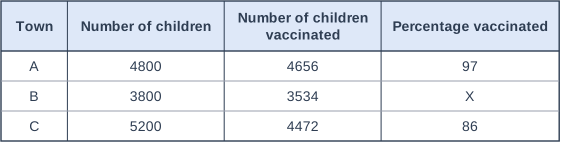
The World Health Organization (WHO) says that at least 95% of children need to be vaccinated against measles to stop the virus spreading in a population. The table shows information about three towns.

Calculate value X in the table. Then identify which town or towns have enough children vaccinated to stop measles spreading.

Use the equation:
percentage vaccinated = (number of children vaccinated ÷ number of children) × 100

Table with columns "Town", "Number of children", "Number of children vaccinated", "Percentage vaccinated". Town: A; Number of children: 4800; Number of children vaccinated: 4656; Percentage vaccinated: 97 | Town: B; Number of children: 3800; Number of children vaccinated: 3534; Percentage vaccinated: X | Town: C; Number of children: 5200; Number of children vaccinated: 4472; Percentage vaccinated: 86.

Model answer

X = 3534 ÷ 3800 × 100 = 93%
Only Town A (97%) has at least 95% of children vaccinated, so only Town A has enough children vaccinated to stop measles spreading. Towns B (93%) and C (86%) are below 95%.

Explanation

Percentage vaccinated = number vaccinated ÷ number of children × 100. Then compare each town with the 95% needed: only Town A is above it. In towns B and C the virus could still spread among the unvaccinated children.

Mark scheme
  1. 1 mark

    3534 ÷ 3800 × 100

    Allow 3534 ÷ 3800 = 0.93.

  2. 1 mark

    X = 93 (%)

    Allow 93.0. Do not accept 0.93 for this mark. A correct answer with no working scores both marks for X, but full marks are not awarded for a correct final answer from incorrect working.

  3. 1 mark

    Town A only

    Allow ecf from their value of X (e.g. if X is 95 or more, towns A and B). Town C (86%) is below 95%. Do not accept towns A and C. Right + wrong = wrong: naming town B or town C as well as town A scores 0 for this mark.

Ready to try the rest? Every answer you write is marked against the mark scheme, so you can see exactly where the marks are.

Study Helper Hints first, answers after you try

Stuck on this one? Ask for a hint and I’ll point you in the right direction, without giving the answer away. Once you’ve checked your answer, I’ll show you how the marks are awarded.