
Level:
Correct: 0
Incorrect: 0
Marks: 0/0
Exam Practice
Course:
Topics:
Avg
score:
–
Topics
done:
0/17

Response to exercise and metabolism

Practise 21 exam-style questions on Response to exercise and metabolism for AQA GCSE Combined Science (Foundation Biology Paper 1). Write your answer as you would in the exam and get it marked in seconds against the mark scheme, point by point, with the Study Helper on hand if you get stuck.

  • 21 questions
  • 1–6 marks each
  • Instant marking
  • No sign-up needed
20 questions, marked as you go

Sample questions with model answers

Here are 4 of the questions in this topic, each with a model answer, an explanation of why it earns the marks and the mark scheme an examiner would use.

Question 1

1 mark

During vigorous exercise, a runner's leg muscles respire anaerobically.

Which statement about this anaerobic respiration is correct?

Choose your answer.

  • It creates an oxygen debt
  • It produces carbon dioxide
  • It transfers more energy than aerobic respiration
  • It happens when there is plenty of oxygen

Model answer

It creates an oxygen debt

Explanation

When the muscles do not get enough oxygen, they respire anaerobically. The incomplete oxidation of glucose causes a build-up of lactic acid and creates an oxygen debt. Carbon dioxide is produced by anaerobic respiration in yeast and plants, not in muscles.

Mark scheme
  1. 1 mark

    It creates an oxygen debt

    If more than one option is given, 0 marks. Anaerobic respiration in muscles produces only lactic acid, not carbon dioxide. It transfers much less energy than aerobic respiration, and it happens when not enough oxygen is supplied to the muscles.
Question 2

2 marks

During exercise, a person's breathing rate and breath volume both increase.

Explain why.

Model answer

The muscles are respiring faster, so more oxygen must be taken into the blood for aerobic respiration, and more carbon dioxide produced by respiration must be removed from the blood.

Explanation

Breathing faster and more deeply moves more air in and out of the lungs each minute. This supplies the extra oxygen needed by the respiring muscles and removes the extra carbon dioxide they produce. 'To get more air' is not enough on its own.

Mark scheme
  1. 1 mark

    to take more oxygen into the blood (for aerobic respiration in the muscles)

    allow muscles need more oxygen for respiration
    ignore to get more air unqualified
    do not accept to make / produce energy

  2. 1 mark

    to remove more carbon dioxide (produced by respiration) from the blood

    allow to breathe out more carbon dioxide

Question 3

3 marks

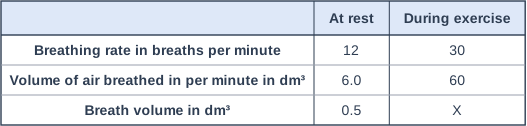
The table shows some measurements of Mia's breathing at rest and during exercise.

Calculate value X, Mia's breath volume during exercise.

Use the equation:

volume of air breathed in per minute = breathing rate × breath volume

Then calculate how many times greater Mia's breath volume was during exercise than at rest.

Table with columns (row headings), "At rest", "During exercise". Breathing rate in breaths per minute; At rest: 12; During exercise: 30 | Volume of air breathed in per minute in dm³; At rest: 6.0; During exercise: 60 | Breath volume in dm³; At rest: 0.5; During exercise: X.

Model answer

60 = 30 × breath volume
breath volume X = 60 ÷ 30 = 2.0 dm³
2.0 ÷ 0.5 = 4, so her breath volume was 4 times greater during exercise.

Explanation

Substitute the values you know into the equation, then rearrange: breath volume = volume per minute ÷ breathing rate. During exercise both the breathing rate (12 to 30 breaths per minute) and the breath volume increase, so far more air is breathed in each minute.

Mark scheme
  1. 1 mark

    60 = 30 × breath volume or breath volume = 60 ÷ 30

    correct answers with no working score 3 marks; full marks are not awarded for a correct final answer from incorrect working

  2. 1 mark

    X = 2 (dm³)

    allow 2.0
    do not accept 1800 (60 × 30) or 0.5 (30 ÷ 60)

  3. 1 mark

    2 ÷ 0.5 = 4 (times)

    allow ecf from their value of X ÷ 0.5
    allow 4 times as much / 4 times bigger
    do not accept 1.5 (the difference) or 0.25 (0.5 ÷ 2)

Question 4

4 marks

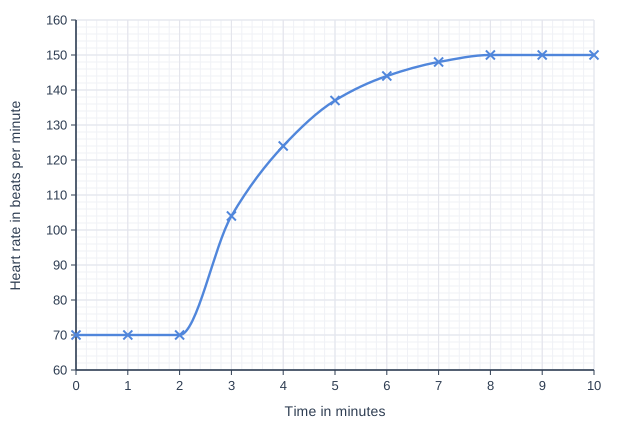
Kofi rested for 2 minutes and then ran on a treadmill at a steady speed for 8 minutes.

The graph shows his heart rate.

Describe how Kofi's heart rate changed when he started running, and explain why it changed.

Line graph of heart rate in beats per minute (y-axis, 60 to 160) against time in minutes (x-axis, 0 to 10). The line is a smooth curve through (0, 70), (1, 70), (2, 70), (3, 104), (4, 124), (5, 137), (6, 144), (7, 148), (8, 150), (9, 150), (10, 150).

Model answer

When Kofi started running, his heart rate increased from 70 to 150 beats per minute, and then it stayed at 150. His leg muscles were contracting more, so they needed more energy. This means more aerobic respiration, which needs more oxygen and glucose. A faster heart rate pumps more oxygenated blood to the muscles each minute, and also removes the extra carbon dioxide.

Explanation

Describe the change with values from the graph, then explain it as a chain: more muscle contraction, more energy needed, more respiration, more oxygen needed, so the heart beats faster to deliver more oxygenated blood. Say that respiration transfers energy: answers saying energy is 'made' do not gain credit.

Mark scheme
  1. 1 mark

    heart rate increased from 70 to 150 beats per minute (then stayed the same)

    allow increased (rapidly) and then levelled off
    allow increased by 80 beats per minute

  2. 1 mark

    his (leg) muscles were contracting more, so they needed more energy

    do not accept to make / produce more energy

  3. 1 mark

    (so) more (aerobic) respiration, which needs more oxygen (and glucose)

  4. 1 mark

    the heart pumps blood faster, so more oxygenated blood reaches the muscles

    allow to supply the muscles with more oxygen

  5. 1 mark

    (and) more carbon dioxide is removed from the muscles

    max 4
    the four explanation points (the second to fifth points) score max 3: full marks need the description of the change in the first point
    ignore lactic acid

Ready to try the rest? Every answer you write is marked against the mark scheme, so you can see exactly where the marks are.

Study Helper Hints first, answers after you try

Stuck on this one? Ask for a hint and I’ll point you in the right direction, without giving the answer away. Once you’ve checked your answer, I’ll show you how the marks are awarded.