
Level:
Correct: 0
Incorrect: 0
Marks: 0/0
Exam Practice
Course:
Topics:
Avg
score:
–
Topics
done:
0/17

Photosynthesis

Practise 25 exam-style questions on Photosynthesis for AQA GCSE Combined Science (Foundation Biology Paper 1). Write your answer as you would in the exam and get it marked in seconds against the mark scheme, point by point, with the Study Helper on hand if you get stuck.

  • 25 questions
  • 1–6 marks each
  • Instant marking
  • No sign-up needed
20 questions, marked as you go

Sample questions with model answers

Here are 4 of the questions in this topic, each with a model answer, an explanation of why it earns the marks and the mark scheme an examiner would use.

Question 1

1 mark

Plants convert some of the glucose they make into starch for storage.

Why is starch better than glucose for storage?

Choose your answer.

  • Starch dissolves easily in water
  • Starch is used to make proteins
  • Starch strengthens the cell wall
  • Starch is insoluble in water

Model answer

Starch is insoluble in water

Explanation

Glucose is soluble, but plants convert it into insoluble starch for storage, for example in potatoes and seeds. Cellulose, also made from glucose, is the substance that strengthens cell walls.

Mark scheme
  1. 1 mark

    Starch is insoluble in water

    If more than one option is given, 0 marks. Glucose dissolves easily, not starch. Proteins are made from amino acids (made with glucose and nitrate ions), not from starch. It is cellulose, not starch, that strengthens the cell wall.
Question 2

2 marks

Photosynthesis can be written using chemical symbols.

Which two substances are products of photosynthesis?

Give two answers from this list:

CO₂   C₆H₁₂O₆   H₂O   N₂   O₂

Model answer

C₆H₁₂O₆ and O₂

Explanation

C₆H₁₂O₆ is glucose and O₂ is oxygen: these are the products. CO₂ (carbon dioxide) and H₂O (water) are the reactants. N₂ (nitrogen) is not involved in photosynthesis.

Mark scheme
  1. 1 mark

    C₆H₁₂O₆

    allow glucose
    each wrong extra answer cancels a correct answer (list rule): e.g. C₆H₁₂O₆, O₂ and H₂O = 1 mark

  2. 1 mark

    O₂

    allow oxygen

Question 3

2 marks

Scientists measured the rate of photosynthesis of some algae as 0.45 cm³ of oxygen per minute.

Calculate the volume of oxygen the algae would produce in 20 minutes at this rate.

Use the equation:

rate of photosynthesis = volume of oxygen ÷ time

Model answer

0.45 = volume ÷ 20
volume = 0.45 × 20 = 9 cm³

Explanation

Rearrange the equation: volume = rate × time. Substituting the values first (0.45 = volume ÷ 20) and then multiplying both sides by 20 is a reliable way to avoid dividing the wrong way round.

Mark scheme
  1. 1 mark

    volume = 0.45 × 20

    allow 0.45 = volume ÷ 20
    a correct answer with no working scores 2 marks; full marks are not awarded for a correct final answer from incorrect working

  2. 1 mark

    9 (cm³)

    allow 9.0
    do not accept 0.0225 (0.45 ÷ 20) or 44.4 (20 ÷ 0.45)

Question 4

4 marks

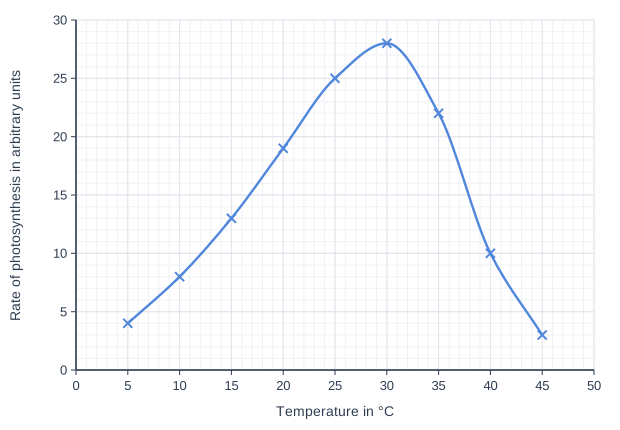
A scientist measured the rate of photosynthesis of a plant at different temperatures. All other conditions were kept the same.

The graph shows the results.

Use the graph to find the two temperatures at which the rate of photosynthesis was 20 arbitrary units.

Explain why the rate of photosynthesis is lower than the maximum rate at each of these two temperatures.

Line graph of rate of photosynthesis in arbitrary units (y-axis, 0 to 30) against temperature in °C (x-axis, 0 to 50). The line is a smooth curve through (5, 4), (10, 8), (15, 13), (20, 19), (25, 25), (30, 28), (35, 22), (40, 10), (45, 3).

Model answer

From the graph, the rate is 20 arbitrary units at about 21 °C and at about 36 °C.
At 21 °C the temperature is below the optimum of 30 °C. Photosynthesis is controlled by enzymes, and at this lower temperature the enzymes work more slowly because the molecules move more slowly and collide less often.
At 36 °C the temperature is above the optimum, so some of the enzymes are denatured: the shape of their active site changes.

Explanation

Read across from 20 on the y-axis to both sides of the curve, then down to the x-axis. The rate is the same at the two temperatures but for different reasons: below the optimum the enzymes are working slowly, above it some are denatured. Enzymes are proteins, not living things, so they cannot be 'killed'.

Mark scheme
  1. 1 mark

    21 (°C)

    allow 20 to 22 (°C)

  2. 1 mark

    36 (°C)

    allow 35 to 37 (°C)

  3. 1 mark

    at the lower temperature (below the optimum of 30 °C) the enzymes (that control photosynthesis) work more slowly / molecules move more slowly and collide less often

    allow it is too cold for the enzymes to work quickly
    do not accept the enzymes are denatured at the lower temperature

  4. 1 mark

    at the higher temperature (above the optimum) (some of) the enzymes are denatured / the shape of the active site changes

    do not accept enzymes are killed
    ignore enzymes stop working unqualified

Ready to try the rest? Every answer you write is marked against the mark scheme, so you can see exactly where the marks are.

Study Helper Hints first, answers after you try

Stuck on this one? Ask for a hint and I’ll point you in the right direction, without giving the answer away. Once you’ve checked your answer, I’ll show you how the marks are awarded.