
Level:
Correct: 0
Incorrect: 0
Marks: 0/0
Exam Practice
Course:
Topics:
Avg
score:
–
Topics
done:
0/17

Cell division

Practise 24 exam-style questions on Cell division for AQA GCSE Combined Science (Foundation Biology Paper 1). Write your answer as you would in the exam and get it marked in seconds against the mark scheme, point by point, with the Study Helper on hand if you get stuck.

  • 24 questions
  • 1–6 marks each
  • Instant marking
  • No sign-up needed
20 questions, marked as you go

Sample questions with model answers

Here are 4 of the questions in this topic, each with a model answer, an explanation of why it earns the marks and the mark scheme an examiner would use.

Question 1

1 mark

Which type of cell can be made to differentiate into most different types of human cell?

Choose your answer.

  • Embryonic stem cell
  • Adult bone marrow stem cell
  • Nerve cell
  • Red blood cell

Model answer

Embryonic stem cell

Explanation

Stem cells from human embryos can be cloned and made to differentiate into most different types of human cell. Adult stem cells, such as those in bone marrow, can form fewer types of cell, including blood cells. Specialised cells such as nerve cells have already differentiated.

Mark scheme
  1. 1 mark

    Embryonic stem cell

    If more than one option is given, 0 marks. Adult bone marrow stem cells can form many types of cell, including blood cells, but not most types. Nerve cells and red blood cells are already specialised and cannot differentiate into other types of cell.
Question 2

2 marks

What is a stem cell?

Model answer

A stem cell is an undifferentiated cell that can divide to give rise to many more cells of the same type, and from which certain other types of cell can arise by differentiation.

Explanation

The two key ideas are that a stem cell is not yet specialised and that it can produce more cells, which can then differentiate into other types of cell. Take care with 'any type of cell': embryonic stem cells can form most types of human cell, but adult stem cells, such as those in bone marrow, can only form some types.

Mark scheme
  1. 1 mark

    an undifferentiated cell

    allow an unspecialised cell

  2. 1 mark

    that can give rise to many more cells of the same type / that can differentiate into other types of cell

    allow can divide to make more stem cells; allow can become / turn into other / many / different types of cell; allow can become any type of cell; ignore can divide unqualified

Question 3

3 marks

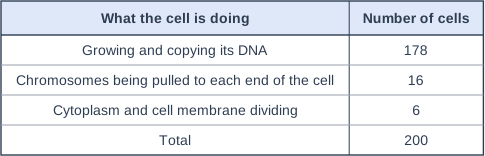
A student looked at 200 cells from the tip of an onion root using a microscope. The table shows what the cells were doing.

One cell cycle in these cells takes 20 hours.

Use the equation:
time in a stage = (number of cells in the stage ÷ total number of cells) × time for one cell cycle

Calculate the time, in minutes, that a cell spends with its chromosomes being pulled to each end of the cell.

Table with columns "What the cell is doing", "Number of cells". What the cell is doing: Growing and copying its DNA; Number of cells: 178 | What the cell is doing: Chromosomes being pulled to each end of the cell; Number of cells: 16 | What the cell is doing: Cytoplasm and cell membrane dividing; Number of cells: 6 | What the cell is doing: Total; Number of cells: 200.

Model answer

time = (16 ÷ 200) × 20 = 0.08 × 20 = 1.6 hours
1.6 × 60 = 96 minutes

Explanation

The fraction of cells in a stage shows the fraction of the cell cycle spent in that stage: 16 out of 200 cells is 0.08, and 0.08 × 20 hours = 1.6 hours = 96 minutes. Most cells are in the first stage (growing and copying DNA) because it is the longest stage. Remember to convert hours to minutes by multiplying by 60, not 100.

Mark scheme
  1. 1 mark

    (16 ÷ 200) × 20

    allow 0.08 × 20; a correct answer with no working scores full marks

  2. 1 mark

    = 1.6 (hours)

    allow ecf from an incorrect substitution correctly calculated

  3. 1 mark

    96 (minutes)

    allow ecf from their time in hours × 60; full marks are not awarded for a correct final answer from incorrect working; 1.6 alone (not converted) scores 2

Question 4

4 marks

Banana farmers grow a type of banana plant that is resistant to a fungal disease. Growers produce new banana plants for farmers by cloning small pieces of meristem tissue.

Explain why producing banana plants from meristem tissue is useful to farmers.

Model answer

Meristem tissue can differentiate into any type of plant cell, so each small piece can grow into a whole new plant. This means growers can produce large numbers of plants quickly and economically. The new plants are clones of the parent plant, so they all have the same feature: resistance to the fungal disease. Farmers then lose fewer plants to the disease.

Explanation

The marks are for why meristem tissue works (its cells can differentiate into any type of plant cell), what this gives growers (many plants, quickly and cheaply) and why farmers want the clones (every plant has the disease resistance). Saying the plants are 'immune to diseases' is wrong: the clones are resistant to one particular disease.

Mark scheme
  1. 4 marks

    any four from:
    • meristem tissue can differentiate into any type of plant cell
    • (so) each small piece can grow into a whole new plant
    • large numbers of plants can be produced (from one parent plant)
    • quickly
    • cheaply / economically
    • the new plants are clones / genetically identical (to the parent plant)
    • (so) all the new plants are resistant to the fungal disease

    1 mark for each point, max 4; allow fewer plants / crops are lost to the disease (so there is a bigger yield); ignore the plants grow faster / bigger unqualified; do not accept the plants are immune to all diseases

Ready to try the rest? Every answer you write is marked against the mark scheme, so you can see exactly where the marks are.

Study Helper Hints first, answers after you try

Stuck on this one? Ask for a hint and I’ll point you in the right direction, without giving the answer away. Once you’ve checked your answer, I’ll show you how the marks are awarded.