
Level:
Correct: 0
Incorrect: 0
Marks: 0/0
Exam Practice
Course:
Topics:
Avg
score:
–
Topics
done:
0/17

Plant tissues, organs and systems

Practise 27 exam-style questions on Plant tissues, organs and systems for AQA GCSE Combined Science (Foundation Biology Paper 1). Write your answer as you would in the exam and get it marked in seconds against the mark scheme, point by point, with the Study Helper on hand if you get stuck.

  • 27 questions
  • 1–6 marks each
  • Instant marking
  • No sign-up needed
20 questions, marked as you go

Sample questions with model answers

Here are 4 of the questions in this topic, each with a model answer, an explanation of why it earns the marks and the mark scheme an examiner would use.

Question 1

1 mark

The diagram shows part of a xylem vessel from the stem of a plant.

The rings labelled X contain a substance that strengthens the walls of the vessel.

Name substance X.
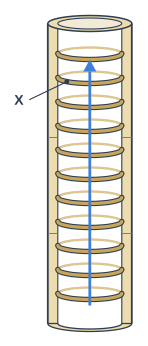
Diagram: a long vertical tube with thick walls, drawn as if you can see into it: it is open at the top (its end shows as a ring) and at the bottom, it is empty inside with no cross walls, and darker hoops thicken its wall all the way round at regular intervals. A blue arrow inside the tube points upwards. Label X points to one of the darker hoops that thicken the wall all the way round the tube.

Model answer

Lignin

Explanation

Xylem vessels are hollow tubes whose walls are strengthened by lignin. The lignin stops the tubes collapsing as water is pulled up the plant, and helps to support the stem. Cellulose is the main substance in all plant cell walls, so it is not the answer here.

Mark scheme
  1. 1 mark

    lignin

    Allow phonetic spellings such as 'lignen' or 'lignum'. Do not accept cellulose / wax / starch / chitin.
Question 2

2 marks

Leaves at the top of a tree grow in bright sunlight. Leaves near the bottom of the same tree are shaded by the leaves above them.

Scientists found that the leaves at the top of the tree have a thicker layer of palisade mesophyll than the leaves near the bottom.

Suggest why it is an advantage for the leaves at the top of the tree to have a thicker layer of palisade mesophyll.

Model answer

Leaves at the top of the tree receive more light. A thicker palisade layer has more cells containing chloroplasts, so more of this light can be absorbed and the leaf can photosynthesise more.

Explanation

The palisade mesophyll is where most photosynthesis happens. More light reaches the top of the tree, so extra palisade cells there can absorb it and make more glucose; in the shade there would not be enough light to make use of them. Say the light is absorbed, not just that the leaves 'get' more light.

Mark scheme
  1. 1 mark

    leaves at the top receive more light / a higher light intensity

    Allow converse: leaves in the shade receive less light.

  2. 1 mark

    (so) more (palisade) cells / chloroplasts can absorb the light, (so) more photosynthesis

    Allow more glucose / sugar made. Allow converse: in the shade there is too little light for extra palisade cells to be useful. Ignore 'more sunlight' alone (that is the first marking point). Do not accept 'more chlorophyll makes more light'.

Question 3

3 marks

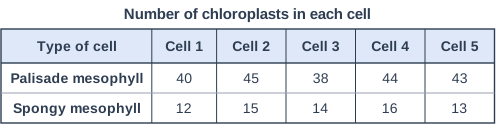
A student counted the number of chloroplasts in five palisade mesophyll cells and in five spongy mesophyll cells from the same leaf. The table shows the results.

Calculate how many times more chloroplasts there are in a palisade mesophyll cell than in a spongy mesophyll cell, on average.

Use the mean number of chloroplasts for each type of cell.

Number of chloroplasts in each cell. Table with columns "Type of cell", "Cell 1", "Cell 2", "Cell 3", "Cell 4", "Cell 5". Type of cell: Palisade mesophyll; Cell 1: 40; Cell 2: 45; Cell 3: 38; Cell 4: 44; Cell 5: 43 | Type of cell: Spongy mesophyll; Cell 1: 12; Cell 2: 15; Cell 3: 14; Cell 4: 16; Cell 5: 13.

Model answer

Mean for palisade cells = (40 + 45 + 38 + 44 + 43) ÷ 5 = 210 ÷ 5 = 42
Mean for spongy cells = (12 + 15 + 14 + 16 + 13) ÷ 5 = 70 ÷ 5 = 14
42 ÷ 14 = 3
A palisade cell has 3 times as many chloroplasts.

Explanation

Find each mean by adding the five counts and dividing by 5, then divide the larger mean by the smaller one to find 'how many times more'. Subtracting (42 - 14 = 28) gives the difference, not how many times more. Palisade cells have more chloroplasts because they are near the top of the leaf, where they get the most light.

Mark scheme
  1. 1 mark

    mean for palisade mesophyll cells = 210 ÷ 5 = 42

    Allow (40 + 45 + 38 + 44 + 43) ÷ 5.

  2. 1 mark

    mean for spongy mesophyll cells = 70 ÷ 5 = 14

    Allow (12 + 15 + 14 + 16 + 13) ÷ 5.

  3. 1 mark

    42 ÷ 14 = 3 (times)

    Allow ecf from their means. Allow 210 ÷ 70 = 3 for 3 marks. A correct answer with no working scores 3 marks, but full marks are not awarded for a correct answer from incorrect working. Do not accept 28 (the difference between the means) for this mark.

Question 4

4 marks

Water moves from the soil, through a plant, and into the air around the leaves.

Describe how water moves along this route.

Model answer

Water enters the root hair cells from the soil by osmosis. It moves across the root into the xylem and is carried up the stem in the xylem to the leaves. In the leaf, water evaporates from the surfaces of the mesophyll cells into the air spaces, and the water vapour diffuses out of the leaf through the stomata.

Explanation

Follow the water in order: root hair cells (osmosis), xylem up the stem, leaf cells, evaporation, and out through the stomata as water vapour. This flow of water is the transpiration stream. Naming the phloem instead of the xylem, or saying that water enters the roots by active transport, loses marks.

Mark scheme
  1. 1 mark

    water enters root hair cells (from the soil) by osmosis

    Any four marking points for max 4. Allow phonetic spelling of osmosis. Do not accept 'by active transport' or 'by diffusion' for this mark.

  2. 1 mark

    water moves (across the root) into the xylem

    Do not award if phloem is named instead of xylem.

  3. 1 mark

    water moves up the stem in the xylem

    Allow in the transpiration stream. Do not award if phloem is named.

  4. 1 mark

    water moves into the leaves / to the mesophyll cells

  5. 1 mark

    water evaporates from (the surfaces of) the cells in the leaf (into the air spaces)

  6. 1 mark

    water vapour diffuses out of the leaf through the stomata

    Allow water vapour leaves / evaporates out through the stomata. Ignore 'transpiration' unqualified. Max 4.

Ready to try the rest? Every answer you write is marked against the mark scheme, so you can see exactly where the marks are.

Study Helper Hints first, answers after you try

Stuck on this one? Ask for a hint and I’ll point you in the right direction, without giving the answer away. Once you’ve checked your answer, I’ll show you how the marks are awarded.