
Level:
Correct: 0
Incorrect: 0
Marks: 0/0
Exam Practice
Course:
Topics:
Avg
score:
–
Topics
done:
0/17

Cell specialisation and differentiation

Practise 18 exam-style questions on Cell specialisation and differentiation for AQA GCSE Combined Science (Foundation Biology Paper 1). Write your answer as you would in the exam and get it marked in seconds against the mark scheme, point by point, with the Study Helper on hand if you get stuck.

  • 18 questions
  • 1–6 marks each
  • Instant marking
  • No sign-up needed
18 questions, marked as you go

Sample questions with model answers

Here are 4 of the questions in this topic, each with a model answer, an explanation of why it earns the marks and the mark scheme an examiner would use.

Question 1

1 mark

When do most types of animal cell differentiate?

Choose your answer.

  • Early in development
  • Only after birth
  • Only during puberty
  • Throughout life

Model answer

Early in development

Explanation

Most types of animal cell differentiate at an early stage, as the embryo develops. In contrast, many types of plant cell keep the ability to differentiate throughout the life of the plant. In mature animals, cell division is mainly for repair and replacement.

Mark scheme
  1. 1 mark

    Early in development

    If more than one option is given, 0 marks. Most animal cells have already differentiated before birth, while the embryo develops. 'Throughout life' describes many types of plant cell, not most animal cells. Puberty brings growth and changes to the body, but most cell types formed long before.
Question 2

1 mark

In mature animals, cell division is mainly used for repair and for the replacement of cells.

Give one example of cells that are replaced in an adult human.

Model answer

Skin cells are replaced as dead cells are lost from the surface of the skin.

Explanation

Most cells in an adult animal are already specialised, so cell division is mostly used to repair damaged tissues and to replace cells that wear out, such as skin cells, blood cells and the cells lining the gut. Growth is not the answer here, because the question is about a mature animal.

Mark scheme
  1. 1 mark

    any one from:
    • skin cells
    • (red / white) blood cells
    • cells lining the gut / intestine / stomach

    allow cells lost from the surface of the skin; allow other correct examples, eg cells lining the mouth / airways; ignore hair / nails growing; ignore growth; ignore repair of a cut unless replacement of (skin) cells is stated; do not accept nerve cells; do not accept sperm or egg cells

Question 3

2 marks

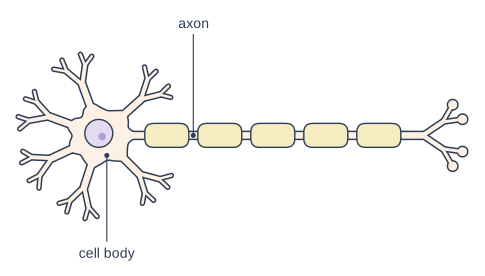
Figure 1 shows a nerve cell. Figure 1 is not drawn to scale.

In an adult, one nerve cell carries impulses all the way from the spinal cord to a muscle in the foot.

length of the axon = 1 m
width of the cell body = 0.1 mm

1 m = 1000 mm

Calculate how many times longer the axon is than the width of the cell body.

Give your answer in standard form.

Diagram: a long cell drawn horizontally. On the left is a rounded central part containing a round structure, with many short branching extensions around it. A long thin fibre runs from it to the right, covered along most of its length by five sausage-shaped segments with small gaps between them, and ends in short branches with small knobs at their tips. The label "cell body" points to the rounded central part on the left, around the round structure; the label "axon" points to the long thin fibre running to the right, at a point where it is not covered.

Model answer

1 m = 1000 mm
1000 ÷ 0.1 = 10 000
10 000 = 1 × 10⁴
The axon is 1 × 10⁴ times longer than the width of the cell body.

Explanation

Both lengths must be in the same unit, so change 1 m to 1000 mm before dividing: 1000 ÷ 0.1 = 10 000, which is 1 × 10⁴ in standard form. A nerve cell is specialised by having a very long axon, so one cell can carry impulses over a long distance, such as from the spinal cord to the foot. A common error is to divide 1 by 0.1 without converting the units.

Mark scheme
  1. 1 mark

    1000 ÷ 0.1 = 10 000

    allow 1 ÷ 0.0001 (both lengths in metres); a correct answer with no working scores full marks

  2. 1 mark

    1 × 10⁴ (times longer)

    allow 10⁴; allow 1 × 10 to the power 4; allow ecf from their value correctly written in standard form (eg 1 ÷ 0.1 = 10 written as 1 × 10¹ scores this mark only); 10 000 not in standard form scores the first mark only; do not accept 10 × 10³ (not standard form); full marks are not awarded for a correct final answer from incorrect working

Question 4

4 marks

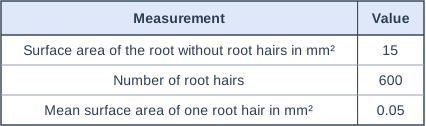
A scientist studied a 1 cm length of root from a young plant. The table shows the scientist's measurements.

Use the equation:
percentage increase = (increase in surface area ÷ surface area without root hairs) × 100

Calculate the percentage increase in the surface area of this part of the root due to the root hairs.

Explain why this increase in surface area is important to the plant.

Table with columns "Measurement", "Value". Measurement: Surface area of the root without root hairs in mm²; Value: 15 | Measurement: Number of root hairs; Value: 600 | Measurement: Mean surface area of one root hair in mm²; Value: 0.05.

Model answer

Increase in surface area = 600 × 0.05 = 30 mm²
Percentage increase = (30 ÷ 15) × 100 = 200%
A larger surface area means the root can absorb more water by osmosis and more mineral ions by active transport from the soil.

Explanation

The increase is the area of all the root hairs: 600 × 0.05 = 30 mm². Divide by the original area (15 mm²) and multiply by 100 to get 200%. Root hairs are long, thin extensions of root hair cells; their large surface area speeds up the absorption of water and mineral ions. A common error is to use the new total area (45 mm²) as the increase.

Mark scheme
  1. 1 mark

    (increase in surface area =) 600 × 0.05 = 30 (mm²)

    a correct answer with no working scores all 3 calculation marks

  2. 1 mark

    (30 ÷ 15) × 100

    allow ecf from their increase in surface area

  3. 1 mark

    200 (%)

    allow ecf from their working; full marks are not awarded for a correct final answer from incorrect working; 300 (%) comes from using the total area of 45 mm² as the increase

  4. 1 mark

    more water / mineral ions can be absorbed (from the soil)

    allow water is absorbed faster / by osmosis; allow mineral ions are absorbed faster / by active transport; ignore food / nutrients unqualified; do not accept absorbs sugar / glucose / carbon dioxide / oxygen for photosynthesis

Ready to try the rest? Every answer you write is marked against the mark scheme, so you can see exactly where the marks are.

Study Helper Hints first, answers after you try

Stuck on this one? Ask for a hint and I’ll point you in the right direction, without giving the answer away. Once you’ve checked your answer, I’ll show you how the marks are awarded.