
Level:
Correct: 0
Incorrect: 0
Marks: 0/0
Exam Practice
Course:
Topics:
Avg
score:
–
Topics
done:
0/17

The heart, blood vessels and blood

Practise 25 exam-style questions on The heart, blood vessels and blood for AQA GCSE Combined Science (Foundation Biology Paper 1). Write your answer as you would in the exam and get it marked in seconds against the mark scheme, point by point, with the Study Helper on hand if you get stuck.

  • 25 questions
  • 1–6 marks each
  • Instant marking
  • No sign-up needed
20 questions, marked as you go

Sample questions with model answers

Here are 4 of the questions in this topic, each with a model answer, an explanation of why it earns the marks and the mark scheme an examiner would use.

Question 1

1 mark

The natural resting heart rate is controlled by a group of cells that act as a pacemaker.

Where in the heart are these cells found?

Choose your answer.

  • Left atrium
  • Left ventricle
  • Right atrium
  • Right ventricle

Model answer

Right atrium

Explanation

The natural pacemaker is a group of cells in the wall of the right atrium. These cells control the natural resting heart rate. Students often guess the left ventricle because it is the most muscular chamber, but it is not where the pacemaker is.

Mark scheme
  1. 1 mark

    Right atrium

    If more than one option is given, 0 marks. The pacemaker cells are in the wall of the right atrium, not in the left atrium or in either ventricle.
Question 2

2 marks

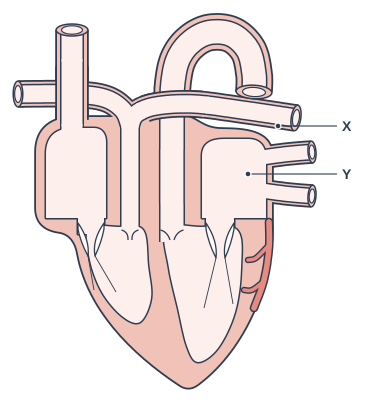
Figure 1 shows a section through the human heart, seen from the front.

Name the blood vessel labelled X and the chamber labelled Y.

Diagram of a vertical section through the heart, seen from the front. Four chambers are shown: two smaller upper chambers and two larger lower chambers, with a thick wall of muscle down the middle between the two lower chambers. The lower chamber on the right of the drawing has a much thicker muscular wall than the lower chamber on the left. Flaps held by thin threads lie between each upper chamber and the lower chamber below it, and small flaps sit at the bases of the two large vessels that leave the lower chambers. A large vessel enters the top of the upper left chamber; a vessel leaves the top of the lower left chamber and divides into two branches; two vessels enter the upper right chamber from the right; a large vessel leaves the top of the lower right chamber and arches over the top of the heart. A narrow branching vessel lies on the outer surface of the heart wall on the right. Label X points to the vessel that leaves the top of the lower left chamber and divides into two branches; label Y points to the upper chamber on the right of the drawing.

Model answer

X is the pulmonary artery. Y is the left atrium.

Explanation

The diagram is drawn as if you are facing the person, so the left side of the heart is on the right of the drawing. The pulmonary artery leaves the right ventricle and divides to go to both lungs. The left atrium receives blood from the pulmonary veins. Getting left and right the wrong way round is the most common error.

Mark scheme
  1. 1 mark

    X = pulmonary artery

    do not accept pulmonary vein
    do not accept aorta
    ignore artery unqualified

  2. 1 mark

    Y = left atrium

    allow left auricle
    do not accept right atrium
    do not accept left ventricle
    ignore atrium unqualified

Question 3

2 marks

Blood products, such as donated blood and plasma, are used to treat patients who have lost a lot of blood.

In the UK, every blood donation is tested for HIV before it is used.

Explain why.

Model answer

HIV is a virus that can be carried in the blood of a donor, who may not know they are infected. If infected blood were given to a patient, the patient would be infected with HIV, which attacks the immune system.

Explanation

HIV spreads by the exchange of body fluids such as blood, so a transfusion of infected blood would pass it on. Testing every donation (as well as asking donors about their health) reduces this risk to a very low level. Vague answers such as 'to make sure the blood is safe' need to say what the danger is.

Mark scheme
  1. 1 mark

    HIV is a virus / pathogen that can be (carried) in the donor's blood

    allow HIV is spread by the exchange of body fluids such as blood
    allow the donor might have HIV without knowing it

  2. 1 mark

    (so) the patient could be infected with HIV (which attacks the immune system / can lead to AIDS)

    allow to stop HIV being passed on to the patient
    ignore 'to check the blood is safe' unqualified
    ignore 'the patient could die' unqualified

Question 4

4 marks

Joyce's heart beats too slowly, so doctors fitted her with an artificial pacemaker.

A doctor measured Joyce's resting heart rate and the volume of blood pumped out of her left ventricle in each beat, before and after the pacemaker was fitted.

Before the pacemaker was fitted:
heart rate = 40 beats per minute
volume of blood pumped per beat = 90 cm³

After the pacemaker was fitted:
heart rate = 72 beats per minute
volume of blood pumped per beat = 75 cm³

Use the equations:
volume of blood pumped per minute = heart rate × volume of blood pumped per beat
percentage increase = (increase in volume per minute ÷ volume per minute before) × 100

Calculate the percentage increase in the volume of blood pumped per minute after the pacemaker was fitted.

Model answer

Before: 40 × 90 = 3600 cm³ per minute
After: 72 × 75 = 5400 cm³ per minute
Increase = 5400 − 3600 = 1800 cm³ per minute
Percentage increase = (1800 ÷ 3600) × 100 = 50%

Explanation

Work out the volume pumped per minute before and after the pacemaker was fitted, find the increase, then divide the increase by the value before and multiply by 100. A common error is to divide 5400 by 3600 and give 150%: that shows the new value is 1.5 times the old one, which is an increase of 50%. Using only the heart rates gives the wrong answer, because the volume pumped in each beat also changed.

Mark scheme
  1. 1 mark

    (before) 40 × 90 = 3600 (cm³ per minute)

    allow 3.6 dm³ per minute
    A correct final answer with no working scores 4 marks. Full marks are not awarded for a correct final answer from incorrect working.

  2. 1 mark

    (after) 72 × 75 = 5400 (cm³ per minute)

    allow 5.4 dm³ per minute

  3. 1 mark

    (increase =) 5400 − 3600 = 1800 (cm³ per minute)

    allow ecf from their values before and after

  4. 1 mark

    (percentage increase =) 1800 ÷ 3600 × 100 = 50 (%)

    allow ecf from their increase and their value before
    an answer of 150 (%) (5400 ÷ 3600 × 100, the value after as a percentage of the value before) scores 2 marks
    an answer of 33.3 (%) (1800 ÷ 5400 × 100, dividing by the wrong value) scores 3 marks
    an answer of 80 (%) (using only the heart rates: 32 ÷ 40 × 100) scores 0 marks

Ready to try the rest? Every answer you write is marked against the mark scheme, so you can see exactly where the marks are.

Study Helper Hints first, answers after you try

Stuck on this one? Ask for a hint and I’ll point you in the right direction, without giving the answer away. Once you’ve checked your answer, I’ll show you how the marks are awarded.