
Level:
Correct: 0
Incorrect: 0
Marks: 0/0
Exam Practice
Course:
Topics:
Avg
score:
–
Topics
done:
0/17

Antibiotics, painkillers and drug development

Practise 23 exam-style questions on Antibiotics, painkillers and drug development for AQA GCSE Combined Science (Foundation Biology Paper 1). Write your answer as you would in the exam and get it marked in seconds against the mark scheme, point by point, with the Study Helper on hand if you get stuck.

  • 23 questions
  • 1–6 marks each
  • Instant marking
  • No sign-up needed
20 questions, marked as you go

Sample questions with model answers

Here are 4 of the questions in this topic, each with a model answer, an explanation of why it earns the marks and the mark scheme an examiner would use.

Question 1

1 mark

Some strains of bacteria are resistant to antibiotics.

What does 'resistant to antibiotics' mean?

Choose your answer.

  • The bacteria cannot cause disease
  • The bacteria have become immune to vaccines
  • The bacteria are not killed by the antibiotic
  • The patient is no longer affected by the antibiotic

Model answer

The bacteria are not killed by the antibiotic

Explanation

A resistant strain of bacteria survives when it is treated with the antibiotic, so infections it causes are hard to treat. A common mistake is to say the patient becomes resistant, or to mix up resistance with immunity. It is the bacteria that are resistant, and that is why resistant strains are of great concern.

Mark scheme
  1. 1 mark

    The bacteria are not killed by the antibiotic

    If more than one option is given, 0 marks. Resistant bacteria can still cause disease, so 'cannot cause disease' is wrong. Resistance is not immunity, and vaccines are not antibiotics. It is the bacteria that are resistant, not the patient.
Question 2

1 mark

A new drug is tested in a clinical trial. Some patients in the trial are given a placebo.

Why are some patients given a placebo?

Choose your answer.

  • To check that the drug is not toxic
  • To find the optimum dose of the drug
  • To reduce the side effects of the drug
  • To compare with the effects of the drug

Model answer

To compare with the effects of the drug

Explanation

A placebo looks like the drug but does not contain it. Comparing patients given the placebo with patients given the drug shows whether any improvement is really caused by the drug. A placebo is not given to treat patients or to reduce side effects.

Mark scheme
  1. 1 mark

    To compare with the effects of the drug

    If more than one option is given, 0 marks. Toxicity is checked in preclinical tests and in the first trials with healthy volunteers. The optimum dose is found by giving patients different doses of the real drug. A placebo contains no drug, so it cannot reduce the drug's side effects.

Question 3

2 marks

Many clinical trials are double blind trials, in which some patients are given a placebo.

Explain why double blind trials are used.

Model answer

In a double blind trial neither the patients nor the doctors know which patients have the drug and which have the placebo. This means the results are not biased, because what the doctors or patients expect cannot affect the results.

Explanation

If doctors knew who had the drug, they might treat or judge those patients differently; if patients knew, their expectations could change how they feel. Keeping both groups 'blind' removes this bias. A trial in which only the patients do not know is a single blind trial.

Mark scheme
  1. 1 mark

    neither the patients nor the doctors know who has been given the drug and who has been given the placebo

    both patients and doctors must be mentioned
    do not accept only the patients do not know

  2. 1 mark

    (so) the results are not biased / the doctors' or patients' expectations cannot affect the results

    allow so the doctors cannot treat or assess the two groups differently
    ignore to make it a fair test unqualified
    ignore to make it reliable

Question 4

4 marks

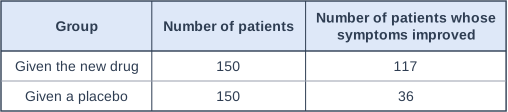
Scientists tested a new drug to treat the symptoms of hay fever. The trial was a double blind trial.

The table shows the results.

Calculate the percentage of patients whose symptoms improved in each group.

Use the equation:

percentage = (number of patients whose symptoms improved ÷ number of patients) × 100

Then give one conclusion about the new drug.

Table with columns "Group", "Number of patients", "Number of patients whose symptoms improved". Group: Given the new drug; Number of patients: 150; Number of patients whose symptoms improved: 117 | Group: Given a placebo; Number of patients: 150; Number of patients whose symptoms improved: 36.

Model answer

Drug group: (117 ÷ 150) × 100 = 78%
Placebo group: (36 ÷ 150) × 100 = 24%
Conclusion: the new drug is effective, because a much higher percentage of patients improved with the drug (78%) than with the placebo (24%).

Explanation

Divide the number who improved by the number in the group and multiply by 100. Some patients improve even with a placebo, so a drug only works if it gives clearly better results than the placebo. The conclusion must compare the two groups.

Mark scheme
  1. 1 mark

    (117 ÷ 150) × 100 or (36 ÷ 150) × 100

    a correct answer with no working scores the calculation marks; full marks are not awarded for a correct final answer from incorrect working

  2. 1 mark

    (drug group =) 78 (%)

    do not accept 0.78 (not a percentage)

  3. 1 mark

    (placebo group =) 24 (%)

    do not accept 0.24 (not a percentage)

  4. 1 mark

    the drug is effective / works, because a much higher percentage of patients improved with the drug than with the placebo

    allow ecf from their percentages if the conclusion matches them
    must be a comparison of the two groups
    ignore the drug cures hay fever
    ignore the placebo works for some people

Ready to try the rest? Every answer you write is marked against the mark scheme, so you can see exactly where the marks are.

Study Helper Hints first, answers after you try

Stuck on this one? Ask for a hint and I’ll point you in the right direction, without giving the answer away. Once you’ve checked your answer, I’ll show you how the marks are awarded.