Practise 20 exam-style questions on Aerobic and anaerobic respiration for AQA GCSE Combined Science (Foundation Biology Paper 1). Write your answer as you would in the exam and get it marked in seconds against the mark scheme, point by point, with the Study Helper on hand if you get stuck.
20 questions
1–6 marks each
Instant marking
No sign-up needed
20 questions, marked as you go
Sample questions with model answers
Here are 4 of the questions in this topic, each with a model answer, an explanation of why it earns the marks and the mark scheme an examiner would use.
Question 1
1 mark
Which equation shows anaerobic respiration in human muscle cells?
Choose your answer.
glucose → ethanol + carbon dioxide
glucose → lactic acid
glucose + oxygen → carbon dioxide + water
glucose + oxygen → lactic acid
Model answer
glucose → lactic acid
Explanation
Anaerobic respiration in muscles has only one product, lactic acid, and uses no oxygen. Do not mix it up with anaerobic respiration in yeast and plants, which produces ethanol and carbon dioxide.
Mark scheme
1 mark
glucose → lactic acid
If more than one option is given, 0 marks. Glucose → ethanol + carbon dioxide is anaerobic respiration in plant and yeast cells. Glucose + oxygen → carbon dioxide + water is aerobic respiration. Anaerobic respiration does not use oxygen, so glucose + oxygen → lactic acid is wrong.
Question 2
2 marks
A student says: 'Plants make their own food by photosynthesis, so they do not need to respire.'
Explain why the student is wrong.
Model answer
All living cells, including plant cells, respire continuously, day and night. Photosynthesis makes glucose, but the plant must respire this glucose to transfer the energy it needs for living processes such as building larger molecules and growth.
Explanation
Photosynthesis and respiration are not alternatives. Photosynthesis stores energy in glucose; respiration transfers that energy for the cell to use. A common misconception is that plants respire only at night: they respire all the time, but at night respiration is not masked by photosynthesis.
Mark scheme
1 mark
all living cells (including plant cells) respire / plants respire all the time (day and night)
allow respiration happens continuously in living cells do not accept plants only respire at night
1 mark
respiration transfers the energy needed for living processes, e.g. building larger molecules / growth / active transport
do not accept respiration makes / produces / creates energy
1 mark
photosynthesis makes glucose, but the plant must respire the glucose to transfer energy from it / there is no photosynthesis at night but the plant still needs energy
max 2
Question 3
2 marks
Wine is made by fermenting grape juice with yeast. The container is fitted with an airlock. The airlock lets gas out of the container but stops air getting in.
Explain why air must be kept out of the container.
Model answer
Air contains oxygen. If oxygen got in, the yeast would respire aerobically, producing carbon dioxide and water instead of ethanol, so less alcohol would be made.
Explanation
Ethanol is only produced when yeast respires anaerobically, so oxygen must be kept out. The airlock still lets out the carbon dioxide produced by fermentation, so pressure does not build up.
Mark scheme
1 mark
air contains oxygen, so the yeast would respire aerobically
allow so the yeast would not respire anaerobically / ferment
1 mark
(so) the yeast would produce carbon dioxide and water instead of ethanol / less ethanol (alcohol) would be made
allow microorganisms from the air could get in and spoil the wine max 2
Question 4
4 marks
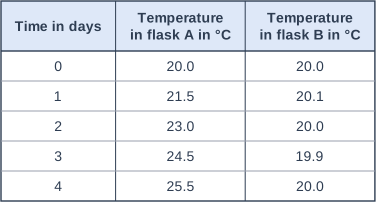
A student put germinating (growing) pea seeds in vacuum flask A and the same number of boiled (dead) pea seeds in vacuum flask B. Both sets of seeds had been rinsed in disinfectant. She measured the temperature inside each flask every day for 4 days.
The table shows the results.
Calculate the mean increase in temperature per day in flask A.
Use the equation:
mean increase in temperature per day = total increase in temperature ÷ number of days
Explain why the temperature in flask A increased.
Model answer
Increase = 25.5 − 20.0 = 5.5 °C over 4 days Mean increase per day = 5.5 ÷ 4 = 1.375 °C per day The germinating seeds are alive, so they respire. Respiration is exothermic: it transfers energy to the surroundings, heating the air in the flask, and the vacuum flask stops this energy escaping, so the temperature rises.
Explanation
Find the total increase in flask A, then divide by the number of days. Living seeds respire continuously, and respiration is an exothermic reaction. The boiled seeds are dead, so they do not respire and the temperature in flask B stays the same.
Mark scheme
1 mark
(25.5 − 20.0) ÷ 4 or 5.5 ÷ 4
a correct answer with no working scores both calculation marks; full marks are not awarded for a correct final answer from incorrect working
1 mark
1.375 (°C per day)
allow 1.38 / 1.4 allow ecf from their total increase ÷ 4 do not accept 5.5 (the total increase) or 6.4 (25.5 ÷ 4)
1 mark
the germinating seeds respire
allow the seeds are alive / growing, so they respire do not accept the seeds photosynthesise
1 mark
respiration is exothermic / transfers energy to the surroundings (by heating) (and the vacuum flask stops the energy escaping)
allow respiration releases heat / thermal energy do not accept respiration produces / makes energy do not accept respiration produces heat by burning glucose
Ready to try the rest? Every answer you write is marked against the mark scheme, so you can see exactly where the marks are.
Ctrl + Enter to check
Study HelperHints first, answers after you try
Stuck on this one? Ask for a hint and I’ll point you in the right direction, without giving the answer away. Once you’ve checked your answer, I’ll show you how the marks are awarded.