Coronary heart disease: a non-communicable disease
Practise 19 exam-style questions on Coronary heart disease: a non-communicable disease for AQA GCSE Combined Science (Foundation Biology Paper 1). Write your answer as you would in the exam and get it marked in seconds against the mark scheme, point by point, with the Study Helper on hand if you get stuck.
19 questions
1–6 marks each
Instant marking
No sign-up needed
19 questions, marked as you go
Sample questions with model answers
Here are 4 of the questions in this topic, each with a model answer, an explanation of why it earns the marks and the mark scheme an examiner would use.
Question 1
1 mark
A patient has a faulty heart valve.
Which treatment can be used to correct this problem?
Choose your answer.
A stent
A replacement valve
An artificial pacemaker
Statins
Model answer
A replacement valve
Explanation
Faulty heart valves can be replaced using biological valves (made from animal tissue) or mechanical valves. Stents, pacemakers and statins treat different problems: narrowed coronary arteries, an irregular heart rate and high blood cholesterol.
Mark scheme
1 mark
A replacement valve
If more than one option is given, 0 marks. A stent holds open a narrowed artery. An artificial pacemaker corrects an irregular heart rate. Statins lower blood cholesterol. None of these repairs a faulty valve.
Question 2
2 marks
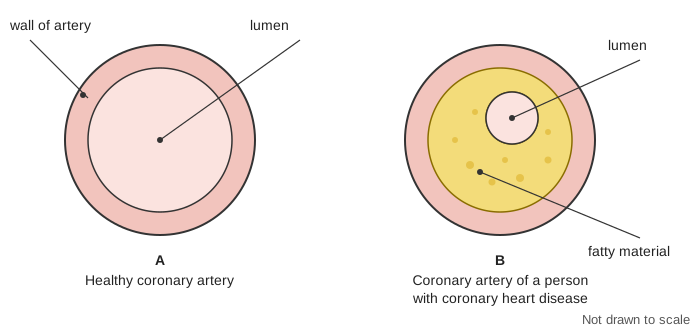
Figure 1 shows two coronary arteries cut across.
Artery A is from a healthy person. Artery B is from a person with coronary heart disease.
Describe how artery B is different from artery A.
Use Figure 1.
Model answer
Artery B has a thick layer of fatty material built up on the inside of its wall. This makes the lumen of artery B much narrower than the lumen of artery A, so there is less space for blood to flow through.
Explanation
In coronary heart disease, layers of fatty material build up inside the coronary arteries and narrow them. One mark is for the fatty material on the inside of the artery and one is for the narrower lumen. In Figure 1 the outer wall is the same in both arteries, so describe the fatty layer and the space left inside, not just a 'thicker wall'.
Mark scheme
1 mark
(artery B has a) layer of fatty material (built up) on the inside of the (artery) wall
allow fat / fatty deposit / plaque inside the artery allow fatty material in the inner lining of the artery wall allow artery B is partly blocked by fatty material ignore 'artery B is blocked' unqualified ignore 'the wall of artery B is thicker' unless the fatty layer is described do not accept fatty material outside the artery
1 mark
the lumen (of artery B) is narrower / smaller
allow there is less space for blood to flow (through artery B) allow converse for artery A allow correct comparison of the widths from the figure, e.g. the lumen of B is about a third of the width of the lumen of A ignore 'the artery is narrower' unless it is clear the space inside is meant
Question 3
2 marks
After a heart transplant, a patient must take drugs called immunosuppressants for the rest of their life. These drugs stop the immune system rejecting the donor heart.
Explain why patients who take these drugs are more likely to get infectious diseases.
Model answer
The drugs weaken the immune system, so the white blood cells are less active. This means pathogens that enter the body are not destroyed as quickly, so they can reproduce and cause an infectious disease.
Explanation
This is an example of diseases interacting: a weakened immune system makes infectious diseases more likely. The answer links the drug's effect on the immune system to pathogens not being destroyed. Answers that only repeat that the drugs stop rejection do not score.
Mark scheme
1 mark
the drugs weaken / suppress the immune system / reduce the activity of white blood cells
allow the immune system does not work properly allow fewer white blood cells ignore 'the drugs stop rejection' (this is given in the question)
1 mark
(so) pathogens are not destroyed / are destroyed more slowly (so they can reproduce and cause disease)
allow less phagocytosis of pathogens / fewer antibodies or antitoxins against the pathogens allow named pathogen, e.g. bacteria / viruses ignore germs ignore 'the body cannot fight the disease' unqualified
Question 4
4 marks
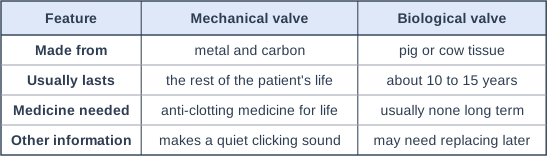
Lena needs a new heart valve. Her doctor gives her information about the two types of replacement valve. The table shows the information.
Compare mechanical valves with biological valves.
Use the table and your own knowledge.
Model answer
Both types of valve replace a faulty valve and stop blood flowing backwards, and both are fitted in an operation.
Mechanical valves are made of metal and carbon, while biological valves are made from tissue from pigs or cows. A mechanical valve usually lasts for the rest of the patient's life, but a biological valve usually lasts only about 10 to 15 years, so it may need to be replaced in another operation.
However, a patient with a mechanical valve must take anti-clotting medicine every day for life to stop blood clots forming on the valve, which increases the risk of bleeding, whereas a patient with a biological valve usually needs no long-term medicine. A mechanical valve also makes a quiet clicking sound, but a biological valve does not.
Explanation
Compare means giving similarities and differences, using linking words such as 'but', 'whereas' and 'both'. The main trade-off is that mechanical valves last much longer but need daily anti-clotting medicine for life, while biological valves avoid the medicine but wear out. Copying the table row by row without linking the two types stays in Level 1.
Mark scheme
4 marks
Levels of response (4 marks). Level 2 (3-4 marks): Scientifically relevant features are identified; the way(s) in which they are similar / different is made clear and (where appropriate) the magnitude of the similarity / difference is noted. Level 1 (1-2 marks): Relevant features are identified and differences noted. No relevant content: 0 marks.
Indicative content (not a checklist; credit other valid points): Differences - mechanical valves are made of metal and carbon, but biological valves are made from animal tissue (from pigs or cows) - mechanical valves usually last for the rest of the patient's life, but biological valves usually last only about 10 to 15 years - so a biological valve may need replacing in another operation, especially in a younger patient - a patient with a mechanical valve must take anti-clotting medicine (an anticoagulant) every day for life, but a patient with a biological valve usually does not need long-term medicine - blood clots are more likely to form on a mechanical valve - anti-clotting medicine increases the risk of bleeding - a mechanical valve makes a quiet clicking sound, but a biological valve does not - some people may not want a valve made from animal tissue (e.g. for ethical or religious reasons) Similarities - both replace a faulty valve that does not open fully or that leaks - both stop blood flowing backwards / keep blood flowing in one direction - both are fitted in an operation on the heart Statements must be comparative: 'mechanical valves last a lifetime' on its own is a feature, not a comparison. For Level 2, at least two clear comparisons (differences or similarities) must be made; for 4 marks, at least one should note the size of a difference (e.g. lasts for life compared with about 10 to 15 years). Start at Level 1 and use best fit. Full marks only if no incorrect statement contradicts a correct one.
Ready to try the rest? Every answer you write is marked against the mark scheme, so you can see exactly where the marks are.
Ctrl + Enter to check
Study HelperHints first, answers after you try
Stuck on this one? Ask for a hint and I’ll point you in the right direction, without giving the answer away. Once you’ve checked your answer, I’ll show you how the marks are awarded.