Level:
Correct: 0
Incorrect: 0
Marks: 0/0
Exam Practice
Course:
Topics:
Avg
score:
–
Topics
done:
0/17

Osmosis and active transport

Practise 22 exam-style questions on Osmosis and active transport for AQA GCSE Combined Science (Foundation Biology Paper 1). Write your answer as you would in the exam and get it marked in seconds against the mark scheme, point by point, with the Study Helper on hand if you get stuck.

  • 22 questions
  • 1–6 marks each
  • Instant marking
  • No sign-up needed
20 questions, marked as you go

Sample questions with model answers

Here are 4 of the questions in this topic, each with a model answer, an explanation of why it earns the marks and the mark scheme an examiner would use.

Question 1

1 mark

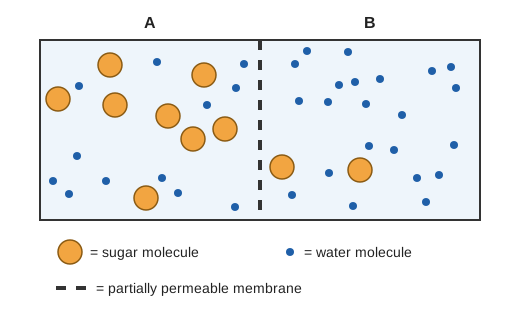
Figure 1 is a model of two sugar solutions, A and B, separated by a partially permeable membrane.

In which direction will there be a net movement of molecules through the membrane?

Choose your answer.

  • Water from A to B
  • Water from B to A
  • Sugar from A to B
  • Sugar from B to A
Figure 1: a rectangular container divided into two halves by a dashed vertical line. The left half is labelled A and the right half is labelled B. A key says that large orange circles are sugar molecules, small blue dots are water molecules and the dashed line is a partially permeable membrane. Side A contains 8 sugar molecules and 12 water molecules. Side B contains 2 sugar molecules and 22 water molecules.

Model answer

Water from B to A

Explanation

Count the molecules: B has fewer sugar molecules and more water molecules, so it is the more dilute solution. Water moves by osmosis from the dilute solution (B) to the concentrated solution (A). Sugar molecules are too large to fit through the membrane.

Mark scheme
  1. 1 mark

    Water from B to A

    If more than one option is given, 0 marks. Side A has 8 sugar molecules and 12 water molecules; side B has 2 sugar molecules and 22 water molecules. B is the more dilute solution, so the net movement of water is from B to A. Sugar molecules are too large to pass through the partially permeable membrane, so sugar cannot move either way.
Question 2

2 marks

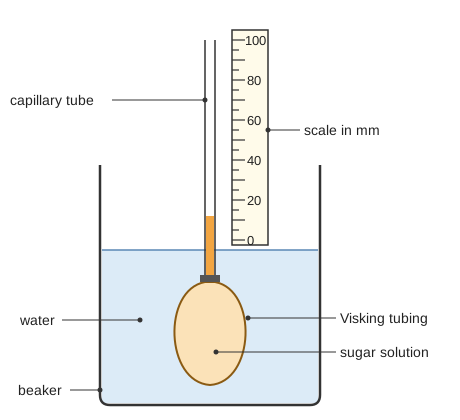
A student set up the apparatus in the diagram as a model of osmosis. Visking tubing is a partially permeable membrane.

The liquid level in the capillary tube rose during the investigation.

Explain why the liquid level rose.

A beaker containing water. A bag made of Visking tubing, full of sugar solution, hangs in the water. The neck of the bag is tied around the bottom of a narrow glass capillary tube, which rises straight up out of the water. A scale in mm, numbered from 0 at the bottom to 100 at the top, stands beside the capillary tube. Sugar solution fills the capillary tube up to 12 mm on the scale. Labels: capillary tube, scale in mm, Visking tubing, sugar solution, water, beaker.

Model answer

Water moved by osmosis from the water in the beaker into the Visking tubing, from the dilute solution to the more concentrated sugar solution through the partially permeable membrane. This increased the volume of liquid inside the tubing, so the liquid was pushed up the capillary tube.

Explanation

The Visking tubing acts like a cell membrane: water can pass through it but sugar cannot. Water moves from the dilute solution outside to the concentrated solution inside, so the volume inside increases and the liquid rises up the tube. A common error is to say that sugar moves out of the tubing.

Mark scheme
  1. 1 mark

    water moved into the Visking tubing (from the beaker) by osmosis

    allow water diffused into the tubing; do not accept sugar moved out of the tubing; do not accept 'by active transport'

  2. 1 mark

    from the dilute solution / water (in the beaker) to the more concentrated (sugar) solution (inside the tubing)

    allow the solution inside the tubing is more concentrated than the water in the beaker; allow from a high concentration of water to a low concentration of water; ignore 'the volume inside the tubing increases' on its own (it does not explain why); do not accept water moves from the concentrated solution to the dilute solution

Question 3

2 marks

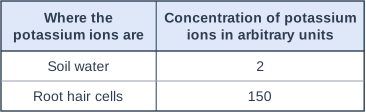
The table shows the concentration of potassium ions in the soil water and in the root hair cells of a plant.

Explain how the data show that the root hair cells absorb potassium ions by active transport.

Table with columns "Where the potassium ions are", "Concentration of potassium ions in arbitrary units". Where the potassium ions are: Soil water; Concentration of potassium ions in arbitrary units: 2 | Where the potassium ions are: Root hair cells; Concentration of potassium ions in arbitrary units: 150.

Model answer

The concentration of potassium ions in the root hair cells (150 arbitrary units) is much higher than in the soil water (2 arbitrary units). So the ions are being moved from a lower to a higher concentration, against the concentration gradient, which only active transport can do.

Explanation

Diffusion can only give a net movement from a higher to a lower concentration. The root hair cells contain 75 times the concentration of potassium ions in the soil water, so the ions must have been moved against the concentration gradient, using energy from respiration.

Mark scheme
  1. 1 mark

    the concentration of potassium ions is (much) higher in the root hair cells than in the soil water

    allow 150 compared with 2; allow 75 times higher

  2. 1 mark

    so the ions are moving against the concentration gradient / from a lower to a higher concentration (which diffusion cannot do)

    allow from a dilute solution to a more concentrated solution; ignore 'it needs energy' on its own (the data do not show energy is used)

Question 4

4 marks

Scientists grew barley seedlings with their roots in a solution of potassium ions. For one group of seedlings air was bubbled through the solution. For a second group nitrogen gas, which contains no oxygen, was bubbled through the solution.

The scientists measured the mass of potassium ions taken up by the roots.

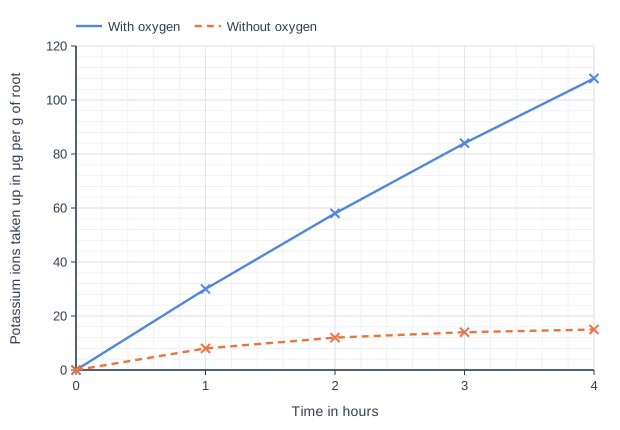
The graph shows the results.

Describe and explain the effect of oxygen on the uptake of potassium ions by the roots.

Line graph of potassium ions taken up in μg per g of root (y-axis, 0 to 120) against time in hours (x-axis, 0 to 4). "With oxygen" joins the points (0, 0), (1, 30), (2, 58), (3, 84), (4, 108). "Without oxygen" (dashed) joins the points (0, 0), (1, 8), (2, 12), (3, 14), (4, 15).

Model answer

With oxygen, the roots keep taking up potassium ions, reaching 108 μg per g of root after 4 hours. Without oxygen, uptake almost stops at 15 μg per g, about 7 times less.
The root cells need oxygen for aerobic respiration. Respiration transfers the energy needed for active transport, which moves the potassium ions into the root cells. Without oxygen there is little respiration, so little energy is available and very few ions are taken up.

Explanation

Describe the difference with data from both lines, then explain the link: oxygen, aerobic respiration, energy, active transport. Energy is transferred or released by respiration; saying it is 'made' or 'produced' loses the mark. This shows that mineral ions enter roots by active transport, not by diffusion.

Mark scheme
  1. 1 mark

    more potassium ions are taken up with oxygen (than without oxygen) / with oxygen uptake keeps increasing but without oxygen it almost stops

    allow converse

  2. 1 mark

    data, e.g. after 4 hours 108 μg per g with oxygen compared with 15 μg per g without / 93 μg per g more / about 7 times as much

    data must be correct and used to compare the two groups

  3. 1 mark

    the root cells use oxygen for aerobic respiration

  4. 1 mark

    respiration transfers the energy needed for active transport (of potassium ions)

    allow active transport needs energy from respiration; do not accept energy is made / produced / created

  5. 1 mark

    without oxygen there is little or no aerobic respiration, so less energy is available and little active transport happens

    max 4

Ready to try the rest? Every answer you write is marked against the mark scheme, so you can see exactly where the marks are.

Study Helper Hints first, answers after you try

Stuck on this one? Ask for a hint and I’ll point you in the right direction, without giving the answer away. Once you’ve checked your answer, I’ll show you how the marks are awarded.