
Level:
Correct: 0
Incorrect: 0
Marks: 0/0
Exam Practice
Course:
Topics:
Avg
score:
–
Topics
done:
0/17

Eukaryotes, prokaryotes, animal and plant cells

Practise 22 exam-style questions on Eukaryotes, prokaryotes, animal and plant cells for AQA GCSE Combined Science (Foundation Biology Paper 1). Write your answer as you would in the exam and get it marked in seconds against the mark scheme, point by point, with the Study Helper on hand if you get stuck.

  • 22 questions
  • 1–6 marks each
  • Instant marking
  • No sign-up needed
20 questions, marked as you go

Sample questions with model answers

Here are 4 of the questions in this topic, each with a model answer, an explanation of why it earns the marks and the mark scheme an examiner would use.

Question 1

1 mark

Which of these lengths is the same as 1 nanometre (1 nm)?

Choose your answer.

  • 1 × 10⁻³ m
  • 1 × 10⁻⁶ m
  • 1 × 10⁻⁹ m
  • 1 × 10⁻¹² m

Model answer

1 × 10⁻⁹ m

Explanation

Nano means one thousand millionth, so 1 nm = 0.000 000 001 m = 1 × 10⁻⁹ m. Learn the prefixes in order: centi (10⁻²), milli (10⁻³), micro (10⁻⁶) and nano (10⁻⁹). Each step from milli to micro to nano is 1000 times smaller.

Mark scheme
  1. 1 mark

    1 × 10⁻⁹ m

    If more than one option is given, 0 marks. 1 × 10⁻³ m is 1 millimetre (mm). 1 × 10⁻⁶ m is 1 micrometre (μm). 1 × 10⁻¹² m is a thousand times smaller than 1 nm.
Question 2

2 marks

A cell from the skin of a frog is 0.005 cm wide.

1 cm = 10 mm
1 mm = 1000 μm

What is the width of the cell in micrometres (μm)?

Model answer

0.005 cm × 10 = 0.05 mm
0.05 mm × 1000 = 50 μm
Width = 50 μm

Explanation

Convert one step at a time: centimetres to millimetres (× 10), then millimetres to micrometres (× 1000), so 0.005 cm = 50 μm. When converting to a smaller unit the number must get bigger. A common mistake is to do only one of the two conversions.

Mark scheme
  1. 1 mark

    0.005 × 10 = 0.05 (mm)

    allow 0.005 × 10 000 for this mark; a correct answer with no working scores full marks

  2. 1 mark

    50 (μm)

    allow ecf from their value in mm × 1000; full marks are not awarded for a correct final answer from incorrect working; 0.5 or 5 μm usually comes from multiplying by 100 or 1000 only once

Question 3

2 marks

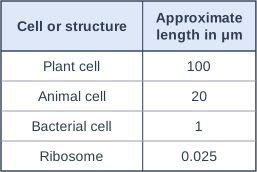
The table shows the approximate lengths of some cells and sub-cellular structures.

How many orders of magnitude larger is the plant cell than the bacterial cell?

Table with columns "Cell or structure", "Approximate length in μm". Cell or structure: Plant cell; Approximate length in μm: 100 | Cell or structure: Animal cell; Approximate length in μm: 20 | Cell or structure: Bacterial cell; Approximate length in μm: 1 | Cell or structure: Ribosome; Approximate length in μm: 0.025.

Model answer

100 μm ÷ 1 μm = 100
100 = 10²
The plant cell is 2 orders of magnitude larger.

Explanation

Divide the larger length by the smaller one, then write the answer as a power of ten: 100 = 10², which is two orders of magnitude. Each order of magnitude is a factor of 10. A common mistake is to give 100 as the number of orders of magnitude.

Mark scheme
  1. 1 mark

    100 ÷ 1 = 100 (times larger)

    a correct answer with no working scores full marks

  2. 1 mark

    2 (orders of magnitude)

    allow 10² (times larger) / two powers of ten; allow ecf from an incorrect ratio correctly expressed as a power of ten; full marks are not awarded for a correct final answer from incorrect working; 100 given as the number of orders of magnitude gains the first mark only

Question 4

4 marks

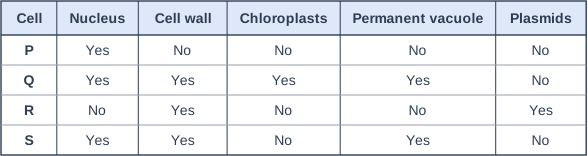
The table shows whether four cells, P, Q, R and S, have some sub-cellular structures.

The four cells are:
• an animal cell
• a bacterial cell
• a cell from a plant leaf
• a cell from a plant root.

Identify each cell. Write each letter, P, Q, R and S, with its type of cell.

Table with columns "Cell", "Nucleus", "Cell wall", "Chloroplasts", "Permanent vacuole", "Plasmids". Cell: P; Nucleus: Yes; Cell wall: No; Chloroplasts: No; Permanent vacuole: No; Plasmids: No | Cell: Q; Nucleus: Yes; Cell wall: Yes; Chloroplasts: Yes; Permanent vacuole: Yes; Plasmids: No | Cell: R; Nucleus: No; Cell wall: Yes; Chloroplasts: No; Permanent vacuole: No; Plasmids: Yes | Cell: S; Nucleus: Yes; Cell wall: Yes; Chloroplasts: No; Permanent vacuole: Yes; Plasmids: No.

Model answer

P is the animal cell, Q is the plant leaf cell, R is the bacterial cell and S is the plant root cell.

Explanation

R has no nucleus but has plasmids, so it is the bacterial cell. P has a nucleus but no cell wall, so it is the animal cell. Q and S both have a cell wall and a permanent vacuole, so they are plant cells; only Q has chloroplasts, so it is from the leaf. Root cells are underground, where there is no light for photosynthesis, so they have no chloroplasts.

Mark scheme
  1. 1 mark

    P = animal cell

    if a letter is given more than one type of cell, that letter gains no mark

  2. 1 mark

    Q = (cell from a plant) leaf

  3. 1 mark

    R = bacterial cell

    allow bacterium / prokaryotic cell

  4. 1 mark

    S = (cell from a plant) root

Ready to try the rest? Every answer you write is marked against the mark scheme, so you can see exactly where the marks are.

Study Helper Hints first, answers after you try

Stuck on this one? Ask for a hint and I’ll point you in the right direction, without giving the answer away. Once you’ve checked your answer, I’ll show you how the marks are awarded.