
Level:
Correct: 0
Incorrect: 0
Marks: 0/0
Exam Practice
Course:
Topics:
Avg
score:
–
Topics
done:
0/23

Water uptake, transpiration and translocation

Practise 17 exam-style questions on Water uptake, transpiration and translocation for OCR GCSE Combined Science (Biology Paper 1). Write your answer as you would in the exam and get it marked in seconds against the mark scheme, point by point, with the Study Helper on hand if you get stuck.

  • 17 questions
  • 1–6 marks each
  • Instant marking
  • No sign-up needed
17 questions, marked as you go

Sample questions with model answers

Here are 4 of the questions in this topic, each with a model answer, an explanation of why it earns the marks and the mark scheme an examiner would use.

Question 1

1 mark

Water moves up a plant from its roots to its leaves in the xylem.

Which process causes the water to move up the xylem?

Choose your answer.

  • A active transport by the xylem cells
  • B diffusion of sucrose up the stem
  • C evaporation of water from the leaves
  • D photosynthesis in the cells of the roots

Model answer

C

Explanation

The loss of water from the leaves by evaporation, transpiration, pulls a continuous stream of water up the xylem from the roots. The plant does not use energy to pump the water: xylem vessels are dead, hollow tubes.

Mark scheme
  1. 1 mark

    C / evaporation of water from the leaves

    The only correct answer is C: in transpiration, water evaporates from the cells inside the leaves and the water vapour diffuses out through the stomata; this draws more water up the xylem to replace it. A is not correct because xylem vessels are dead, so they cannot carry out active transport. B is not correct because sucrose is carried in the phloem, not the xylem, and it does not move water. D is not correct because roots are underground and do not photosynthesise. ALLOW the letter or the option. If more than one option is given, do not award the mark.
Question 2

2 marks

Mistletoe is a plant with green leaves that grows on the branches of trees such as apple trees. It has no roots in the soil. Instead, it grows special structures into the branch of the host tree, which join on to the host's xylem.

Suggest which substances mistletoe gets from the host tree. Explain why mistletoe does not get sugars from the host in this way.

Model answer

Mistletoe takes water and mineral ions from the host's xylem. It does not get sugars this way because xylem does not carry sugars, which are carried in the phloem; mistletoe has green leaves, so it can make its own sugars by photosynthesis.

Explanation

Xylem carries water and dissolved mineral ions up from the roots; phloem carries sucrose. A plant that taps into the xylem therefore gets water and minerals but no sugar, which is fine for mistletoe because it photosynthesises. Plants that cannot photosynthesise, such as dodder, tap into the phloem instead.

Mark scheme
  1. 1 mark

    water and mineral ions

    Max 1 if water and mineral ions are not both given. Max 2 from the three marking points. Both are needed for this mark. ALLOW minerals / named mineral ions such as nitrate for mineral ions. DO NOT ALLOW sucrose / sugar / glucose / food.

  2. 1 mark

    xylem does not carry sugars (sugars are carried in the phloem)

    ALLOW xylem only carries water and mineral ions.

  3. 1 mark

    mistletoe makes its own sugars by photosynthesis (in its green leaves)

    ALLOW it has chlorophyll, so it can make its own glucose.

Question 3

2 marks

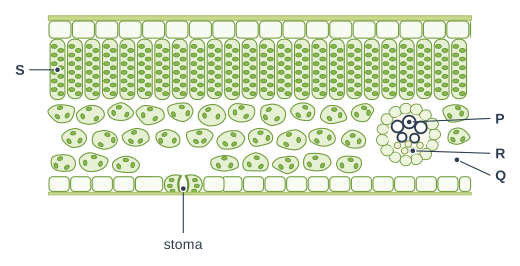
The diagram shows a section through a leaf.

Give the letter of the tissue that brings water into the leaf.

Give the letter of the spaces that water vapour moves into before it diffuses out of the leaf through the stoma.

Diagram of a cross-section through a leaf (upper surface at the top). Layers of cells. From the top: a thin outer layer covering the surface; a single row of flat clear cells; a layer of tall closely packed cells full of green discs; a layer of rounded cells with fewer green discs and spaces between them; another row of flat clear cells; and another thin outer layer. In the layer of rounded cells, on the right, is a round bundle with large hollow cells in its upper part and smaller cells in its lower part. In the bottom row a small pore lies between two bean-shaped cells, which contain green discs, with a space above it. Label P points to the large hollow cells in the upper part of the round bundle; label Q points to the space between the rounded, loosely packed cells, near the right-hand edge; label R points to the smaller cells in the lower part of the round bundle; label S points to the layer of tall, closely packed cells full of green discs; the label "stoma" points to the small pore in the bottom surface, between the two bean-shaped cells.

Model answer

P (the xylem) brings water into the leaf.
Q (the air spaces) are where water vapour collects before it diffuses out through the stoma.

Explanation

Water arrives in the leaf in the xylem of the veins, moves into the mesophyll cells and evaporates from their surfaces into the air spaces of the spongy mesophyll. The water vapour then diffuses out through the stomata: this loss of water is transpiration. The phloem in the vein carries sucrose out of the leaf.

Mark scheme
  1. 1 mark

    P (xylem)

    ALLOW xylem if no letter is given. DO NOT ALLOW R (phloem).

  2. 1 mark

    Q (air spaces)

    ALLOW air spaces if no letter is given.

Question 4

3 marks

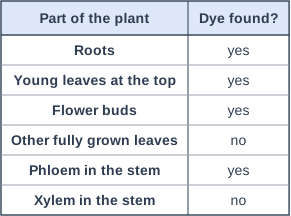
Scientists put a harmless dye on one fully grown leaf halfway up a bean plant. The dye moves through the plant in the same way as sucrose. After four hours, the scientists looked for the dye in different parts of the plant. The table shows the results.

What can the scientists conclude about translocation from these results?

Suggest why no dye was found in the other fully grown leaves.

Table with columns "Part of the plant", "Dye found?". Part of the plant: Roots; Dye found?: yes | Part of the plant: Young leaves at the top; Dye found?: yes | Part of the plant: Flower buds; Dye found?: yes | Part of the plant: Other fully grown leaves; Dye found?: no | Part of the plant: Phloem in the stem; Dye found?: yes | Part of the plant: Xylem in the stem; Dye found?: no.

Model answer

The dye reached the roots below the leaf and the young leaves and flower buds above it, so translocation moves sucrose both up and down the plant. It was found in the phloem but not in the xylem, so translocation happens in the phloem. The sucrose is taken to parts that are growing or cannot make enough sugar. No dye reached the other fully grown leaves because they photosynthesise and make their own sugar, so sucrose is not moved into them.

Explanation

Translocation is the movement of dissolved sugars (sucrose) in the phloem from where they are made to where they are used or stored, in both directions. Growing parts, roots and buds receive sugar; mature leaves are the sources that send it out, so they do not receive it.

Mark scheme
  1. 1 mark

    (the dye / sucrose) moves both up and down the plant / to the top and to the roots

    Max 2 if the answer does not suggest why no dye was found in the other fully grown leaves. Max 3 from the four marking points. ALLOW translocation is in both directions.

  2. 1 mark

    it moves in the phloem (not the xylem)

    ALLOW no dye was in the xylem, so translocation is in the phloem.

  3. 1 mark

    it moves to parts that are growing / store sugar / cannot make enough sugar (roots, young leaves, flower buds)

    ALLOW to parts that need sugar for respiration / growth.

  4. 1 mark

    fully grown leaves photosynthesise / make their own sugar, so (sucrose is not moved into them / they do not need it)

    ALLOW mature leaves make more sugar than they use / send sugar out rather than take it in.

Ready to try the rest? Every answer you write is marked against the mark scheme, so you can see exactly where the marks are.

Study Helper Hints first, answers after you try

Stuck on this one? Ask for a hint and I’ll point you in the right direction, without giving the answer away. Once you’ve checked your answer, I’ll show you how the marks are awarded.