
Level:
Correct: 0
Incorrect: 0
Marks: 0/0
Exam Practice
Course:
Topics:
Avg
score:
–
Topics
done:
0/23

Hormones in human reproduction and the menstrual cycle

Practise 11 exam-style questions on Hormones in human reproduction and the menstrual cycle for OCR GCSE Combined Science (Biology Paper 1). Write your answer as you would in the exam and get it marked in seconds against the mark scheme, point by point, with the Study Helper on hand if you get stuck.

  • 11 questions
  • 1–4 marks each
  • Instant marking
  • No sign-up needed
11 questions, marked as you go

Sample questions with model answers

Here are 4 of the questions in this topic, each with a model answer, an explanation of why it earns the marks and the mark scheme an examiner would use.

Question 1

1 mark

A woman has a regular 28-day menstrual cycle. Her period starts on 1 May.

On which date is she most likely to release an egg (ovulate)?

Choose your answer.

  • A 7 May
  • B 14 May
  • C 21 May
  • D 28 May

Model answer

B

Explanation

Day 1 of the cycle is the first day of the period, so 1 May is day 1 and 14 May is day 14, when an egg is usually released in a 28-day cycle. Many cycles are not exactly 28 days long, so the day of ovulation varies from woman to woman and from cycle to cycle.

Mark scheme
  1. 1 mark

    B / 14 May

    The only correct answer is B: in a 28-day cycle, with day 1 as the first day of the period, ovulation happens at about day 14, which is 14 May. A is not correct because on day 7 the lining of the uterus is still being repaired and the egg is still maturing. C is not correct because day 21 is after ovulation, when the thick lining is being maintained. D is not correct because day 28 is the end of the cycle, just before the next period. ALLOW the letter or the option. If more than one option is given, do not award the mark.
Question 2

2 marks

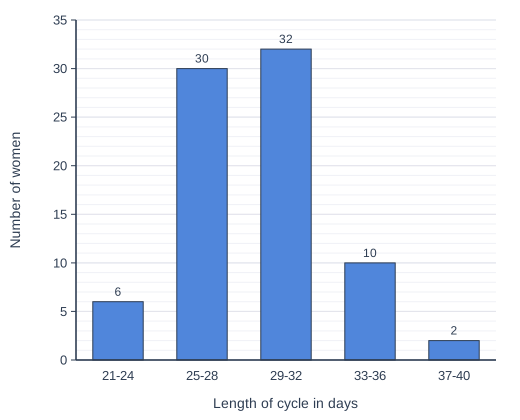
Scientists recorded the length of one menstrual cycle for each of 80 women.

The bar chart shows their results.

Calculate the percentage of the women whose cycle was longer than 28 days.

Bar chart of number of women for each length of cycle in days: 21-24 6, 25-28 30, 29-32 32, 33-36 10, 37-40 2.

Model answer

Women with cycles longer than 28 days = 32 + 10 + 2 = 44
Percentage = 44 ÷ 80 × 100 = 55 %

Explanation

Add up every group longer than 28 days (29-32, 33-36 and 37-40 days), then divide by the total of 80 women and multiply by 100. The 25-28 group includes 28 days, so it is not 'longer than 28 days'. The data also show that many women have cycles that are not 28 days long.

Mark scheme
  1. 1 mark

    32 + 10 + 2 = 44 (women) / 44 ÷ 80 (× 100); or a correct final answer of 55 % with no working

    An answer of 55 % with no working scores 2 marks. ALLOW 0.55 or 44/80 for this mark only (not changed into a percentage).

  2. 1 mark

    evaluation: 55 (%)

    ALLOW ECF from a wrong number of women correctly divided by 80 and multiplied by 100, for 1 mark (for example 40 % from the 29-32 group only, or 92.5 % if the 25-28 group is included).

Question 3

2 marks

Some women take tablets containing a hormone similar to progesterone to delay their period, for example during a holiday.

A woman starts taking the tablets a few days before her period is due. Her period starts a few days after she stops taking them.

Explain how the tablets delay her period.

Model answer

The hormone in the tablets acts like progesterone, which maintains the lining of the uterus and keeps it thick. While she takes the tablets, the lining does not break down, so her period does not start. When she stops taking them, the hormone level falls, the lining breaks down and her period starts.

Explanation

A period is the breakdown and loss of the lining of the uterus. Normally the progesterone concentration falls at the end of the cycle and the lining breaks down. A hormone that acts like progesterone keeps the lining in place, so the period is put off until the tablets are stopped.

Mark scheme
  1. 1 mark

    the hormone (like progesterone) maintains the lining of the uterus / keeps the lining thick

    1 mark for each of points 1 to 3, max 2. ALLOW keeps the hormone level high, so the lining is kept in place. DO NOT ALLOW the hormone thickens / repairs the lining (as the only idea).

  2. 1 mark

    so the lining does not break down / is not lost while she takes the tablets

    ALLOW a period is the lining breaking down, so it cannot happen while the lining is maintained. IGNORE the tablets stop ovulation.

  3. 1 mark

    when she stops taking the tablets, the hormone level falls and the lining breaks down (so her period starts)

    ALLOW without the tablets the lining is no longer maintained, so it is lost.

Question 4

3 marks

FSH and oestrogen are two of the hormones that control the menstrual cycle.

Compare FSH and oestrogen.

Model answer

FSH is released by the pituitary gland, but oestrogen is released by the ovaries. FSH acts on the ovaries, where it causes an egg to mature, but oestrogen acts on the uterus, where it causes the lining to be repaired and to thicken. Both are hormones carried in the blood.

Explanation

A comparison needs both hormones in each point, joined by a word such as 'but' or 'whereas'. Three useful comparisons are where each hormone is released, which organ it acts on and what it does there. Both hormones are carried in the blood, as every hormone is.

Mark scheme
  1. 1 mark

    FSH causes an egg to mature, but oestrogen causes the lining of the uterus to be repaired / to thicken

    1 mark for each comparison, max 3. Each mark needs both hormones (a comparison), except the similarity. ALLOW oestrogen causes female changes at puberty (breasts develop) as its role.

  2. 1 mark

    FSH acts on the ovaries, but oestrogen acts on the uterus

    ALLOW the target organ of FSH is the ovary and the target organ of oestrogen is the uterus.

  3. 1 mark

    FSH is released by the pituitary gland, but oestrogen is released by the ovaries

    DO NOT ALLOW oestrogen is released by the uterus.

  4. 1 mark

    similarity: both are hormones / chemical messengers carried in the blood / both are released by endocrine glands

    ALLOW both control the menstrual cycle only if a further detail is given (for example both are carried in the blood). IGNORE both are female hormones.

Ready to try the rest? Every answer you write is marked against the mark scheme, so you can see exactly where the marks are.

Study Helper Hints first, answers after you try

Stuck on this one? Ask for a hint and I’ll point you in the right direction, without giving the answer away. Once you’ve checked your answer, I’ll show you how the marks are awarded.