
Level:
Correct: 0
Incorrect: 0
Marks: 0/0
Exam Practice
Course:
Topics:
Avg
score:
–
Topics
done:
0/23

Investigating photosynthesis

Practise 14 exam-style questions on Investigating photosynthesis for OCR GCSE Combined Science (Biology Paper 1). Write your answer as you would in the exam and get it marked in seconds against the mark scheme, point by point, with the Study Helper on hand if you get stuck.

  • 14 questions
  • 1–6 marks each
  • Instant marking
  • No sign-up needed
14 questions, marked as you go

Sample questions with model answers

Here are 4 of the questions in this topic, each with a model answer, an explanation of why it earns the marks and the mark scheme an examiner would use.

Question 1

1 mark

To find out how light affects photosynthesis, a student puts a lamp at five different distances from some pondweed. For each distance, the student wants to measure the light intensity at the pondweed.

Which piece of apparatus can the student use for this measurement?

Choose your answer.

  • A gas syringe
  • B light meter
  • C metre rule
  • D thermometer

Model answer

B - light meter

Explanation

A light meter (sometimes called a lux meter) measures light intensity. Moving a lamp closer to a plant makes the light brighter, but measuring the distance with a metre rule does not tell you the light intensity itself. Each instrument measures one quantity: gas syringe for volume of gas, thermometer for temperature.

Mark scheme
  1. 1 mark

    B / light meter

    The only correct answer is B: a light meter measures light intensity directly. A is not correct because a gas syringe measures the volume of gas (oxygen) released by the pondweed; C is not correct because a metre rule measures the distance from the lamp, which changes the light intensity but does not measure it; D is not correct because a thermometer measures temperature. ALLOW the letter or the option. If more than one option is given, do not award the mark.
Question 2

2 marks

A student destarched a geranium plant by keeping it in the dark for two days. The student then covered one of its leaves on both sides with black paper. A letter L had been cut out of the paper on the upper side of the leaf. The plant was then left in bright light for six hours.

The student tested the leaf for starch with iodine solution. Only an L-shaped part of the leaf turned blue-black. The rest of the leaf stayed orange-brown.

Explain these results.

Model answer

Light could reach only the L-shaped part of the leaf, so only that part photosynthesised. The glucose it made was stored as starch, which turned the iodine blue-black. The covered parts had no light, so they made no glucose and no starch, and the plant had been destarched, so they had no starch left.

Explanation

This experiment shows that light is needed for photosynthesis. Destarching first means that any starch found must have been made during the experiment. Where light reached the leaf, photosynthesis made glucose, which was stored as starch; where the paper blocked the light, no starch was made, so the iodine stayed orange-brown.

Mark scheme
  1. 1 mark

    light reached only the L-shaped part of the leaf, so only that part could photosynthesise / ORA (the covered part got no light, so it could not photosynthesise)

    1 mark for each point, max 2. ORA (allow the reverse argument). IGNORE just 'the L got light' with no link to photosynthesis.

  2. 1 mark

    the glucose made by photosynthesis was stored as starch (in the L-shaped part), which turns iodine blue-black

    ALLOW glucose was turned into starch.

  3. 1 mark

    the plant had been destarched, so any starch in the leaf must have been made during the six hours in the light

    ALLOW the rest of the leaf had no starch because the starch had been used up in the dark.

Question 3

2 marks

Two groups of students did the same leaf disc experiment. Each group cut 10 discs from an ivy leaf, made them sink in sodium hydrogencarbonate solution and put a lamp 20 cm away. Each group recorded the time taken for 5 discs to float.

• Group 1: 6.5 minutes
• Group 2: 14.0 minutes

Suggest two reasons why the two groups got such different results.

Model answer

1. The groups may have used ivy leaves from different plants, which photosynthesise at different rates.
2. One group's lamp may have been brighter, or more light from the windows may have reached one group's discs.

Explanation

When two groups follow the same method but get very different results, the results are not reproducible. Usually a variable that should have been controlled was different: the leaves, the light reaching the discs, the temperature or the concentration of the solution. Writing just 'human error' is too vague: name the variable that could have been different.

Mark scheme
  1. 2 marks

    any two from: the leaves were different (from different plants, of different ages, or with different amounts of chlorophyll) / the lamps had different brightness (power), or more light reached one group from a window or room lights / the temperature of the solution was different / the concentration of sodium hydrogencarbonate solution was different / the discs were different sizes / one group did not remove all the air from its discs

    1 mark for each different reason, max 2. If more than two answers are given, a wrong one cancels a right one. IGNORE just 'human error' or 'they did it wrong'. IGNORE distance from the lamp (it was the same for both groups). ALLOW timing errors (for example starting the timer late) for 1 mark only if a specific cause is given.

Question 4

3 marks

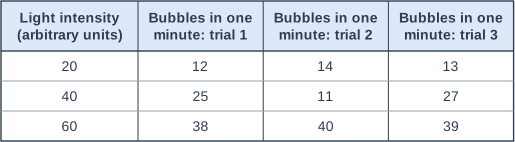
A student counted the bubbles of gas released by a piece of pondweed in one minute, at three light intensities. She measured each light intensity with a light meter, and did three trials at each light intensity.

The table shows the results. One result is anomalous.

Identify the anomalous result, and suggest one reason for it.

Describe the trend shown by the results.

Table with columns "Light intensity (arbitrary units)", "Bubbles in one minute: trial 1", "Bubbles in one minute: trial 2", "Bubbles in one minute: trial 3". Light intensity (arbitrary units): 20; Bubbles in one minute: trial 1: 12; Bubbles in one minute: trial 2: 14; Bubbles in one minute: trial 3: 13 | Light intensity (arbitrary units): 40; Bubbles in one minute: trial 1: 25; Bubbles in one minute: trial 2: 11; Bubbles in one minute: trial 3: 27 | Light intensity (arbitrary units): 60; Bubbles in one minute: trial 1: 38; Bubbles in one minute: trial 2: 40; Bubbles in one minute: trial 3: 39.

Model answer

The anomalous result is 11 bubbles (trial 2 at a light intensity of 40). It may be anomalous because the student miscounted the bubbles in that trial.
Trend: as the light intensity increases, the number of bubbles released in one minute increases.

Explanation

An anomalous result does not fit the pattern of the other results: at 40 units the other two trials gave 25 and 27 bubbles, so 11 is far too low. It is most likely caused by a mistake in that one trial, and it should be left out when a mean is calculated. More light gives a faster rate of photosynthesis, so more bubbles of oxygen are released each minute.

Mark scheme
  1. 1 mark

    (anomalous result) 11 (bubbles) / trial 2 at a light intensity of 40 (arbitrary units)

    1 mark for point 1, 1 mark for any one of points 2 to 4 (max 1) and 1 mark for point 5. For the reason: if more than one answer is given, a wrong one cancels a right one. DO NOT ALLOW any other result as the anomalous result.

  2. 1 mark

    (reason) the student timed for less than one minute / started or stopped the timing at the wrong moment

    1 mark for any one of points 2 to 4, max 1. ALLOW any other sensible reason that would make only this count too low, such as the water being cooler in this trial. This mark can be awarded even if the anomalous result is not identified correctly.

  3. 1 mark

    (reason) the student miscounted / missed some of the bubbles

    ALLOW the bubbles came off too fast to count / some bubbles came off together.

  4. 1 mark

    (reason) the light intensity was lower in this trial / the lamp was moved / another light in the room was switched off

    ALLOW the light meter was read wrongly.

  5. 1 mark

    (trend) as the light intensity increases, the number of bubbles (released in one minute) increases

    ALLOW the rate of photosynthesis / of oxygen release increases as the light intensity increases. ALLOW positive correlation. IGNORE explanations of the trend.

Ready to try the rest? Every answer you write is marked against the mark scheme, so you can see exactly where the marks are.

Study Helper Hints first, answers after you try

Stuck on this one? Ask for a hint and I’ll point you in the right direction, without giving the answer away. Once you’ve checked your answer, I’ll show you how the marks are awarded.