
Level:
Correct: 0
Incorrect: 0
Marks: 0/0
Exam Practice
Course:
Topics:
Avg
score:
–
Topics
done:
0/23

Type 1 and type 2 diabetes

Practise 13 exam-style questions on Type 1 and type 2 diabetes for OCR GCSE Combined Science (Biology Paper 1). Write your answer as you would in the exam and get it marked in seconds against the mark scheme, point by point, with the Study Helper on hand if you get stuck.

  • 13 questions
  • 1–6 marks each
  • Instant marking
  • No sign-up needed
13 questions, marked as you go

Sample questions with model answers

Here are 4 of the questions in this topic, each with a model answer, an explanation of why it earns the marks and the mark scheme an examiner would use.

Question 1

1 mark

A person with type 1 diabetes uses a meter to measure their blood sugar level before each meal.

Why do they do this?

Choose your answer.

  • A to check whether their pancreas has started to make insulin again
  • B to find out how much water they should drink
  • C to work out how much insulin to inject
  • D to work out their body mass index

Model answer

C (to work out how much insulin to inject)

Explanation

People with type 1 diabetes make little or no insulin, so they inject it. Measuring the blood sugar level before a meal lets them choose the right dose: too little insulin leaves the level too high, and too much can make it fall too low. Checking the level is part of the treatment, alongside the insulin itself.

Mark scheme
  1. 1 mark

    C / to work out how much insulin to inject

    The only correct answer is C: the blood sugar level (with the food they are about to eat) tells them what dose of insulin they need, so that the level does not go too high or too low. A is not correct because in type 1 diabetes the insulin-making cells of the pancreas have stopped working, and measuring blood sugar does not test the pancreas; B is not correct because the meter measures glucose, not the water the body needs; D is not correct because body mass index is worked out from body mass and height, not from blood sugar. ALLOW the letter or the option. If more than one option is given, do not award the mark.
Question 2

2 marks

A student says:

'People with type 2 diabetes have a high blood sugar level because their pancreas cannot make any insulin.'

Explain why the student is wrong.

Model answer

In type 2 diabetes the pancreas does still make insulin. The problem is that the body cells no longer respond properly to insulin, so they do not take up enough glucose from the blood, and the blood sugar level stays high.

Explanation

The student has described type 1 diabetes, where the pancreas makes little or no insulin. In type 2 diabetes insulin is still made, but body cells respond to it poorly, so glucose is not removed from the blood properly. This difference in cause explains why type 1 always needs insulin but type 2 can often be controlled by diet and exercise.

Mark scheme
  1. 1 mark

    in type 2 diabetes the pancreas still makes insulin

    ALLOW 'the pancreas makes some insulin / may not make enough insulin'. ALLOW 'it is type 1 diabetes in which the pancreas makes little or no insulin' only if type 2 is also described correctly in point 2.

  2. 1 mark

    but the body cells do not respond (properly) to insulin, so they do not take up enough glucose (and the blood sugar level stays high)

    ALLOW 'cells are resistant to insulin' / 'cells stop responding to insulin'. ALLOW sugar for glucose. DO NOT ALLOW 'the body does not respond to the pancreas' without reference to insulin.

Question 3

2 marks

Between about 1915 and 1922, before insulin was available, some doctors treated people with type 1 diabetes with a diet that contained very little carbohydrate and very little energy. Their blood sugar level was lower on this diet, but most of them became very thin and weak, and many died within a few years.

Explain why the diet lowered their blood sugar level but could not keep them healthy.

Model answer

With very little carbohydrate in the diet, less glucose was absorbed into the blood, so the blood sugar level rose less. But the diet did not replace the missing insulin, so their cells still could not take up enough glucose for respiration, and the body broke down its own fat and muscle, making them thin and weak.

Explanation

Type 1 diabetes is caused by the pancreas making little or no insulin, so diet alone cannot treat it. Eating less carbohydrate means less glucose enters the blood, but without insulin the cells cannot take in the glucose they need. Once insulin became available as a treatment in 1922, the missing hormone could be replaced by injection.

Mark scheme
  1. 1 mark

    less carbohydrate was eaten / digested, so less glucose was absorbed into the blood

    ALLOW 'less sugar / starch in the food, so less glucose entered the blood'. IGNORE 'they ate less' without reference to carbohydrate, sugar or glucose.

  2. 1 mark

    they still had no insulin, so their cells could not take up (enough) glucose from the blood / their cells did not get enough glucose for respiration (so the body used up its fat and muscle)

    ALLOW 'the diet did not treat the cause: the pancreas still made no insulin'. ALLOW 'cells did not get enough energy' only if linked to glucose or respiration.

Question 4

4 marks

A health researcher looked at the records of people diagnosed with diabetes in one area of the UK over five years.

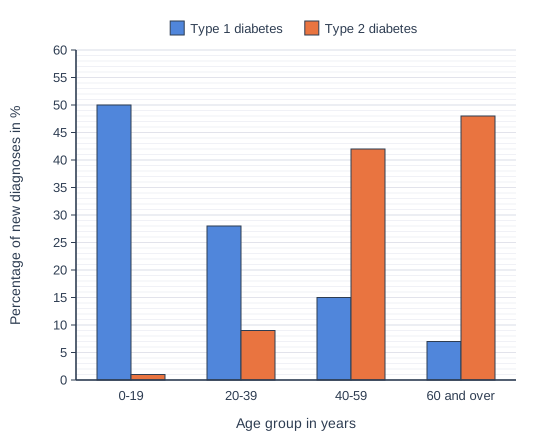
The bar chart shows the percentage of the new diagnoses of each type of diabetes in each age group.

Compare the ages at which people were diagnosed with type 1 diabetes and with type 2 diabetes. Use data from the bar chart.

Suggest one reason why type 2 diabetes is diagnosed more often in older people.

Dual bar chart of percentage of new diagnoses in % for each age group in years, comparing Type 1 diabetes and Type 2 diabetes (a key above the chart shows which bar is which). 0-19: Type 1 diabetes 50, Type 2 diabetes 1; 20-39: Type 1 diabetes 28, Type 2 diabetes 9; 40-59: Type 1 diabetes 15, Type 2 diabetes 42; 60 and over: Type 1 diabetes 7, Type 2 diabetes 48.

Model answer

Type 1 diabetes was diagnosed mostly in young people: 50% of type 1 diagnoses were in people aged 0-19, and the percentage fell with age to 7% in people aged 60 and over. Type 2 diabetes was the opposite: only 1% of diagnoses were in people aged 0-19, and most were in older people, 42% aged 40-59 and 48% aged 60 and over.

Type 2 diabetes is linked to being overweight and inactive, and people tend to gain body mass and exercise less as they get older.

Explanation

A good comparison names the age groups, quotes values for both types and says how the pattern differs: type 1 is mostly diagnosed in young people and type 2 mostly in people over 40. Type 2 diabetes develops slowly as body cells stop responding properly to insulin, and its risk rises with being overweight and taking little exercise, which become more common with age. Remember that the bars show percentages of each type, not numbers of people.

Mark scheme
  1. 1 mark

    type 1 diabetes was most often diagnosed in young people / the 0-19 age group (50%)

    1 mark for each of points 1, 2 and 3 (using the data), and 1 mark for any one of points 4 to 6 (the suggestion), max 4. The question asks for one reason (points 4 to 6): If more than one answer is given, a wrong one cancels a right one. ALLOW 'half of type 1 diagnoses were in people aged 0-19'. ALLOW points 1 and 2 without numbers if the age group is named; point 3 needs a pair of values or a described pattern.

  2. 1 mark

    type 2 diabetes was most often diagnosed in older people / the 60 and over age group (48%) / 90% of type 2 diagnoses were in people aged 40 and over

    ALLOW 42% in the 40-59 age group as the data for older people.

  3. 1 mark

    a correct comparison using data from the same age group, for example 0-19: type 1 50% but type 2 only 1% / 60 and over: type 1 7% but type 2 48% / the percentage for type 1 falls with age but the percentage for type 2 rises with age

    ALLOW any correct pair of values from one age group. ORA (allow the reverse argument).

  4. 1 mark

    (suggestion) people tend to gain body mass / become overweight as they get older (which increases the risk of type 2 diabetes)

    ALLOW 'older people are more likely to be obese'. IGNORE 'older people eat more sugar' unless linked to gaining body mass.

  5. 1 mark

    (suggestion) people tend to exercise less / become less active as they get older (which increases the risk of type 2 diabetes)

    ALLOW 'older people do less physical activity'.

  6. 1 mark

    (suggestion) body cells become less responsive to insulin over many years / type 2 diabetes develops slowly over many years

    ALLOW 'it takes a long time for the cells to stop responding to insulin'.

Ready to try the rest? Every answer you write is marked against the mark scheme, so you can see exactly where the marks are.

Study Helper Hints first, answers after you try

Stuck on this one? Ask for a hint and I’ll point you in the right direction, without giving the answer away. Once you’ve checked your answer, I’ll show you how the marks are awarded.