
Level:
Correct: 0
Incorrect: 0
Marks: 0/0
Exam Practice
Course:
Topics:
Avg
score:
–
Topics
done:
0/23

Mitosis and the cell cycle

Practise 14 exam-style questions on Mitosis and the cell cycle for OCR GCSE Combined Science (Biology Paper 1). Write your answer as you would in the exam and get it marked in seconds against the mark scheme, point by point, with the Study Helper on hand if you get stuck.

  • 14 questions
  • 1–6 marks each
  • Instant marking
  • No sign-up needed
14 questions, marked as you go

Sample questions with model answers

Here are 4 of the questions in this topic, each with a model answer, an explanation of why it earns the marks and the mark scheme an examiner would use.

Question 1

1 mark

In which stage of the cell cycle does the amount of DNA in a cell double?

Choose your answer.

  • A cell growth
  • B DNA replication
  • C more cell growth
  • D movement of chromosomes

Model answer

B - DNA replication

Explanation

Replication means copying. During DNA replication, every chromosome is copied, so the cell has twice as much DNA. When the copies move apart and the cell divides, each new cell gets the same amount of DNA as the cell had at the start.

Mark scheme
  1. 1 mark

    B / DNA replication

    The only correct answer is B: in DNA replication each chromosome is copied, so the amount of DNA in the cell doubles. A is not correct because in cell growth the cell gets bigger and makes more sub-cellular structures, but the DNA has not yet been copied; C is not correct because in more cell growth the DNA has already been copied, so its amount does not change; D is not correct because when the chromosomes move apart the DNA is shared out, not doubled. ALLOW the letter or the option. If more than one option is given, do not award the mark.
Question 2

2 marks

A student uses modelling clay to model what happens to the chromosomes in the cell cycle.

Step 1: She rolls four sausages of clay and puts them inside a circle drawn on paper. Each sausage represents a chromosome.
Step 2: She makes an identical copy of each sausage and presses each copy against its original.
Step 3: She pulls each copy away from its original, so that one of each pair goes to each end of the paper.
Step 4: She draws a line across the middle of the paper and a circle round each group of sausages.

Name the stage of the cell cycle that step 2 models and the stage that step 3 models.

Model answer

Step 2 models DNA replication.
Step 3 models movement of chromosomes.

Explanation

In step 2 each 'chromosome' gets an identical copy, which is what happens in DNA replication. In step 3 the two copies of each chromosome are pulled apart to opposite ends, which is the movement of chromosomes. Step 4 then models the cell dividing into two new cells with identical sets of chromosomes.

Mark scheme
  1. 1 mark

    step 2: DNA replication

    ALLOW copying the DNA / copying the chromosomes / replication. DO NOT ALLOW cell growth or more cell growth. DO NOT ALLOW mitosis for step 2.

  2. 1 mark

    step 3: movement of chromosomes

    ALLOW the chromosomes (copies) separate / move apart / move to opposite ends of the cell. ALLOW anaphase. IGNORE mitosis on its own. DO NOT ALLOW DNA replication for step 3.

Question 3

2 marks

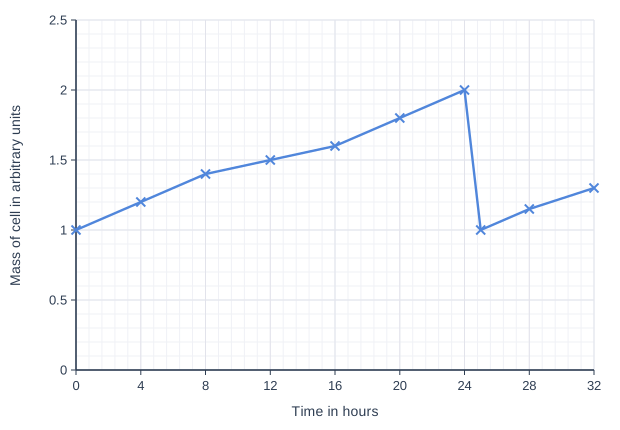
The graph shows the mass of a cell from a growing shoot tip. From 25 hours onwards, the graph follows one of the cells produced from it.

Describe and explain the changes in the mass of the cell shown by the graph.

Line graph of mass of cell in arbitrary units (y-axis, 0 to 2.5) against time in hours (x-axis, 0 to 32). The line joins the points (0, 1), (4, 1.2), (8, 1.4), (12, 1.5), (16, 1.6), (20, 1.8), (24, 2), (25, 1), (28, 1.15), (32, 1.3).

Model answer

From 0 to 24 hours the mass of the cell increases from 1.0 to 2.0 units, because the cell grows during the growth stages of the cell cycle. Between 24 and 25 hours the mass falls to half (1.0 unit), because the cell divides into two new cells and each one gets about half of the cytoplasm. Then the new cell starts to grow again.

Explanation

A cell roughly doubles its mass during the cell cycle by growing, so that when it divides each new cell starts at the normal size. The sudden halving shows the moment of division. The pattern then repeats in each new cell.

Mark scheme
  1. 1 mark

    from 0 to 24 hours the mass increases / doubles (from 1.0 to 2.0 units) because the cell grows (in the growth stages of the cell cycle)

    The change and a reason are both needed. ALLOW the cell makes more cytoplasm / sub-cellular structures / proteins as the reason. ALLOW the mass goes up because of cell growth and more cell growth.

  2. 1 mark

    at 24 to 25 hours the mass falls to half (from 2.0 to 1.0 units) because the cell divides into two (new) cells

    The change and a reason are both needed. ALLOW the mass drops suddenly because mitosis / cell division happens and each new cell gets about half of the cell's contents. DO NOT ALLOW the cell dies / shrinks / loses water.

Question 4

4 marks

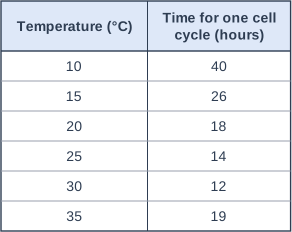
A scientist grew pea seedlings at different temperatures. She measured how long one cell cycle took in the cells at the tips of the roots.

The table shows her results. The roots grew fastest at 30 °C.

Describe the effect of temperature on the time for one cell cycle. Suggest why the roots grew fastest at 30 °C.

Use data from the table in your answer.

Table with columns "Temperature (°C)", "Time for one cell cycle (hours)". Temperature (°C): 10; Time for one cell cycle (hours): 40 | Temperature (°C): 15; Time for one cell cycle (hours): 26 | Temperature (°C): 20; Time for one cell cycle (hours): 18 | Temperature (°C): 25; Time for one cell cycle (hours): 14 | Temperature (°C): 30; Time for one cell cycle (hours): 12 | Temperature (°C): 35; Time for one cell cycle (hours): 19.

Model answer

As the temperature increases from 10 °C to 30 °C, the time for one cell cycle decreases, from 40 hours to only 12 hours. Above 30 °C it increases again, to 19 hours at 35 °C.
At 30 °C the cell cycle is shortest, so the cells at the root tip divide by mitosis most often and the most new cells are made each day, so the root grows fastest. This is probably because 30 °C is close to the optimum temperature for the enzymes that control the reactions in the cell cycle; at 35 °C the enzymes start to denature.

Explanation

Describe the pattern in two parts (decreasing to 30 °C, then increasing) and quote values with their temperatures. Then link a shorter cell cycle to more frequent mitosis and so more new cells for growth. Enzymes help explain why temperature has this effect.

Mark scheme
  1. 1 mark

    as the temperature increases (from 10 °C) to 30 °C, the time for one cell cycle decreases

    1 mark for each of points 1 to 5, max 4. ORA (allow the reverse argument): the lower the temperature (below 30 °C), the longer the cell cycle. ALLOW the cell cycle is shortest / fastest at 30 °C.

  2. 1 mark

    above 30 °C / at 35 °C the time for one cell cycle increases (again)

    ALLOW the cell cycle is slower at 35 °C than at 30 °C.

  3. 1 mark

    use of data, for example 40 hours at 10 °C but only 12 hours at 30 °C / 19 hours at 35 °C

    At least one temperature with its matching time is needed.

  4. 1 mark

    (at 30 °C) the cells divide (by mitosis) most often / the most cell cycles happen in a given time, so the most new cells are made (for growth)

    ALLOW more cells are produced per day at 30 °C. ALLOW (24 ÷ 12 =) 2 divisions per day at 30 °C compared with fewer at other temperatures. IGNORE the root grows faster, without a reference to cells dividing or new cells.

  5. 1 mark

    (30 °C is near the) optimum temperature for the enzymes that control the reactions of the cell cycle / at 35 °C the enzymes start to denature

    ALLOW reactions (in the cell) are fastest at 30 °C. ALLOW at low temperatures the enzymes / reactions work slowly. DO NOT ALLOW the enzymes are killed.

Ready to try the rest? Every answer you write is marked against the mark scheme, so you can see exactly where the marks are.

Study Helper Hints first, answers after you try

Stuck on this one? Ask for a hint and I’ll point you in the right direction, without giving the answer away. Once you’ve checked your answer, I’ll show you how the marks are awarded.