
Level:
Correct: 0
Incorrect: 0
Marks: 0/0
Exam Practice
Course:
Topics:
Avg
score:
–
Topics
done:
0/23

Maintaining internal environments and blood sugar control

Practise 13 exam-style questions on Maintaining internal environments and blood sugar control for OCR GCSE Combined Science (Biology Paper 1). Write your answer as you would in the exam and get it marked in seconds against the mark scheme, point by point, with the Study Helper on hand if you get stuck.

  • 13 questions
  • 1–4 marks each
  • Instant marking
  • No sign-up needed
13 questions, marked as you go

Sample questions with model answers

Here are 4 of the questions in this topic, each with a model answer, an explanation of why it earns the marks and the mark scheme an examiner would use.

Question 1

1 mark

A man walks out of a warm house into freezing air on a winter morning.

Which statement about this change is correct?

Choose your answer.

  • A This is an external change, and his body responds to keep his body temperature at about 37 °C.
  • B This is an external change, so his body does not need to respond to it.
  • C This is an internal change, and his body temperature falls to the temperature of the air.
  • D This is an internal change, so his body responds to keep his body temperature at about 37 °C.

Model answer

A (this is an external change, and his body responds to keep his body temperature at about 37 °C)

Explanation

An external change is a change in the body's surroundings, such as the air temperature; an internal change happens inside the body, such as a rise in blood sugar level after a meal. The body responds to both kinds of change to keep its internal environment, including a temperature of about 37 °C, constant. Humans do not simply take on the temperature of the air around them.

Mark scheme
  1. 1 mark

    A / This is an external change, and his body responds to keep his body temperature at about 37 °C.

    The only correct answer is A: a change in the temperature of the surroundings is an external change, and the body responds to it to keep its internal environment, including its temperature, constant. B is not correct because the body does respond to external changes as well as internal ones; C is not correct because the air temperature is outside the body, so it is an external change, and his body temperature stays at about 37 °C rather than falling to the air temperature; D is not correct because the change is in the surroundings, so it is an external change, not an internal one. ALLOW the letter or the option. If more than one option is given, do not award the mark.
Question 2

1 mark

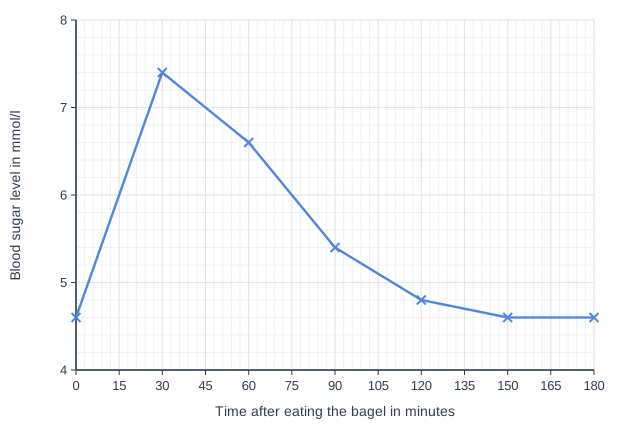
A student who does not have diabetes ate a bagel at 0 minutes. Her blood sugar level was measured every 30 minutes for 3 hours.

The graph shows the results.

Use the graph to find her blood sugar level at 75 minutes.

Line graph of blood sugar level in mmol/l (y-axis, 4 to 8) against time after eating the bagel in minutes (x-axis, 0 to 180). The line joins the points (0, 4.6), (30, 7.4), (60, 6.6), (90, 5.4), (120, 4.8), (150, 4.6), (180, 4.6).

Model answer

6.0 mmol/l

Explanation

Go up from 75 minutes on the time axis to the line, which joins the points at 60 minutes (6.6 mmol/l) and 90 minutes (5.4 mmol/l), then across to the blood sugar axis: the reading is 6.0 mmol/l, halfway between the two points. Check the scale first: each small square on the blood sugar axis is 0.2 mmol/l. Take the reading from the line at 75 minutes, not from the nearest plotted point at 60 or 90 minutes.

Mark scheme
  1. 1 mark

    6.0 (mmol/l)

    ALLOW any value from 5.9 to 6.1 (mmol/l). ALLOW 6. IGNORE units, and ALLOW mmol/L or mmol/dm³.

Question 3

2 marks

A student measured her own blood sugar level 30 minutes after eating a banana on Monday morning. On Tuesday afternoon, she measured it 30 minutes after eating a chocolate bar.

Monday (banana): 6.4 mmol/l
Tuesday (chocolate bar): 7.9 mmol/l

She concludes: 'Chocolate always makes the blood sugar level rise more than bananas do.'

Give two reasons why her results are not enough to support this conclusion.

Model answer

1. She tested only one person (herself) once for each food, so the results may not be repeatable or true for other people.
2. Other variables were not controlled: she ate the foods at different times of day and may not have eaten the same mass of sugar in each.

Explanation

A conclusion about what 'always' happens needs repeated results from many people, with the other variables kept the same. Here only one person was tested once on each day, the tests were at different times of day, and the masses of sugar eaten were not controlled. Saying only 'it is not a fair test' is not enough: name the variable that was not kept the same.

Mark scheme
  1. 2 marks

    any two from: only one person was tested; each food was tested only once / the test was not repeated; the masses of the foods / the masses of sugar in them were not controlled / may not have been the same; the tests were at different times of day / other conditions were not kept the same (for example what she ate before, exercise, time since her last meal); her blood sugar level before eating was not measured, so the rise is not known

    1 mark for each different reason, max 2. If more than two answers are given, a wrong one cancels a right one. ALLOW 'the sample size is too small' for the first reason. ALLOW 'the result could be anomalous' as a version of the second reason. IGNORE 'it is not a fair test' unless a variable that was not controlled is named. IGNORE 'she might have measured it wrongly'.

Question 4

3 marks

The blood of an adult contains about 4.5 g of glucose altogether. A can of fizzy drink contains 35 g of sugar.

Calculate how many times more sugar there is in the can of drink than glucose in the blood.

In a person who does not have diabetes, the blood sugar level rises only a little after they drink the can of drink. Suggest why.

Model answer

35 ÷ 4.5 = 7.8 times
The sugar is absorbed into the blood gradually as the drink is digested, not all at once. As the blood sugar level rises, the pancreas releases insulin, which makes muscle and liver cells take in glucose from the blood, so the level stays close to normal.

Explanation

One can of drink holds almost eight times as much sugar as all the glucose in the blood, so without control the blood sugar level would rise far too high. The pancreas responds to the rise by releasing insulin, which makes body cells take in glucose, and some glucose is used in respiration. This is why the blood sugar level stays within narrow limits.

Mark scheme
  1. 1 mark

    35 ÷ 4.5 = 7.8 (times) / 7.78 / 7.777… / about 8 (times)

    An answer of 7.8, 7.78, 7.777… or 8 with no working scores marking point 1 only. 1 mark for point 1, and 1 mark for each of points 2 to 5 up to 2 marks from points 2 to 5 (3 marks in all). An answer of 0.13 (4.5 ÷ 35) scores 0.

  2. 1 mark

    the sugar is absorbed into the blood gradually / over a period of time (as it is digested and absorbed), not all at once

    ALLOW it takes time for the sugar to be digested and absorbed.

  3. 1 mark

    (as the blood sugar level rises) the pancreas releases (more) insulin (into the blood)

    DO NOT ALLOW the liver releases insulin.

  4. 1 mark

    insulin causes (muscle and liver) cells to take in glucose from the blood

    ALLOW insulin causes glucose to be stored in the liver and muscles. DO NOT ALLOW insulin breaks down glucose.

  5. 1 mark

    (some of the) glucose is used by body cells in respiration

    ALLOW glucose is used up by the cells to release energy.

Ready to try the rest? Every answer you write is marked against the mark scheme, so you can see exactly where the marks are.

Study Helper Hints first, answers after you try

Stuck on this one? Ask for a hint and I’ll point you in the right direction, without giving the answer away. Once you’ve checked your answer, I’ll show you how the marks are awarded.