
Level:
Correct: 0
Incorrect: 0
Marks: 0/0
Exam Practice
Course:
Topics:
Avg
score:
–
Topics
done:
0/23

Practical skills (biology PAGs B1-B5)

Practise 17 exam-style questions on Practical skills (biology PAGs B1-B5) for OCR GCSE Combined Science (Biology Paper 1). Write your answer as you would in the exam and get it marked in seconds against the mark scheme, point by point, with the Study Helper on hand if you get stuck.

  • 17 questions
  • 1–6 marks each
  • Instant marking
  • No sign-up needed
17 questions, marked as you go

Sample questions with model answers

Here are 4 of the questions in this topic, each with a model answer, an explanation of why it earns the marks and the mark scheme an examiner would use.

Question 1

1 mark

A student uses a ruler marked in millimetres to measure the root of a germinating broad bean. The end of the root is between the 2.4 cm and 2.5 cm marks, but much closer to 2.4 cm.

Which length should the student record?

Choose your answer.

  • A 2 cm
  • B 2.4 cm
  • C 2.43 cm
  • D 2.5 cm

Model answer

B

Explanation

Record a measurement to the resolution of the instrument: a millimetre ruler measures to the nearest 0.1 cm, so the length is 2.4 cm. Writing 2.43 cm suggests a precision the ruler cannot give, and 2 cm throws away information.

Mark scheme
  1. 1 mark

    B / 2.4 cm

    The only correct answer is B: the ruler can measure to the nearest millimetre (0.1 cm), and the root is closer to the 2.4 cm mark. A is not correct because it ignores the millimetre marks and is less precise than the ruler allows; C is not correct because it claims a precision (0.01 cm) that a millimetre ruler cannot give; D is not correct because the end of the root is closer to 2.4 cm than to 2.5 cm. ALLOW the letter or the value. If more than one option is given, do not award the mark.
Question 2

2 marks

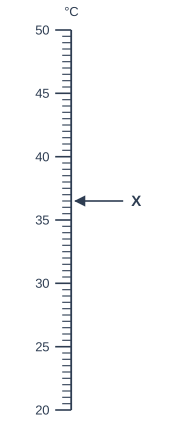
A student set up a water bath for an investigation into the enzyme trypsin. The diagram shows the scale of the thermometer in the water bath. Arrow X shows the top of the liquid in the thermometer.

Give the temperature shown by the thermometer.

Give the resolution of the thermometer.

A vertical scale from 20 to 50 °C, divided into 6 equal parts by long marks, each split into 10 small divisions by short marks. Every long mark is numbered (20, 25, 30, 35, 40, 45 and 50). An arrow labelled X points to a mark on the scale.

Model answer

Temperature = 36.5 °C
Resolution = 0.5 °C

Explanation

The numbered marks are 5 °C apart and there are 10 small divisions between them, so each small division is 0.5 °C: this is the resolution, the smallest change the thermometer can show. Arrow X is 3 small divisions above 35 °C, so the temperature is 35 + 1.5 = 36.5 °C.

Mark scheme
  1. 1 mark

    36.5 (°C)

    IGNORE units unless the question asks for them. DO NOT ALLOW 36 or 37 (the half-degree mark has not been read).

  2. 1 mark

    0.5 °C

    ALLOW the thermometer can be read to the nearest 0.5 °C / each small division is 0.5 °C. DO NOT ALLOW 5 °C (the gap between the numbered marks) or 1 °C.

Question 3

2 marks

Two students looked at the same cells from the thin skin of a rhubarb stalk, using the same light microscope with a total magnification of ×100. Each student made a labelled drawing of one cell. The cell in student A's drawing is twice as long as the cell in student B's drawing.

Both students wrote 'magnification ×100' under their drawings.

Explain why at least one of the students has written the wrong magnification, and describe how each student could work out the magnification of their drawing.

Model answer

The magnification of a drawing depends on how big the student draws the cell, not on the lenses of the microscope. The two drawings show the same cell at different sizes, so they cannot both be ×100: drawing A is magnified twice as much as drawing B. Each student should measure the length of the cell in their drawing and divide it by the real length of the cell (magnification = size of drawing ÷ real size).

Explanation

The ×100 is the magnification of the microscope image, but a drawing can be made any size. The magnification written under a drawing must be worked out from the drawing itself: size of the drawing ÷ real size of the object. A scale bar is another way to show the real size.

Mark scheme
  1. 1 mark

    the magnification of a drawing depends on how big the drawing is (not on the microscope lenses), so two drawings of the same cell at different sizes cannot both be ×100 / drawing A has twice the magnification of drawing B

    ALLOW the microscope magnification is not the same as the magnification of the drawing. IGNORE the students used different microscopes (they used the same one).

  2. 1 mark

    measure the length of the cell in the drawing and divide by the real length of the cell / magnification = size of drawing ÷ real size

    ALLOW find the real size of the cell (for example with a scale) and divide the drawing size by it. ALLOW add a scale bar to the drawing instead of a magnification. DO NOT ALLOW multiply the eyepiece and objective lens magnifications (this gives the microscope magnification, not the drawing's).

Question 4

3 marks

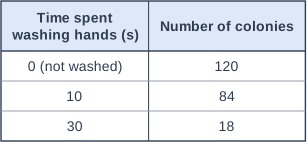
A student investigated whether washing hands for longer removes more bacteria. After washing her hands with soap and water for different times, she pressed one fingertip onto a sterile agar plate. The plates were taped shut and incubated at 25 °C for 2 days. She then counted the colonies of bacteria on each plate.

The table shows the results.

Calculate the percentage decrease in the number of colonies after washing for 30 seconds, compared with not washing.

The plates were not opened after they had been incubated. Suggest why.

Table with columns "Time spent washing hands (s)", "Number of colonies". Time spent washing hands (s): 0 (not washed); Number of colonies: 120 | Time spent washing hands (s): 10; Number of colonies: 84 | Time spent washing hands (s): 30; Number of colonies: 18.

Model answer

Decrease = 120 − 18 = 102 colonies
Percentage decrease = 102 ÷ 120 × 100 = 85 %
The plates were not opened because the bacteria that grew could be harmful, and opening the plates could release them onto the student or into the room.

Explanation

Percentage decrease = decrease ÷ starting value × 100, so divide by the number of colonies with no washing (120). Plates are kept taped shut after incubation because millions of bacteria have grown, and some of them could be harmful if they were touched or breathed in.

Mark scheme
  1. 1 mark

    decrease = 120 − 18 = 102 / 102 ÷ 120 × 100; or a correct final answer of 85 % with no working

    An answer of 85 % with no working scores marking points 1 and 2 only. 15 % (18 ÷ 120 × 100, the percentage that remain) scores marking point 1 only. 567 % (102 ÷ 18 × 100) scores 0.

  2. 1 mark

    85 (%)

    ALLOW 85.0. ALLOW ECF from a wrong decrease correctly divided by 120.

  3. 1 mark

    the bacteria that grew could be harmful / large numbers of bacteria have grown, so opening the plate could spread them to the student or into the room

    ALLOW to stop the student touching or breathing in the bacteria. ALLOW to stop the bacteria escaping. IGNORE to stop the bacteria being contaminated / so the results are not affected.

Ready to try the rest? Every answer you write is marked against the mark scheme, so you can see exactly where the marks are.

Study Helper Hints first, answers after you try

Stuck on this one? Ask for a hint and I’ll point you in the right direction, without giving the answer away. Once you’ve checked your answer, I’ll show you how the marks are awarded.