Level:
Correct: 0
Incorrect: 0
Marks: 0/0
Exam Practice
Course:
Topics:
Avg
score:
–
Topics
done:
0/23

Sub-cellular structures and electron microscopy

Practise 16 exam-style questions on Sub-cellular structures and electron microscopy for OCR GCSE Combined Science (Biology Paper 1). Write your answer as you would in the exam and get it marked in seconds against the mark scheme, point by point, with the Study Helper on hand if you get stuck.

  • 16 questions
  • 1–6 marks each
  • Instant marking
  • No sign-up needed
16 questions, marked as you go

Sample questions with model answers

Here are 4 of the questions in this topic, each with a model answer, an explanation of why it earns the marks and the mark scheme an examiner would use.

Question 1

1 mark

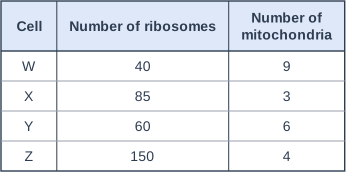
A scientist used a transmission electron microscope to look at four types of cell, W, X, Y and Z.

She counted the ribosomes and the mitochondria in the same area of each cell. The table shows her results.

Which cell is most likely to be making large amounts of protein?

Choose your answer.

  • A W
  • B X
  • C Y
  • D Z
Table with columns "Cell", "Number of ribosomes", "Number of mitochondria". Cell: W; Number of ribosomes: 40; Number of mitochondria: 9 | Cell: X; Number of ribosomes: 85; Number of mitochondria: 3 | Cell: Y; Number of ribosomes: 60; Number of mitochondria: 6 | Cell: Z; Number of ribosomes: 150; Number of mitochondria: 4.

Model answer

D (cell Z)

Explanation

Proteins are made at the ribosomes, so a cell that makes a lot of protein needs a lot of ribosomes. Cell Z has 150 ribosomes in the area counted, far more than the other cells. The number of mitochondria shows how much respiration a cell carries out, not how much protein it makes.

Mark scheme
  1. 1 mark

    D / Z

    The only correct answer is D: ribosomes are the site of protein synthesis, and cell Z has the most ribosomes (150). A is not correct because cell W has the most mitochondria (9), which shows that it releases a lot of energy by respiration, but it has the fewest ribosomes (40); B is not correct because cell X has fewer ribosomes (85) than cell Z; C is not correct because cell Y has fewer ribosomes (60) than cell Z. ALLOW the letter or the option. If more than one option is given, do not award the mark.
Question 2

2 marks

Cells in the taste buds on the tongue can detect sugar molecules. This makes food taste sweet.

Sucralose is an artificial sweetener. It is not a sugar, but it tastes very sweet.

Suggest why sucralose tastes sweet.

Use ideas about the cell membrane in your answer.

Model answer

The cell membranes of the taste bud cells contain receptor molecules that sugar molecules bind to. Sucralose molecules can also fit into these same receptor molecules, so the cells respond in the same way and the food tastes sweet.

Explanation

Cell membranes contain receptor molecules, which let a cell detect particular molecules outside it. A molecule is detected if it fits the receptor. Sucralose is not a sugar, but it can bind to the same receptors as sugar, so the brain gets the same 'sweet' message.

Mark scheme
  1. 1 mark

    the cell membranes (of the taste bud cells) contain receptor molecules (that detect sugar)

    ALLOW receptors in the cell membrane. IGNORE receptors in the tongue / taste buds unless linked to the cell membrane.

  2. 1 mark

    sucralose (molecules) also bind to / fit into the same receptor molecules as sugar (so the cells respond in the same way)

    ALLOW sucralose has a similar shape to sugar, so it fits the (sweet) receptors. ALLOW sucralose triggers the same receptors. DO NOT ALLOW sucralose is turned into sugar / contains sugar.

Question 3

2 marks

Glucose and oxygen can pass through the cell membrane into a muscle cell. The enzymes made inside the cell cannot pass out through the cell membrane.

The cell membrane is described as a selective barrier.

Explain what this means and why it is important for the cell.

Model answer

A selective barrier lets some substances, such as glucose and oxygen, pass through it, but stops others, such as the cell's enzymes. This is important because the cell can take in the glucose and oxygen it needs for respiration while keeping its useful enzymes inside the cell.

Explanation

The cell membrane controls what enters and leaves the cell: small useful molecules can cross it, but large molecules made by the cell, such as enzymes, stay inside. This lets the cell take in what it needs while keeping its contents.

Mark scheme
  1. 1 mark

    it lets some molecules / substances (such as glucose and oxygen) pass through, but not others (such as enzymes)

    Both parts of the idea (some pass, some do not) are needed for this mark. ALLOW it controls which substances enter and leave the cell. DO NOT ALLOW it stops all substances / lets all substances through.

  2. 1 mark

    so the cell can take in the substances it needs (such as glucose and oxygen for respiration) and keep useful substances (such as its enzymes) inside

    ALLOW keeps harmful substances out. ALLOW keeps the conditions inside the cell suitable for its reactions.

Question 4

4 marks

A student read that prokaryotic cells are always smaller than eukaryotic cells.

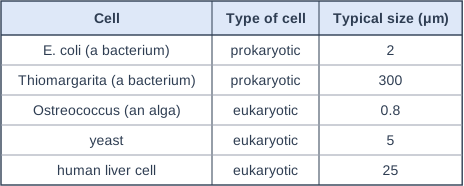
The table shows the approximate typical size of five types of cell. Thiomargarita is a bacterium that scientists first described in 1999. Ostreococcus is a single-celled alga that scientists first described in 1994.

Evaluate the statement that prokaryotic cells are always smaller than eukaryotic cells. Use data from the table in your answer.

Table with columns "Cell", "Type of cell", "Typical size (μm)". Cell: E. coli (a bacterium); Type of cell: prokaryotic; Typical size (μm): 2 | Cell: Thiomargarita (a bacterium); Type of cell: prokaryotic; Typical size (μm): 300 | Cell: Ostreococcus (an alga); Type of cell: eukaryotic; Typical size (μm): 0.8 | Cell: yeast; Type of cell: eukaryotic; Typical size (μm): 5 | Cell: human liver cell; Type of cell: eukaryotic; Typical size (μm): 25.

Model answer

Some of the data support the statement: E. coli, a prokaryotic cell, is only 2 μm long, which is smaller than yeast (5 μm) and liver cells (25 μm). But Thiomargarita is prokaryotic and is about 300 μm across, which is bigger than all the eukaryotic cells in the table, including the liver cell. Also, Ostreococcus is eukaryotic but is only 0.8 μm across, smaller than both prokaryotic cells. So the statement is not correct: prokaryotic cells are usually smaller than eukaryotic cells, but not always.

Explanation

To evaluate a statement, use the data to show where it is supported and where it is not, then make a judgement. Most bacteria are much smaller than most eukaryotic cells, but the giant bacterium Thiomargarita and the tiny eukaryotic alga Ostreococcus do not fit the pattern. Prokaryotic cells are defined by their structure (no nucleus), not by their size.

Mark scheme
  1. 1 mark

    (supports) E. coli (2 μm) is smaller than yeast (5 μm) and liver cells (25 μm)

    Data (values, or a clear size comparison of named cells from the table) are needed for marking points 1, 2 and 3. ALLOW E. coli is smaller than (some of) the eukaryotic cells.

  2. 1 mark

    (does not support) Thiomargarita (300 μm) is larger than all the eukaryotic cells / than a liver cell (25 μm)

    ALLOW Thiomargarita is 12 times larger than a liver cell.

  3. 1 mark

    (does not support) Ostreococcus (0.8 μm) is smaller than both prokaryotic cells / than E. coli (2 μm)

    ALLOW Ostreococcus is the smallest cell in the table, and it is eukaryotic.

  4. 1 mark

    conclusion: the statement is not correct / prokaryotic cells are usually smaller, but not always

    ALLOW size cannot be used on its own to tell whether a cell is prokaryotic or eukaryotic. DO NOT ALLOW the statement is correct.

Ready to try the rest? Every answer you write is marked against the mark scheme, so you can see exactly where the marks are.

Study Helper Hints first, answers after you try

Stuck on this one? Ask for a hint and I’ll point you in the right direction, without giving the answer away. Once you’ve checked your answer, I’ll show you how the marks are awarded.