
Level:
Correct: 0
Incorrect: 0
Marks: 0/0
Exam Practice
Course:
Topics:
Avg
score:
–
Topics
done:
0/23

Cell differentiation and stem cells

Practise 16 exam-style questions on Cell differentiation and stem cells for OCR GCSE Combined Science (Biology Paper 1). Write your answer as you would in the exam and get it marked in seconds against the mark scheme, point by point, with the Study Helper on hand if you get stuck.

  • 16 questions
  • 1–6 marks each
  • Instant marking
  • No sign-up needed
16 questions, marked as you go

Sample questions with model answers

Here are 4 of the questions in this topic, each with a model answer, an explanation of why it earns the marks and the mark scheme an examiner would use.

Question 1

1 mark

A daffodil bulb contains a bud. In spring, a new shoot grows from the bud.

Which tissue in the bud contains the cells that divide to form the new shoot?

Choose your answer.

  • A epidermis
  • B meristem
  • C phloem
  • D xylem

Model answer

B - meristem

Explanation

In plants, stem cells are found in meristems, for example at the tips of roots and shoots and in buds. Meristem cells divide and the new cells differentiate into all the types of cell the new shoot needs. Epidermis, phloem and xylem are specialised tissues.

Mark scheme
  1. 1 mark

    B / meristem

    The only correct answer is B: meristem tissue contains the plant's stem cells, which divide by mitosis and differentiate into the different types of cell in a new shoot. A is not correct because the epidermis is a specialised outer layer that protects the plant; C is not correct because phloem is a specialised tissue that transports sugars; D is not correct because xylem is a specialised tissue that transports water and is made of dead cells that cannot divide. ALLOW the letter or the option. If more than one option is given, do not award the mark.
Question 2

2 marks

Specialised cells each have a particular job.

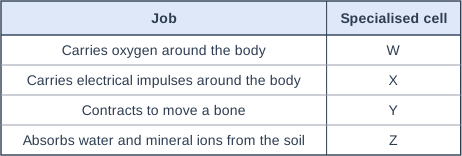
The table shows four jobs, and four specialised cells labelled W, X, Y and Z.

Name each of the specialised cells W, X, Y and Z.

Table with columns "Job", "Specialised cell". Job: Carries oxygen around the body; Specialised cell: W | Job: Carries electrical impulses around the body; Specialised cell: X | Job: Contracts to move a bone; Specialised cell: Y | Job: Absorbs water and mineral ions from the soil; Specialised cell: Z.

Model answer

W: red blood cell
X: nerve cell
Y: muscle cell
Z: root hair cell

Explanation

Each specialised cell is suited to one job: red blood cells carry oxygen, nerve cells carry impulses, muscle cells contract and root hair cells absorb water and mineral ions. All of them develop from unspecialised cells by differentiation.

Mark scheme
  1. 2 marks

    W red blood cell; X nerve cell; Y muscle cell; Z root hair cell

    All four correct = 2 marks; two or three correct = 1 mark; one correct = 0 marks. ALLOW neurone / sensory neurone / motor neurone for X. ALLOW erythrocyte for W. DO NOT ALLOW white blood cell for W. DO NOT ALLOW xylem for Z.

Question 3

2 marks

Plants have meristems. Animals have adult stem cells.

Give one similarity and one difference between meristem cells in plants and adult stem cells in animals.

Model answer

Similarity: both are unspecialised cells that can divide by mitosis.
Difference: meristem cells can differentiate into any type of plant cell, but adult stem cells can only form a few types of cell.

Explanation

Meristem cells and adult stem cells are both unspecialised and both divide to make new cells. Meristems, at the tips of roots and shoots, can produce every type of plant cell and let a plant grow throughout its life; adult stem cells, such as those in bone marrow, form only a limited range of cells, mainly for repair and replacement.

Mark scheme
  1. 1 mark

    (similarity) both are unspecialised (cells) / both can differentiate (into specialised cells)

    1 mark for any one of points 1 and 2 (a similarity), max 1, and 1 mark for any one of points 3 to 5 (a difference), max 1. If more than one answer is given, a wrong one cancels a right one (this applies to the similarity and to the difference separately). IGNORE both are cells / both are found in living things.

  2. 1 mark

    (similarity) both divide by mitosis (to make new cells)

    ALLOW both produce new cells for growth or repair.

  3. 1 mark

    (difference) meristem cells can form any type of plant cell, but adult stem cells can form only a few types of cell

    ORA (allow the reverse argument). IGNORE one is in plants and one is in animals on its own.

  4. 1 mark

    (difference) meristems keep producing cells for growth throughout the plant's life, but in adult animals stem cells mainly replace or repair cells

    ORA (allow the reverse argument). ALLOW plants keep growing all their lives but adult animals do not.

  5. 1 mark

    (difference) meristems are found at the tips of roots and shoots, but adult stem cells are found in tissues such as bone marrow

    ORA (allow the reverse argument). A named place is needed for each.

Question 4

4 marks

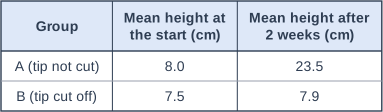
A student grew 20 sunflower seedlings. When the seedlings were about 8 cm tall, she cut the tip off the main shoot of 10 of them (group B). She did not cut group A.

She measured the mean height of the main shoot of each group at the start and after 2 weeks. The table shows her results.

Calculate the increase in mean height of each group.

Explain the difference between the two groups, using ideas about meristems.

Table with columns "Group", "Mean height at the start (cm)", "Mean height after 2 weeks (cm)". Group: A (tip not cut); Mean height at the start (cm): 8.0; Mean height after 2 weeks (cm): 23.5 | Group: B (tip cut off); Mean height at the start (cm): 7.5; Mean height after 2 weeks (cm): 7.9.

Model answer

Group A: 23.5 − 8.0 = 15.5 cm
Group B: 7.9 − 7.5 = 0.4 cm
The tip of the main shoot contains a meristem. In group A, the meristem cells kept dividing by mitosis, and the new cells grew and differentiated, so the main shoot grew 15.5 cm taller. In group B, cutting off the tip removed the meristem, so no new cells were made at the tip and the main shoot grew only 0.4 cm.

Explanation

Subtract the starting height from the final height for each group. Plant shoots grow taller from the meristem at their tip, where unspecialised cells divide and then differentiate. Removing the tip removes these dividing cells, so the main shoot almost stops getting taller.

Mark scheme
  1. 1 mark

    group A: 23.5 − 8.0 = 15.5 (cm) and group B: 7.9 − 7.5 = 0.4 (cm); or a correct final answer of 15.5 cm and 0.4 cm with no working

    An answer of 15.5 cm and 0.4 cm with no working scores marking point 1 only. Both values are needed for this mark. IGNORE units.

  2. 1 mark

    (in group A) the shoot tip contains meristem (tissue / cells)

    ALLOW the tip of the shoot has stem cells. ALLOW cutting the tip removed the meristem (in group B).

  3. 1 mark

    meristem cells divide (by mitosis) and the new cells grow / differentiate, so the shoot grows taller

    ALLOW new cells are made at the tip, so the main shoot gets longer. DO NOT ALLOW the meristem cells are specialised.

  4. 1 mark

    (in group B) the meristem was removed, so no new cells were made at the tip / the main shoot stopped growing taller

    ORA (allow the reverse argument) for group A. IGNORE the plants were damaged / died.

Ready to try the rest? Every answer you write is marked against the mark scheme, so you can see exactly where the marks are.

Study Helper Hints first, answers after you try

Stuck on this one? Ask for a hint and I’ll point you in the right direction, without giving the answer away. Once you’ve checked your answer, I’ll show you how the marks are awarded.