
Level:
Correct: 0
Incorrect: 0
Marks: 0/0
Exam Practice
Course:
Topics:
Avg
score:
–
Topics
done:
0/23

Hormonal coordination and the endocrine system

Practise 10 exam-style questions on Hormonal coordination and the endocrine system for OCR GCSE Combined Science (Biology Paper 1). Write your answer as you would in the exam and get it marked in seconds against the mark scheme, point by point, with the Study Helper on hand if you get stuck.

  • 10 questions
  • 1–4 marks each
  • Instant marking
  • No sign-up needed
10 questions, marked as you go

Sample questions with model answers

Here are 4 of the questions in this topic, each with a model answer, an explanation of why it earns the marks and the mark scheme an examiner would use.

Question 1

1 mark

A hormone causes a response in its target organ.

Which sequence shows the steps of hormonal control in the correct order?

Choose your answer.

  • A gland → blood → receptors on target cells → response
  • B gland → neurone → receptors on target cells → response
  • C gland → receptors on target cells → blood → response
  • D gland → target cells → blood → response

Model answer

A

Explanation

Every hormone works in the same order: an endocrine gland releases it into the blood, the blood carries it all round the body, and only cells with the right receptors (the target cells) respond. Option B describes part of a nervous pathway, not a hormonal one.

Mark scheme
  1. 1 mark

    A / gland → blood → receptors on target cells → response

    The only correct answer is A: the gland releases the hormone into the blood, the blood carries it to the target organ, the hormone binds to receptors on the target cells and the cells respond. B is not correct because hormones are carried in the blood, not along neurones (neurones carry nerve impulses). C is not correct because the hormone has to be carried in the blood before it can reach the receptors on the target cells. D is not correct because the gland does not release the hormone straight into the target cells: the hormone travels in the blood first. ALLOW the letter or the option. If more than one option is given, do not award the mark.
Question 2

1 mark

The pancreas, the pituitary gland and the ovaries all release hormones directly into the blood.

Name the type of gland that releases hormones directly into the blood.

Model answer

Endocrine glands.

Explanation

Glands that release hormones straight into the blood are endocrine glands, and together they make up the endocrine system. For example, the pituitary gland releases FSH, the ovaries release oestrogen and progesterone, and the pancreas releases insulin.

Mark scheme
  1. 1 mark

    endocrine (gland)

    ALLOW endocrine system. ALLOW ductless gland. DO NOT ALLOW exocrine. DO NOT ALLOW answers that only repeat the question, such as 'hormone gland' or 'blood gland'.

Question 3

2 marks

Melatonin is a hormone released by the pineal gland in the brain.

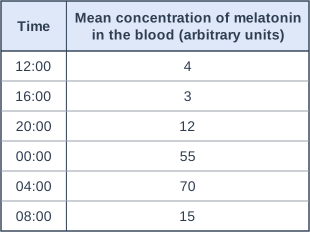
A scientist measured the concentration of melatonin in the blood of a group of adults every 4 hours, from midday (12:00) until 08:00 the next morning. The adults slept in a dark room from 23:00 to 07:00.

The table shows the scientist's results (mean values).

Describe how the concentration of melatonin changed. Use data from the table.

Table with columns "Time", "Mean concentration of melatonin in the blood (arbitrary units)". Time: 12:00; Mean concentration of melatonin in the blood (arbitrary units): 4 | Time: 16:00; Mean concentration of melatonin in the blood (arbitrary units): 3 | Time: 20:00; Mean concentration of melatonin in the blood (arbitrary units): 12 | Time: 00:00; Mean concentration of melatonin in the blood (arbitrary units): 55 | Time: 04:00; Mean concentration of melatonin in the blood (arbitrary units): 70 | Time: 08:00; Mean concentration of melatonin in the blood (arbitrary units): 15.

Model answer

The melatonin concentration was low in the afternoon (4 units at 12:00 and 3 units at 16:00). It rose in the evening and during the night to its highest value of 70 units at 04:00, and then fell to 15 units by 08:00.

Explanation

Describe the pattern in stages: low, then rising to a peak, then falling, and quote a value from the table for each stage, with the time it happened. You do not need to explain the pattern here, only describe it. The highest value (70 units at 04:00) is the most useful single figure to quote.

Mark scheme
  1. 1 mark

    (the concentration is) low in the afternoon / during the day (4 and 3 arbitrary units at 12:00 and 16:00)

    Max 1 if no data from the table are used. 1 mark for each of the three ideas, max 2. IGNORE units.

  2. 1 mark

    (it) rises in the evening / at night to its highest value (of 70 arbitrary units at 04:00)

    ALLOW increases from 12 at 20:00 to 70 at 04:00. ALLOW highest during the night / while the adults are asleep.

  3. 1 mark

    (it then) falls (to 15 arbitrary units) by 08:00 / in the morning

    ALLOW decreases after 04:00.

Question 4

3 marks

Parathyroid hormone is released by small glands in the neck. It is a protein.

Some people with very weak bones are treated with a medicine that contains a form of parathyroid hormone. The medicine is injected under the skin once a day. It would not work if it were swallowed as a tablet.

Explain why the medicine works when it is injected but would not work if it were swallowed.

Model answer

If the medicine is swallowed, enzymes in the stomach and small intestine digest the protein into amino acids. The hormone is destroyed, so it cannot reach the blood whole or bind to the receptors on its target cells. When the medicine is injected under the skin, the hormone passes into the blood without being digested, and the blood carries it to its target organ, the bones.

Explanation

Many hormones are proteins, and the digestive system breaks proteins down into amino acids, so these hormones cannot be taken by mouth. An injection puts the hormone where it needs to be: in the blood, which carries it to the target organ. Saying only that the tablet 'dissolves' does not explain why the hormone stops working.

Mark scheme
  1. 1 mark

    if swallowed, the hormone / protein is digested / broken down by enzymes (in the stomach / small intestine)

    ALLOW broken down by protease. ALLOW denatured by the acid in the stomach. IGNORE 'dissolves' / 'is destroyed' unless digestion, enzymes or acid are mentioned.

  2. 1 mark

    (it is broken into amino acids, so) it no longer works as the hormone / cannot bind to the receptors on its target cells

    ALLOW it is not absorbed into the blood as the whole hormone. ALLOW it no longer has the right shape to fit the receptors.

  3. 1 mark

    when injected, the hormone enters the blood (without being digested) and is carried in the blood to its target organ / the bones

    ALLOW it reaches the bone cells and binds to their receptors.

Ready to try the rest? Every answer you write is marked against the mark scheme, so you can see exactly where the marks are.

Study Helper Hints first, answers after you try

Stuck on this one? Ask for a hint and I’ll point you in the right direction, without giving the answer away. Once you’ve checked your answer, I’ll show you how the marks are awarded.