
Level:
Correct: 0
Incorrect: 0
Marks: 0/0
Exam Practice
Course:
Topics:
Avg
score:
–
Topics
done:
0/23

Factors affecting water uptake and the potometer

Practise 16 exam-style questions on Factors affecting water uptake and the potometer for OCR GCSE Combined Science (Biology Paper 1). Write your answer as you would in the exam and get it marked in seconds against the mark scheme, point by point, with the Study Helper on hand if you get stuck.

  • 16 questions
  • 1–6 marks each
  • Instant marking
  • No sign-up needed
16 questions, marked as you go

Sample questions with model answers

Here are 4 of the questions in this topic, each with a model answer, an explanation of why it earns the marks and the mark scheme an examiner would use.

Question 1

1 mark

A student used a potometer to measure the rate of water uptake by a leafy shoot. In still air, the rate was 18 mm³/min. With a fan blowing air over the leaves, the rate was 27 mm³/min.

What was the percentage increase in the rate of water uptake?

Choose your answer.

  • A 9 %
  • B 33 %
  • C 50 %
  • D 150 %

Model answer

C

Explanation

Percentage increase = increase ÷ starting value × 100. The increase is 27 − 18 = 9 mm³/min, so the percentage increase is 9 ÷ 18 × 100 = 50 %. Always divide by the starting value (18), not by the new value (27).

Mark scheme
  1. 1 mark

    C / 50 %

    The only correct answer is C: increase = 27 − 18 = 9 mm³/min, and 9 ÷ 18 × 100 = 50 %. A is not correct because 9 is the increase in mm³/min, not a percentage; B is not correct because it is 9 ÷ 27 × 100 (dividing by the new rate instead of the starting rate); D is not correct because it is 27 ÷ 18 × 100 (the new rate as a percentage of the old rate, without taking away 100 %). ALLOW the letter or the value. If more than one option is given, do not award the mark.
Question 2

2 marks

A student used a potometer to investigate the effect of temperature on the rate of water uptake. For each temperature, the student cut a new leafy shoot from a different plant of the same species.

Explain why this could make the results less valid.

Model answer

The shoots may have different numbers and sizes of leaves, so they have different numbers of stomata. So they would take up water at different rates even at the same temperature, and the student could not be sure that a difference in the rate was caused by the temperature.

Explanation

A valid investigation tests only the factor it is meant to test. Shoots with more leaves (more stomata) lose more water by transpiration, so they take up water faster at any temperature. Using the same shoot for every temperature means that only the temperature changes.

Mark scheme
  1. 1 mark

    the shoots may have different numbers of leaves / different leaf areas / different numbers of stomata

    ALLOW the shoots may be different sizes / ages / in different health. IGNORE the shoots are different (unqualified).

  2. 1 mark

    so they would take up water at different rates even at the same temperature / so a difference in the rate might not be caused by the temperature / so it is not a fair test

    ALLOW the student should use the same shoot for every temperature, if linked to the idea that only temperature should change. IGNORE it makes the results less accurate / less precise.

Question 3

2 marks

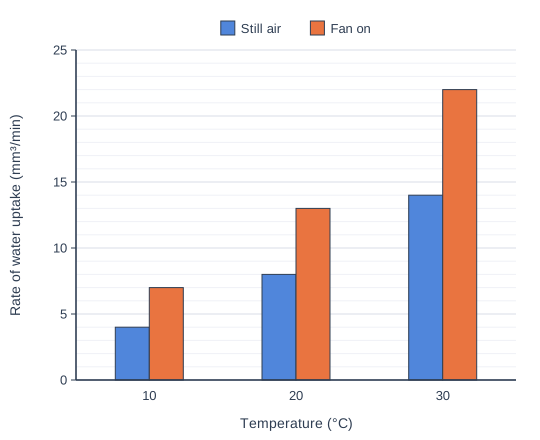
A student measured the rate of water uptake by a leafy shoot at three temperatures, in still air and with a fan blowing air over the leaves. The light intensity was the same each time.

The bar chart shows the results.

Use the bar chart to describe the effect of temperature and the effect of air movement on the rate of water uptake.

Dual bar chart of rate of water uptake (mm³/min) for each temperature (°C), comparing Still air and Fan on (a key above the chart shows which bar is which). 10: Still air 4, Fan on 7; 20: Still air 8, Fan on 13; 30: Still air 14, Fan on 22.

Model answer

As the temperature increases, the rate of water uptake increases: in still air it rises from 4 mm³/min at 10 °C to 14 mm³/min at 30 °C. At every temperature the rate is higher with the fan than in still air; for example at 20 °C it is 13 mm³/min with the fan and 8 mm³/min without it.

Explanation

Compare the bars for one condition across the three temperatures to see the effect of temperature, then compare the two bars at each temperature to see the effect of air movement. Both factors increase the rate of water uptake, and quoting values from the chart makes the description precise.

Mark scheme
  1. 1 mark

    (temperature) as the temperature increases, the rate of water uptake increases (in still air and in moving air)

    ORA (allow the reverse argument). ALLOW correct use of data, for example in still air the rate rises from 4 to 14 mm³/min between 10 °C and 30 °C. IGNORE explanations.

  2. 1 mark

    (air movement) the rate of water uptake is higher in moving air than in still air (at every temperature)

    ORA (allow the reverse argument). ALLOW the fan increases the rate of water uptake. ALLOW correct use of data, for example at 20 °C it is 13 mm³/min with the fan and 8 mm³/min in still air. ALLOW the effect of the fan is bigger at higher temperatures if the effect of air movement is also described.

Question 4

4 marks

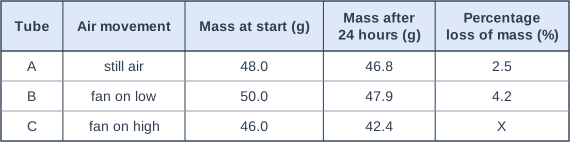
A student cut three leafy shoots of the same size from one plant. Each shoot was put in a boiling tube of water with a thin layer of oil on top of the water. The oil stops water evaporating from the surface of the water.

The tubes were kept side by side for 24 hours at the same light intensity and temperature, but with different air movement.

The table shows the results.

Calculate the percentage loss of mass for tube C (value X in the table).

Explain why tube C lost the most mass.

Table with columns "Tube", "Air movement", "Mass at start (g)", "Mass after 24 hours (g)", "Percentage loss of mass (%)". Tube: A; Air movement: still air; Mass at start (g): 48.0; Mass after 24 hours (g): 46.8; Percentage loss of mass (%): 2.5 | Tube: B; Air movement: fan on low; Mass at start (g): 50.0; Mass after 24 hours (g): 47.9; Percentage loss of mass (%): 4.2 | Tube: C; Air movement: fan on high; Mass at start (g): 46.0; Mass after 24 hours (g): 42.4; Percentage loss of mass (%): X.

Model answer

Mass lost = 46.0 − 42.4 = 3.6 g
Percentage loss = 3.6 ÷ 46.0 × 100 = 7.8 %
The fan on high blows water vapour away from the leaves, so the concentration gradient of water vapour between the inside of the leaves and the air is steeper. Water vapour diffuses out through the stomata faster, so more water is lost by transpiration and tube C loses the most mass.

Explanation

Percentage loss of mass = mass lost ÷ starting mass × 100, so divide by 46.0 g, not by the final mass. The oil means the only way water can leave a tube is through the shoot's leaves. Moving air removes the water vapour that builds up around the leaves, keeping the concentration gradient steep, so transpiration is fastest in tube C.

Mark scheme
  1. 1 mark

    mass lost = 46.0 − 42.4 = 3.6 (g) / 42.4 ÷ 46.0 × 100 = 92.2 (%); or a correct final answer of 7.8 %, 7.83 % or 8 % with no working

    An answer of 7.8 % (or 7.83 %, 7.826 % or 8 %) with no working scores marking points 1 and 2 only. 8.5 % (3.6 ÷ 42.4 × 100, dividing by the final mass) scores marking point 1 only. 92.2 % on its own (the percentage of the mass left) scores marking point 1 only.

  2. 1 mark

    7.8 (%)

    ALLOW 7.83 or 7.826. ALLOW ECF: a wrong mass loss correctly divided by 46.0 and multiplied by 100. ALLOW 8 % (correctly rounded: the question does not ask for a precision).

  3. 2 marks

    the moving air (from the fan) blows water vapour away from (the air around) the leaves; so there is a steeper concentration gradient of water vapour between the inside of the leaves and the air / water vapour diffuses out of the leaves (through the stomata) faster; so more water is lost from the leaves by transpiration (and replaced by water taken up from the tube)

    1 mark for each of these ideas, max 2. ALLOW faster transpiration / more evaporation from the leaves for the last idea. IGNORE the fan dries the plant / the wind takes the water (unqualified). DO NOT ALLOW the fan cools the leaves so more water evaporates. DO NOT ALLOW water evaporated from the surface of the water in the tube (the oil stops this).

Ready to try the rest? Every answer you write is marked against the mark scheme, so you can see exactly where the marks are.

Study Helper Hints first, answers after you try

Stuck on this one? Ask for a hint and I’ll point you in the right direction, without giving the answer away. Once you’ve checked your answer, I’ll show you how the marks are awarded.