
Level:
Correct: 0
Incorrect: 0
Marks: 0/0
Exam Practice
Course:
Topics:
OCR GCSE Biology (Paper 4) Smart practice A mixed round aimed at your weak spots
Avg
score:
–
Topics
done:
0/29

Plant defences and detecting plant diseases

Practise 14 exam-style questions on Plant defences and detecting plant diseases for OCR GCSE Biology (Paper 4). Write your answer as you would in the exam and get it marked in seconds against the mark scheme, point by point, with the Study Helper on hand if you get stuck.

  • 14 questions
  • 1–6 marks each
  • Instant marking
  • No sign-up needed
14 questions, marked as you go

Sample questions with model answers

Here are 4 of the questions in this topic, each with a model answer, an explanation of why it earns the marks and the mark scheme an examiner would use.

Question 1

1 mark

When the bark of a pine tree is damaged, a sticky resin flows out over the wound. The resin hardens and seals the wound. It also contains substances that kill fungi and bacteria.

Which statement describes this defence response?

Choose your answer.

  • A A chemical defence only, because the resin contains substances that kill fungi and bacteria in the wound.
  • B A physical defence only, because the hardened resin forms a seal over the wound.
  • C An immune response, because the resin contains antibodies that find and destroy pathogens.
  • D Both a physical and a chemical defence, because the resin seals the wound and kills pathogens.

Model answer

D (Both a physical and a chemical defence, because the resin seals the wound and kills pathogens.)

Explanation

A wound in the bark is a way in for pathogens. The resin does two jobs: when it hardens it forms a physical barrier over the wound, and the antimicrobial substances in it are a chemical defence. Read every part of the stem: the seal and the substances that kill fungi and bacteria are both described.

Mark scheme
  1. 1 mark

    D / Both a physical and a chemical defence, because the resin seals the wound and kills pathogens.

    The only correct answer is D: the hardened resin is a physical barrier that seals the wound, so pathogens cannot get in through it, and the antimicrobial substances in the resin are a chemical defence that kills pathogens. A is not correct because it leaves out the physical barrier formed by the hardened resin; B is not correct because it leaves out the antimicrobial substances, which are a chemical defence; C is not correct because plants do not make antibodies. ALLOW the letter or the option. If more than one option is given, do not award the mark.
Question 2

2 marks

Apples are picked by hand and stored for several months. Apples that are bruised or cut when they are picked are much more likely to rot in storage, because fungi grow into them.

Explain why apples that are bruised or cut are more likely to rot.

Model answer

The skin of the apple is covered by a waxy cuticle, which is a barrier to fungi. A bruise or a cut breaks this barrier and the cell walls underneath, so fungal spores can get into the apple and reach the cells, and the sugars that leak from the damaged cells help the fungi to grow.

Explanation

The cuticle and the cell walls are the physical defences of the fruit. Damage breaks both, giving pathogens a way in, which is why fruit is handled carefully. Avoid vague answers such as 'the apple is weaker': say which barrier is broken.

Mark scheme
  1. 1 mark

    the skin / waxy cuticle of the apple is broken / damaged, so fungi / spores can get into the apple (through the damaged area)

    Max 2. ALLOW the physical barrier is broken. IGNORE the apple is weaker.

  2. 1 mark

    the walls of the damaged cells are broken, so fungi can get into the cells / reach the cell contents

    ALLOW cell walls are a barrier that is broken by the damage.

  3. 1 mark

    damaged cells release sugars / nutrients (and water), which the fungi use to grow

    ALLOW food for the fungi leaks out of the damaged cells.

Question 3

3 marks

Many bacteria that cause leaf diseases cannot get through the waxy cuticle. They enter leaves through the stomata.

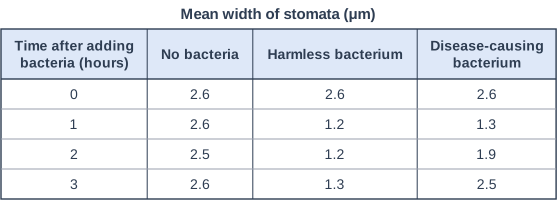
A scientist floated pieces of leaf on water in bright light. She added a harmless bacterium to one dish and a bacterium that causes a leaf disease to a second dish. A third dish had no bacteria. She measured the mean width of the stomata at intervals.

The table shows her results.

Use the data to explain how the plant responds to bacteria, and suggest why the disease-causing bacterium can still infect the leaf.

Mean width of stomata (μm). Table with columns "Time after adding bacteria (hours)", "No bacteria", "Harmless bacterium", "Disease-causing bacterium". Time after adding bacteria (hours): 0; No bacteria: 2.6; Harmless bacterium: 2.6; Disease-causing bacterium: 2.6 | Time after adding bacteria (hours): 1; No bacteria: 2.6; Harmless bacterium: 1.2; Disease-causing bacterium: 1.3 | Time after adding bacteria (hours): 2; No bacteria: 2.5; Harmless bacterium: 1.2; Disease-causing bacterium: 1.9 | Time after adding bacteria (hours): 3; No bacteria: 2.6; Harmless bacterium: 1.3; Disease-causing bacterium: 2.5.

Model answer

With both bacteria the stomata closed within 1 hour, from 2.6 μm to about 1.2-1.3 μm, but they stayed open in the dish with no bacteria. So the plant detects bacteria and closes its stomata, which stops bacteria getting into the leaf through them. With the harmless bacterium the stomata stayed closed, but with the disease-causing bacterium they opened again, to 2.5 μm by 3 hours. The disease-causing bacterium may release a chemical that makes the guard cells open the stomata, so it can get into the leaf.

Explanation

Stomata are pores in the cuticle and epidermis, so they are a way in for bacteria. Closing them is a physical defence response. Compare the columns: the dish with no bacteria is the control, which shows that the stomata close because of the bacteria and not because of the method. Use numbers from the table rather than just 'it goes down'.

Mark scheme
  1. 1 mark

    (the guard cells) close the stomata / the width of the stomata decreases when (either type of) bacteria are added (but not in the dish with no bacteria), using data: from 2.6 μm to 1.2 / 1.3 μm within 1 hour

    Max 3. A value from the table (or a correct decrease of 1.3 or 1.4 μm) is needed for this mark. ALLOW the width almost halves within 1 hour.

  2. 1 mark

    closing the stomata is a defence (response) / stops or reduces bacteria entering the leaf (through the stomata)

    ALLOW closing the stomata keeps the bacteria out of the leaf. IGNORE closing stomata reduces water loss.

  3. 1 mark

    with the disease-causing bacterium the stomata open again (to 2.5 μm by 3 hours), but with the harmless bacterium they stay closed (1.3 μm)

    ALLOW the stomata reopen after 1 hour only with the disease-causing bacterium.

  4. 1 mark

    (suggestion) the disease-causing bacterium produces a substance / chemical that makes the guard cells open the stomata (again), so it can enter the leaf through the open stomata

    ALLOW any sensible suggestion of how the bacterium makes the stomata reopen, for example it affects the guard cells, linked to it entering the leaf.

Question 4

4 marks

Take-all is a disease of cereal roots caused by a fungus that lives in the soil.

• The roots of oat plants contain avenacin. Avenacin is an antimicrobial substance that damages the cell membranes of fungi.
• Wheat roots do not contain avenacin.
• One type of the take-all fungus can infect wheat but not oats.
• A second type can infect both wheat and oats. This type makes an enzyme that breaks down avenacin into harmless products.

Scientists produced mutants of the second type of fungus that could not make this enzyme. The mutants could still infect wheat, but they could no longer infect oats.

Explain these observations.

Model answer

Avenacin is a chemical defence in oat roots: it damages the cell membranes of fungi, so it kills them or stops them growing. The first type of fungus has no way of breaking down avenacin, so it cannot infect oats. The second type makes an enzyme that breaks avenacin down into harmless products, so it survives in oat roots and can infect them. The mutants cannot make the enzyme, so the avenacin in oat roots kills them, just as it kills the first type. Wheat roots contain no avenacin, so no enzyme is needed to infect wheat, and the mutants can still infect it.

Explanation

Antimicrobial substances are a chemical defence, but some pathogens have evolved ways round them: here, an enzyme that breaks the substance down. The mutants are the key evidence: without the enzyme the fungus can no longer infect oats, but its ability to infect wheat is unchanged because wheat has no avenacin. Explain the wheat result as well as the oat result.

Mark scheme
  1. 1 mark

    avenacin is a chemical defence (of oats): it kills / damages / stops the growth of fungi that try to infect oat roots

    Max 3 if the results on wheat are not explained. Max 4. ALLOW avenacin damages the membranes of the fungus, so its cells die / its contents leak out.

  2. 1 mark

    the first type (of fungus) cannot break down avenacin, so it is killed / damaged in oat roots and cannot infect oats

    ALLOW the first type does not have / make the enzyme.

  3. 1 mark

    the second type breaks down avenacin with its enzyme, so it is not harmed / can grow in oat roots

    ALLOW the enzyme detoxifies avenacin / makes avenacin harmless.

  4. 1 mark

    the mutants cannot make the enzyme, so avenacin is not broken down and it kills / damages them in oat roots

    ALLOW the mutants are like the first type.

  5. 1 mark

    wheat roots have no avenacin, so the enzyme is not needed to infect wheat / so all types (and the mutants) can infect wheat

    ALLOW wheat has no chemical defence against this fungus.

  6. 1 mark

    the enzyme is specific to avenacin / its active site is complementary to (the shape of) avenacin

    ALLOW lock and key idea for this enzyme and avenacin.

Ready to try the rest? Every answer you write is marked against the mark scheme, so you can see exactly where the marks are.

Study Helper Hints first, answers after you try

Stuck on this one? Ask for a hint and I’ll point you in the right direction, without giving the answer away. Once you’ve checked your answer, I’ll show you how the marks are awarded.