
Level:
Correct: 0
Incorrect: 0
Marks: 0/0
Exam Practice
Course:
Topics:
OCR GCSE Biology (Paper 4) Smart practice A mixed round aimed at your weak spots
Avg
score:
–
Topics
done:
0/29

Food security: agricultural and biotechnological solutions

Practise 15 exam-style questions on Food security: agricultural and biotechnological solutions for OCR GCSE Biology (Paper 4). Write your answer as you would in the exam and get it marked in seconds against the mark scheme, point by point, with the Study Helper on hand if you get stuck.

  • 15 questions
  • 1–6 marks each
  • Instant marking
  • No sign-up needed
15 questions, marked as you go

Sample questions with model answers

Here are 4 of the questions in this topic, each with a model answer, an explanation of why it earns the marks and the mark scheme an examiner would use.

Question 1

1 mark

Biological control is often more successful in a glasshouse than in an open field.

Which statement gives the best explanation?

Choose your answer.

  • A Glasshouse crops are never attacked by insect pests or mites.
  • B Pests cannot reproduce at the warm temperatures in a glasshouse.
  • C The control organisms stay in the glasshouse, close to the pests.
  • D The control organisms do not need any food in a glasshouse.

Model answer

C - the control organisms stay in the glasshouse, close to the pests.

Explanation

Biological control uses a natural predator or parasite of a pest. In a field the control organisms can spread away or be killed by the weather, but in a glasshouse they are kept with the crop and the conditions can be controlled. Warmth speeds up the reproduction of pests, which is why glasshouses need good pest control.

Mark scheme
  1. 1 mark

    C / the control organisms stay in the glasshouse, close to the pests

    The only correct answer is C: in an enclosed glasshouse the predators or parasites cannot spread away from the crop, so they keep finding and attacking the pests. A is not correct because glasshouse crops are often attacked by pests such as whitefly, aphids and spider mites; B is not correct because warm conditions usually make pests reproduce faster, not slower; D is not correct because the control organisms feed on the pests, so they do need food. ALLOW the letter or the option. If more than one option is given, do not award the mark.
Question 2

2 marks

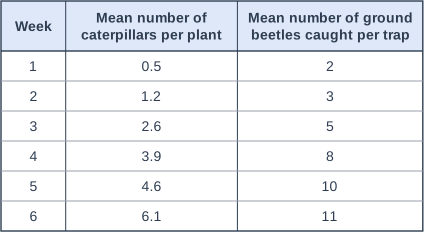
Caterpillars of the diamondback moth are pests of cabbages. Ground beetles living in the soil eat the caterpillars. An adviser tells a farmer to spray an insecticide only when the mean number of caterpillars on each plant is more than 4.

Each week the farmer counted the caterpillars on 40 cabbage plants and the ground beetles caught in traps set in the field. The table shows the results.

Give the first week in which the farmer should spray.

Explain one reason why the farmer is advised not to spray before the number of caterpillars reaches this level.

Table with columns "Week", "Mean number of caterpillars per plant", "Mean number of ground beetles caught per trap". Week: 1; Mean number of caterpillars per plant: 0.5; Mean number of ground beetles caught per trap: 2 | Week: 2; Mean number of caterpillars per plant: 1.2; Mean number of ground beetles caught per trap: 3 | Week: 3; Mean number of caterpillars per plant: 2.6; Mean number of ground beetles caught per trap: 5 | Week: 4; Mean number of caterpillars per plant: 3.9; Mean number of ground beetles caught per trap: 8 | Week: 5; Mean number of caterpillars per plant: 4.6; Mean number of ground beetles caught per trap: 10 | Week: 6; Mean number of caterpillars per plant: 6.1; Mean number of ground beetles caught per trap: 11.

Model answer

Week 5 (the mean was 4.6 caterpillars per plant, which is more than 4).

Spraying early would also kill the ground beetles. The number of beetles caught was increasing (from 2 to 8 per trap by week 4), and they eat the caterpillars, so they may keep the caterpillars under control without any insecticide.

Explanation

Read the table carefully: week 4 (3.9 caterpillars) is still below the threshold. Spraying only when pests reach a damaging level saves money, protects natural predators that act as biological control, and slows the evolution of resistance, because fewer sprays mean less selection pressure.

Mark scheme
  1. 1 mark

    week 5

    DO NOT ALLOW week 4 (3.9 caterpillars per plant is not more than 4) or week 6.

  2. 1 mark

    one reason with an explanation, for example: the insecticide would also kill the ground beetles, which are increasing and may keep the caterpillars under control; spraying costs money, and a small number of caterpillars causes little loss of yield, so spraying early may cost more than it saves; spraying less often slows the evolution of insecticide resistance in the moths; spraying less harms fewer other insects such as pollinators / causes less pollution

    1 mark for one reason that is explained. IGNORE 'to save money' or 'it is bad for the environment' with no explanation.

Question 3

3 marks

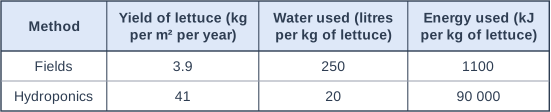
Scientists compared lettuce grown in fields in Arizona, USA, with lettuce grown by hydroponics in a glasshouse in the same area. The table shows their estimates (Barbosa and others, 2015).

Calculate how many times more lettuce is produced on each square metre each year by hydroponics than in the fields. Give your answer to 2 significant figures.

Use the table to give one disadvantage of hydroponics, and explain why it could make hydroponic farming less sustainable.

Table with columns "Method", "Yield of lettuce (kg per m² per year)", "Water used (litres per kg of lettuce)", "Energy used (kJ per kg of lettuce)". Method: Fields; Yield of lettuce (kg per m² per year): 3.9; Water used (litres per kg of lettuce): 250; Energy used (kJ per kg of lettuce): 1100 | Method: Hydroponics; Yield of lettuce (kg per m² per year): 41; Water used (litres per kg of lettuce): 20; Energy used (kJ per kg of lettuce): 90 000.

Model answer

41 ÷ 3.9 = 10.5, so hydroponics produces about 11 times more lettuce per square metre each year.

Disadvantage: hydroponics uses far more energy - 90 000 kJ per kg of lettuce compared with 1100 kJ in the fields, about 82 times more. If this energy comes from burning fossil fuels, which will run out and release carbon dioxide, hydroponic farming is less sustainable.

Explanation

Divide the hydroponic yield by the field yield and round to 2 significant figures (10.5 becomes 11). The table also shows that hydroponics uses much less water (20 litres instead of 250 litres per kg), but much more energy, so whether it is sustainable depends on where the energy comes from. Dividing the wrong way round (3.9 ÷ 41) is a common error.

Mark scheme
  1. 1 mark

    41 ÷ 3.9; or a correct final answer of 11 with no working

    An answer of 11 with no working scores marking points 1 and 2. ALLOW 1 mark for 10.5 or 10.51 (not given to 2 significant figures). ALLOW ECF for the significant-figure mark from a valid calculation. DO NOT ALLOW 0.095 (3.9 ÷ 41).

  2. 1 mark

    evaluation: 11 (times)

    IGNORE units.

  3. 1 mark

    hydroponics uses much more energy per kg of lettuce, and this energy (for heating, cooling, lighting or pumps) may come from fossil fuels, which are non-renewable / release carbon dioxide / are expensive

    Both the disadvantage and the explanation are needed for this mark. ALLOW 90 000 kJ compared with 1100 kJ per kg / about 82 times more energy. IGNORE disadvantages not shown in the table, such as the cost of building glasshouses.

Question 4

5 marks

As people in a country become wealthier, they often eat more meat. In one country, the mean mass of pork eaten by each person rose from 15 kg per year in 1990 to 40 kg per year in 2020. The population of the country in 2020 was about 120 million.

Assume that producing 1 kg of pork needs 3 kg of grain to feed the pigs.

Calculate the extra mass of grain needed in 2020 to produce the extra pork eaten by the population that year, compared with what they would have eaten at the 1990 rate. Give your answer in tonnes.

1 tonne = 1000 kg

Explain how this change in diet could reduce food security for people in other countries.

Model answer

Extra pork per person = 40 − 15 = 25 kg per year.
Extra grain per person = 25 × 3 = 75 kg.
Extra grain for the population = 75 × 120 000 000 = 9 000 000 000 kg = 9 000 000 tonnes (9.0 × 10⁶ tonnes).

To feed its pigs, the country may have to import much of this grain. This increases the demand for grain on the world market, so the price of grain rises and poorer people in other countries may not be able to afford enough food. Land in other countries may also be used to grow animal feed instead of food for local people.

Explanation

Work out the increase per person first (25 kg), then multiply by the grain needed per kg and by the population, and convert kg to tonnes by dividing by 1000. Feeding grain to animals wastes much of its energy, so a richer diet in one country increases the global demand for crops and can raise world food prices.

Mark scheme
  1. 1 mark

    extra pork per person = 40 − 15 = 25 (kg) / extra grain per person = 25 × 3 = 75 (kg); or a correct final answer of 9 000 000 tonnes with no working

    An answer of 9 000 000 tonnes (9.0 × 10⁶ tonnes) with no working scores marking points 1, 2 and 3. ALLOW 9 million tonnes. ALLOW 2 marks for 9.0 × 10⁹ (kg not converted to tonnes). ALLOW 2 marks for 3 000 000 tonnes (grain factor of 3 not used). ALLOW 2 marks for 14 400 000 tonnes (40 kg used instead of the increase of 25 kg).

  2. 1 mark

    75 × 120 000 000 = 9 000 000 000 kg / 9.0 × 10⁹ kg; or a correct final answer of 9 000 000 tonnes with no working

    ALLOW 25 × 120 000 000 × 3 in any order. ALLOW (40 × 3 × 120 000 000) − (15 × 3 × 120 000 000) for marking points 1 and 2.

  3. 1 mark

    evaluation: 9 000 000 tonnes / 9.0 × 10⁶ tonnes

    ALLOW 9 million tonnes. ALLOW 9 × 10⁶ and typed forms such as 9E6 or 9 times 10 to the power 6.

  4. 1 mark

    the country may need to import grain / soya to feed its pigs, so the demand for grain on the world market increases and the price rises

    ALLOW grain that could feed people is fed to animals instead (energy is lost at each trophic level, so less food is available overall).

  5. 1 mark

    so poorer people in other countries cannot afford enough food / forests or farmland in other countries are used to grow animal feed instead of food for local people

    ALLOW land is cleared (deforestation) in other countries to grow feed, which reduces biodiversity and may cause soil erosion, reducing future food production.

Ready to try the rest? Every answer you write is marked against the mark scheme, so you can see exactly where the marks are.

Study Helper Hints first, answers after you try

Stuck on this one? Ask for a hint and I’ll point you in the right direction, without giving the answer away. Once you’ve checked your answer, I’ll show you how the marks are awarded.