
Level:
Correct: 0
Incorrect: 0
Marks: 0/0
Exam Practice
Course:
Topics:
OCR GCSE Biology (Paper 4) Smart practice A mixed round aimed at your weak spots
Avg
score:
–
Topics
done:
0/29

Genome, environment and variation; mutations

Practise 20 exam-style questions on Genome, environment and variation; mutations for OCR GCSE Biology (Paper 4). Write your answer as you would in the exam and get it marked in seconds against the mark scheme, point by point, with the Study Helper on hand if you get stuck.

  • 20 questions
  • 1–6 marks each
  • Instant marking
  • No sign-up needed
20 questions, marked as you go

Sample questions with model answers

Here are 4 of the questions in this topic, each with a model answer, an explanation of why it earns the marks and the mark scheme an examiner would use.

Question 1

1 mark

All variants of genes arise from mutations.

Which of these changes to the DNA in a cell is a mutation?

Choose your answer.

  • A The DNA coils up tightly to form chromosomes before the cell divides.
  • B The DNA is copied before the cell divides by mitosis.
  • C The order of the repeating units in a section of the DNA is changed.
  • D The two strands of the double helix separate when the DNA is copied.

Model answer

C

Explanation

DNA is a polymer, a long chain of repeating units, and a mutation is a change in that chain in a section of DNA such as a gene. Copying the DNA, separating its strands and coiling it into chromosomes all happen in every cell cycle without changing the DNA. Mistakes when DNA is copied are one way mutations arise, which is why option B is a common wrong answer.

Mark scheme
  1. 1 mark

    C / the order of the repeating units in a section of the DNA is changed

    The only correct answer is C: a mutation is a change in the DNA itself, which can produce a new variant of a gene. A is not correct because coiling into chromosomes is a normal stage of cell division and does not change the DNA; B is not correct because copying the DNA (DNA replication) is a normal stage of the cell cycle - a mistake made during copying can cause a mutation, but copying is not itself a mutation; D is not correct because the strands separate during normal copying and the DNA is not changed. ALLOW the letter or the statement. If more than one option is given, do not award the mark.
Question 2

2 marks

Stoats are small mammals with brown fur. In the Scottish Highlands, most stoats grow white fur in winter. In southern England, very few stoats grow white fur in winter.

Suggest one way the environment and one way the genome could explain this difference.

Model answer

Environment: winters in the Scottish Highlands are colder and snowier, and the low temperature may trigger the stoats to grow white fur.

Genome: stoats in the Highlands may have different alleles of the genes that control fur colour, which make them grow white fur in winter; stoats in southern England may not have these alleles.

Explanation

A phenotype such as fur colour can depend on both the genome and the environment. The environment can affect which phenotype develops (cold may trigger white fur), and populations in different places can also have different alleles. The environment does not change the stoats' genes.

Mark scheme
  1. 1 mark

    environment: winters in the Highlands are colder / snowier, and low temperatures may trigger the growth of white fur

    ALLOW winter days are shorter in the Highlands. ALLOW temperature / snow / day length affects which colour of fur grows, as the environmental factor. IGNORE 'there is more snow' with no link to the growth of the fur.

  2. 1 mark

    genome: stoats in the Highlands may have different alleles / variants (of the genes controlling fur colour) that make them grow white fur in winter

    ALLOW Highland stoats are genetically different / have a different genome. ALLOW natural selection may have favoured stoats with alleles for white winter fur in snowy areas (camouflage). DO NOT ALLOW the cold changes the stoats' genes.

Question 3

3 marks

Nectarines are peaches with a smooth skin instead of a fuzzy (hairy) skin. Skin type is controlled by a single gene. The variant for smooth skin is recessive to the variant for fuzzy skin.

Some peach trees are heterozygous for this gene. Occasionally, one branch of a heterozygous peach tree starts to produce nectarines, while all of the other branches still produce peaches.

Explain how this can happen.

Model answer

In one cell in a bud or growing tip of the tree, a mutation changed the DNA of the dominant variant for fuzzy skin, so that this cell no longer had a working fuzzy-skin variant: both of its variants of the gene now gave smooth skin.

The cell was in a meristem, so it divided by mitosis many times, and all the cells that grew from it, making up the new branch and its fruit, carried the mutation. The cells of the rest of the tree did not.

This gene determines skin type, so with no fuzzy-skin variant the fruit on that branch have smooth skins and are nectarines. This is unusual, because most mutations have no effect on the phenotype.

Explanation

All variants arise from mutations. Smooth skin is recessive, so a single mutation can make a branch produce nectarines only if the tree is heterozygous and the mutation changes its one dominant fuzzy-skin variant. A mutation in a dividing cell at a growing tip is copied into every cell made from it by mitosis, so a whole branch can carry it. Here the variants of a single gene determine the phenotype, which is unusual: most mutations have no effect, and some only influence the phenotype.

Mark scheme
  1. 1 mark

    a mutation / change in the DNA of the (dominant) variant for fuzzy skin happened in one cell, so that cell no longer had a working variant for fuzzy skin / had two variants for smooth skin

    1 mark for each point, max 3. ALLOW the dominant allele mutated (into a recessive / smooth-skin allele) / the cell became homozygous recessive. ALLOW the fuzzy-skin variant was lost from that cell. A mutation that is not linked to the fuzzy-skin variant (for example 'a mutation produced the smooth-skin variant') does not score this point. DO NOT ALLOW the tree was cross-pollinated / the branch grew from a seed / the recessive variant became dominant.

  2. 1 mark

    the mutation was in a dividing cell in the bud / meristem / growing tip that produced that branch

    ALLOW in a stem cell / unspecialised cell of the branch.

  3. 1 mark

    the cell divided by mitosis, so all the cells of that branch (and its fruit) carry the mutation, but the cells of the other branches do not

    ALLOW the DNA (with the mutation) was copied into every new cell of the branch. DO NOT ALLOW meiosis.

  4. 1 mark

    this gene determines the phenotype: with no working fuzzy-skin variant the fruit has a smooth skin, which is unusual because most mutations have no effect on the phenotype

    ALLOW one mutation is enough on its own to change the skin of the fruit. ALLOW the recessive phenotype now shows because there is no dominant variant in these cells.

Question 4

4 marks

Scientists studied one variant of a gene in 6000 adults. Each adult had 0, 1 or 2 copies of the variant. The scientists also recorded whether each adult was physically active or physically inactive.

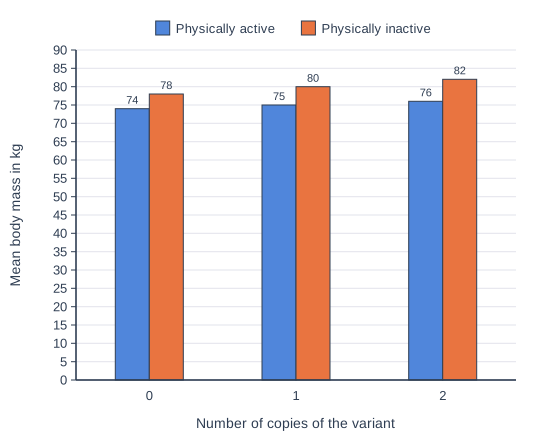
The graph shows the mean body mass of each group. In every group, the body masses of the individual adults ranged from less than 55 kg to more than 110 kg.

Use the data to explain why the variant is described as influencing body mass rather than determining it, and how the data show that the genome and the environment interact.

Dual bar chart of mean body mass in kg for each number of copies of the variant, comparing Physically active and Physically inactive (a key above the chart shows which bar is which). 0: Physically active 74, Physically inactive 78; 1: Physically active 75, Physically inactive 80; 2: Physically active 76, Physically inactive 82.

Model answer

The variant affects body mass: mean body mass rises with the number of copies, from 78 kg (0 copies) to 82 kg (2 copies) in inactive adults. However, the effect is small, only 2 to 4 kg, and in every group body masses range from below 55 kg to above 110 kg, so knowing how many copies a person has does not tell you their body mass. The variant influences body mass but does not determine it.

The environment also matters: active adults have a lower mean body mass than inactive adults with the same number of copies, for example 76 kg compared with 82 kg for 2 copies.

The genome and environment interact because the variant has a bigger effect in inactive adults (an increase of 4 kg) than in active adults (an increase of 2 kg), so being active reduces the effect of the variant.

Explanation

A variant that determines a phenotype gives a predictable result whatever the environment; one that influences a phenotype only shifts the average a little, with large overlap between groups. To show an interaction, compare the effect of one factor at each level of the other: here the effect of the variant is twice as large in inactive adults. Quote the means from the graph and the range given in the question.

Mark scheme
  1. 1 mark

    mean body mass increases with the number of copies of the variant (for example from 78 kg to 82 kg in inactive adults), so the variant / genome affects body mass

    1 mark for each point. Max 3 if no data from the graph are used. ALLOW from 74 kg to 76 kg in active adults.

  2. 1 mark

    but the effect is small (only 2 to 4 kg) and the masses in every group overlap / range from below 55 kg to above 110 kg, so a person's genotype does not decide their body mass (it influences it)

    ALLOW a person with 2 copies can have any body mass in the range / can have a lower mass than a person with no copies. ALLOW body mass is also affected by many other genes and by the environment.

  3. 1 mark

    physical activity (the environment) also affects body mass: active adults have a lower mean body mass for each number of copies (for example 76 kg compared with 82 kg for 2 copies)

    ALLOW 74 compared with 78 kg (0 copies) or 75 compared with 80 kg (1 copy).

  4. 1 mark

    interaction: the variant has a bigger effect in inactive adults (4 kg) than in active adults (2 kg) / being active reduces the effect of the variant

    ALLOW the difference between active and inactive adults is larger for people with more copies (4, 5 and 6 kg). DO NOT ALLOW exercise changes / removes the variant.

Ready to try the rest? Every answer you write is marked against the mark scheme, so you can see exactly where the marks are.

Study Helper Hints first, answers after you try

Stuck on this one? Ask for a hint and I’ll point you in the right direction, without giving the answer away. Once you’ve checked your answer, I’ll show you how the marks are awarded.