
Level:
Correct: 0
Incorrect: 0
Marks: 0/0
Exam Practice
Course:
Topics:
OCR GCSE Biology (Paper 4) Smart practice A mixed round aimed at your weak spots
Avg
score:
–
Topics
done:
0/29

Aseptic techniques

Practise 10 exam-style questions on Aseptic techniques for OCR GCSE Biology (Paper 4). Write your answer as you would in the exam and get it marked in seconds against the mark scheme, point by point, with the Study Helper on hand if you get stuck.

  • 10 questions
  • 1–4 marks each
  • Instant marking
  • No sign-up needed
10 questions, marked as you go

Sample questions with model answers

Here are 4 of the questions in this topic, each with a model answer, an explanation of why it earns the marks and the mark scheme an examiner would use.

Question 1

1 mark

Technicians wipe benches with 70% ethanol (70% ethanol and 30% water) rather than with pure (100%) ethanol.

Which statement explains why 70% ethanol is used?

Choose your answer.

  • A It denatures the proteins of microorganisms more quickly than pure ethanol does.
  • B It evaporates more quickly than pure ethanol, so the bench dries faster.
  • C It kills bacterial spores, which pure ethanol is not able to kill.
  • D It makes the bench sterile by killing every type of microorganism on it.

Model answer

A (It denatures the proteins of microorganisms more quickly than pure ethanol does.)

Explanation

Like heat, ethanol kills microorganisms by changing the shape of their proteins, so enzymes stop working. Water speeds up this denaturing, so 70% ethanol works better than pure ethanol. Ethanol does not kill bacterial spores, which is why agar and glassware are sterilised in an autoclave instead.

Mark scheme
  1. 1 mark

    A / It denatures the proteins of microorganisms more quickly than pure ethanol does.

    The only correct answer is A: ethanol kills microorganisms mainly by denaturing their proteins (including their enzymes), and proteins are denatured more quickly when water is present, so a mixture of ethanol and water kills microorganisms better than pure ethanol. B is not correct because 70% ethanol evaporates more slowly than pure ethanol, so it stays in contact with the microorganisms for longer; C is not correct because ethanol, at any concentration, does not kill bacterial spores; D is not correct because ethanol does not kill spores, so it disinfects the bench but does not make it sterile. ALLOW the letter or the option. If more than one option is given, do not award the mark.
Question 2

2 marks

Nutrient broth is a liquid growth medium for microorganisms. Before it is used, the broth is heated in an autoclave.

A load of small bottles, each holding 100 cm³ of broth, needs a 15-minute cycle to make sure all of the broth is sterile. A load containing one large bottle of 1000 cm³ of broth needs a much longer cycle.

Use ideas about surface area : volume ratio to explain why.

Model answer

The 1000 cm³ bottle has a much smaller surface area : volume ratio than a 100 cm³ bottle. Heat from the steam enters through the surface, so it takes much longer for the broth in the centre of the large bottle to reach 121 °C. The cycle must be long enough for all of the broth to be held at this temperature for long enough to kill every microorganism.

Explanation

Surface area : volume ratio affects heating in the same way as it affects exchange in organisms: a large volume has relatively little surface for heat to pass through. A common error is to say the larger bottle has a smaller surface area; it has a larger surface area but a smaller surface area : volume ratio.

Mark scheme
  1. 1 mark

    the larger volume of broth / large bottle has a smaller surface area : volume ratio

    Max 2. ORA (allow the reverse argument) for the smaller bottle. DO NOT ALLOW the larger bottle has a smaller surface area.

  2. 1 mark

    heat enters through the surface, so it takes longer for the broth in the centre / all of the broth to reach the sterilising temperature (121 °C)

    ALLOW the broth takes longer to heat up all the way through. ALLOW the heat has further to travel to reach the middle.

  3. 1 mark

    all of the broth must be kept at the sterilising temperature for long enough to kill every microorganism / spore, so the cycle must be longer

    ALLOW microorganisms in the centre might survive a 15-minute cycle.

Question 3

3 marks

Technicians check that an autoclave is working by using spore strips. A spore strip is a small strip of paper carrying about one million spores of a bacterium. These spores are much harder to kill by heating than most other microorganisms.

• A strip is placed in the middle of each load in the autoclave.
• After the autoclave cycle, each strip is put into a tube of sterile nutrient broth containing a purple indicator. The tubes are incubated.
• If any bacteria grow, they produce acid, which turns the indicator yellow.
• One strip that has not been through the autoclave is also put in broth and incubated.

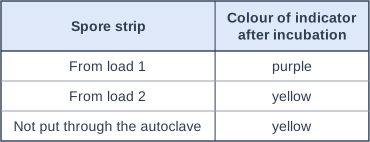
The table shows the results.

Explain what each result shows, and suggest why spores that are hard to kill by heating are used.

Table with columns "Spore strip", "Colour of indicator after incubation". Spore strip: From load 1; Colour of indicator after incubation: purple | Spore strip: From load 2; Colour of indicator after incubation: yellow | Spore strip: Not put through the autoclave; Colour of indicator after incubation: yellow.

Model answer

The strip from load 1 stayed purple, so no bacteria grew: all the spores were killed and load 1 was sterilised. The strip from load 2 turned yellow, so some spores survived, which means load 2 was not sterilised and must be autoclaved again. The strip that was not autoclaved turned yellow, which shows that the spores were alive and could grow, so the purple result for load 1 really was caused by the autoclave. Spores that are very hard to kill by heating are used because if they are killed, all the other microorganisms in the load must have been killed too.

Explanation

An autoclave sterilises growth media and glassware only if every part of the load reaches a high enough temperature for long enough. The spore strip tests this. The strip that is not autoclaved is a control: without it, a purple result might only mean that the spores were already dead.

Mark scheme
  1. 1 mark

    load 1: (purple, so) no bacteria grew / all the spores were killed, so load 1 was sterilised / the autoclave worked for load 1

    Max 2 if no reason is given for using spores that are hard to kill. Max 3.

  2. 1 mark

    load 2: (yellow, so) some spores survived (and grew), so load 2 was not sterilised / may still contain living microorganisms / must be autoclaved again before it is used

    ALLOW the autoclave did not work properly for load 2.

  3. 1 mark

    strip not autoclaved: (yellow, so) the spores were alive / able to grow, so the purple colour for load 1 was caused by the autoclave killing the spores

    ALLOW it is a control that shows the spores and broth can produce a yellow result.

  4. 1 mark

    if the spores that are hardest to kill have been killed, then all the other / less resistant microorganisms in the load will also have been killed

    ALLOW it is a test of the worst case: anything easier to kill will be dead too.

Question 4

3 marks

In many laboratories, cultures are handled in a laminar flow cabinet instead of next to a Bunsen burner.

In a laminar flow cabinet, a fan pulls air from the room through a filter that removes microorganisms and dust. The filtered air then flows steadily across the work surface and out through the open front of the cabinet, towards the person working.

Explain how this cabinet stops cultures being contaminated by microorganisms.

Suggest why it should not be used for cultures of bacteria that could cause disease in humans.

Model answer

The filter removes microorganisms from the air, so the air that flows over the cultures is free of microorganisms. Because this clean air flows outwards all the time, air from the room and microorganisms from the worker's breath, skin and hair are blown away and cannot reach the cultures. But the air that has passed over the cultures blows straight towards the worker, so if the bacteria could cause disease, they could be blown into the worker's face and breathed in.

Explanation

Like a Bunsen burner, a laminar flow cabinet uses a current of air to keep microorganisms away from open cultures, but it also filters the air. The direction of the air flow protects the culture, not the person, so cultures of pathogens are handled in safety cabinets that draw air away from the worker. Answers should link each point to the direction of the air.

Mark scheme
  1. 1 mark

    the filter removes microorganisms, so the air flowing over the cultures / work surface contains no microorganisms

    ALLOW the air reaching the cultures is sterile / clean.

  2. 1 mark

    the air flows outwards all the time, so microorganisms from the room / from the worker (breath, skin, hair) are blown away from the cultures / cannot reach the cultures

    ALLOW unfiltered air cannot get into the cabinet.

  3. 1 mark

    air that has passed over the cultures is blown towards the worker, so microorganisms / pathogens from the cultures could be breathed in / reach the worker (and infect them)

    ALLOW the cabinet protects the culture but not the worker, if linked to the direction of the air flow.

Ready to try the rest? Every answer you write is marked against the mark scheme, so you can see exactly where the marks are.

Study Helper Hints first, answers after you try

Stuck on this one? Ask for a hint and I’ll point you in the right direction, without giving the answer away. Once you’ve checked your answer, I’ll show you how the marks are awarded.