
Level:
Correct: 0
Incorrect: 0
Marks: 0/0
Exam Practice
Course:
Topics:
OCR GCSE Biology (Paper 4) Smart practice A mixed round aimed at your weak spots
Avg
score:
–
Topics
done:
0/29

Genetic engineering and gene technology in agriculture

Practise 16 exam-style questions on Genetic engineering and gene technology in agriculture for OCR GCSE Biology (Paper 4). Write your answer as you would in the exam and get it marked in seconds against the mark scheme, point by point, with the Study Helper on hand if you get stuck.

  • 16 questions
  • 1–6 marks each
  • Instant marking
  • No sign-up needed
16 questions, marked as you go

Sample questions with model answers

Here are 4 of the questions in this topic, each with a model answer, an explanation of why it earns the marks and the mark scheme an examiner would use.

Question 1

1 mark

Two types of enzyme are used to put a new gene into a plasmid: restriction enzymes and ligase.

Which statement describes what these enzymes do?

Choose your answer.

  • A Restriction enzymes and ligase both cut DNA, but at different base sequences.
  • B Restriction enzymes break DNA into its separate repeating units, and ligase joins the units into a new strand.
  • C Restriction enzymes cut DNA at a specific base sequence, and ligase joins two pieces of DNA together.
  • D Restriction enzymes join two pieces of DNA together, and ligase cuts DNA at a specific base sequence.

Model answer

C

Explanation

Restriction enzymes cut, ligase joins. A common error, mentioned in examiners' reports, is to confuse ligase with lipase, which is a digestive enzyme that breaks down lipids. The two enzymes catalyse opposite types of reaction: one breaks bonds in the DNA polymer and the other forms them.

Mark scheme
  1. 1 mark

    C / restriction enzymes cut DNA at a specific base sequence, and ligase joins two pieces of DNA together

    The only correct answer is C: a restriction enzyme cuts DNA only where its particular base sequence occurs, and ligase joins the cut ends, for example the gene to the plasmid. A is not correct because ligase joins DNA, it does not cut it; B is not correct because restriction enzymes cut DNA at a few specific places, not into all its units; D is not correct because it describes the enzymes the wrong way round. ALLOW the letter or the option. If more than one option is given, do not award the mark.
Question 2

2 marks

The restriction enzyme EcoRI is made by a bacterium. It cuts DNA only where one particular sequence of six bases occurs.

Scientists use EcoRI to cut a gene out of the DNA of a maize plant, and also to cut open a plasmid from a bacterium.

Explain why the same enzyme can cut DNA from two such different organisms.

Model answer

DNA in every organism is the same kind of polymer: two strands twisted into a double helix, made from the same repeating units. So the same six-base sequence can be present in maize DNA and in a bacterial plasmid. The active site of EcoRI is complementary to that base sequence, not to a particular organism, so the enzyme binds and cuts wherever the sequence occurs.

Explanation

This question uses DNA structure and enzyme specificity from Paper 7 (B1.2a, B1.2b and B1.2d). Because DNA has the same structure in all organisms, genes can be moved between them, and a restriction enzyme recognises a base sequence, not a species. Answers that say the active site is 'the same shape' as the DNA lose the mark: it is complementary.

Mark scheme
  1. 1 mark

    the DNA of all organisms is the same kind of polymer / two strands in a double helix made of the same repeating units, so the same base sequence can occur in the DNA of any organism

    ALLOW maize DNA and bacterial DNA have the same structure. IGNORE 'all DNA is the same' unqualified.

  2. 1 mark

    the active site of the enzyme is complementary to / specific to that base sequence (not to an organism), so it binds and cuts wherever that sequence occurs

    ALLOW lock and key: only that sequence fits the active site. DO NOT ALLOW the active site is the same shape as the DNA.

Question 3

3 marks

Scientists inserted a gene into plasmids that also carry a gene for resistance to the antibiotic ampicillin. They then mixed the plasmids with bacteria. Only some of the bacteria took up a plasmid.

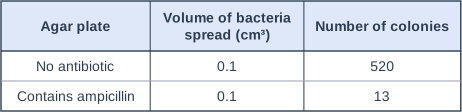
The scientists spread the same volume of the bacteria onto two agar plates: one with no antibiotic and one containing ampicillin. Each colony grows from a single bacterium. The table shows the results.

Calculate the percentage of the bacteria that took up a plasmid.

Explain why only bacteria that took up a plasmid formed colonies on the plate containing ampicillin.

Table with columns "Agar plate", "Volume of bacteria spread (cm³)", "Number of colonies". Agar plate: No antibiotic; Volume of bacteria spread (cm³): 0.1; Number of colonies: 520 | Agar plate: Contains ampicillin; Volume of bacteria spread (cm³): 0.1; Number of colonies: 13.

Model answer

Percentage = 13 ÷ 520 × 100 = 2.5%

The plasmid carries the gene for resistance to ampicillin. On the ampicillin plate, bacteria without a plasmid are killed or cannot grow, so only bacteria that took up a plasmid survive and divide to form colonies.

Explanation

The plate without antibiotic shows how many bacteria were spread, and the ampicillin plate shows how many had a plasmid, so divide 13 by 520. The antibiotic resistance gene is a marker: it lets scientists select the few bacteria that have taken up the plasmid. Bacteria are not 'immune'; immunity is a property of animals.

Mark scheme
  1. 1 mark

    13 ÷ 520 × 100; or a correct final answer of 2.5% with no working

    An answer of 2.5% with no working scores marking points 1 and 2. ALLOW marking point 1 only for 13 ÷ 520 = 0.025 or '1 in 40' that is not converted to a percentage. 13 ÷ (520 + 13) × 100 = 2.4% is a wrong method (the two plates are separate samples of the same culture) and scores 0 for marking points 1 and 2.

  2. 1 mark

    evaluation: 2.5 (%)

    IGNORE units unless the question asks for them.

  3. 1 mark

    the plasmid carries the gene for ampicillin resistance (the marker), so only bacteria with a plasmid survive and divide; bacteria without a plasmid are killed / cannot grow

    ALLOW antibiotic resistance marker. DO NOT ALLOW the bacteria become immune to ampicillin.

Question 4

4 marks

Aphids are insects that damage wheat. When an aphid is attacked, it releases a chemical called an alarm pheromone, which makes other aphids move away.

Scientists at Rothamsted Research genetically engineered wheat plants to make this alarm pheromone. They hoped that farmers could then spray less insecticide.

- In laboratory tests, aphids moved away from the GM wheat.
- In a field trial in 2012, the numbers of aphids on the GM wheat and on non-GM wheat were not significantly different (Bruce and others, 2015).

Evaluate the claim that growing this GM wheat would let farmers use less insecticide.

Model answer

The laboratory tests support the claim: aphids moved away from the GM wheat, so if this happened on farms fewer aphids would damage the crop and less insecticide would be needed.

However, the field trial does not support it: there was no significant difference in aphid numbers between the GM and non-GM wheat, so farmers would still have to spray. The field result could differ because the wind carries the chemical away, and because the plants release it all the time, so the aphids may stop responding to it.

The field trial is closer to real farming, so I conclude that the claim is not supported at present; more field trials in different years and places would be needed.

Explanation

Evaluate by giving the evidence for and against, explaining why laboratory and field results may differ, and reaching a conclusion that follows from the evidence. This example also counters a common misconception: genetic engineering does not always increase pesticide use, and some GM crops are designed to reduce it, but each claim must be tested in the field.

Mark scheme
  1. 1 mark

    (supports) in the laboratory aphids moved away from the GM wheat, so fewer aphids would damage the crop and less insecticide would be needed

    Max 3 if the answer gives only one side (only evidence for the claim or only evidence against it).

  2. 1 mark

    (does not support) in the field trial there was no significant difference in aphid numbers, so farmers would still need to spray the same amount of insecticide

    ALLOW the field trial is more like real farming, so it is better evidence.

  3. 1 mark

    a reason why the field result could differ from the laboratory, for example: in the field the wind carries the chemical away / dilutes it; the plants release the chemical all the time, so aphids may get used to it / stop responding; field conditions (weather, other insects) cannot be controlled

    1 mark for any one reason, max 1.

  4. 1 mark

    conclusion: the claim is not supported at present / more field trials (in different years and places) are needed before it can be accepted

    The conclusion must follow from the evidence. ALLOW the claim may be true for other GM crops, but not for this wheat yet.

Ready to try the rest? Every answer you write is marked against the mark scheme, so you can see exactly where the marks are.

Study Helper Hints first, answers after you try

Stuck on this one? Ask for a hint and I’ll point you in the right direction, without giving the answer away. Once you’ve checked your answer, I’ll show you how the marks are awarded.