
Level:
Correct: 0
Incorrect: 0
Marks: 0/0
Exam Practice
Course:
Topics:
OCR GCSE Biology (Paper 4) Smart practice A mixed round aimed at your weak spots
Avg
score:
–
Topics
done:
0/29

Levels of organisation, abiotic and biotic factors

Practise 16 exam-style questions on Levels of organisation, abiotic and biotic factors for OCR GCSE Biology (Paper 4). Write your answer as you would in the exam and get it marked in seconds against the mark scheme, point by point, with the Study Helper on hand if you get stuck.

  • 16 questions
  • 1–6 marks each
  • Instant marking
  • No sign-up needed
16 questions, marked as you go

Sample questions with model answers

Here are 4 of the questions in this topic, each with a model answer, an explanation of why it earns the marks and the mark scheme an examiner would use.

Question 1

1 mark

Woodlice are small animals whose body temperature is the same as the temperature of their surroundings. On cold nights, woodlice move and feed much more slowly than on warm nights.

Which statement explains why?

Choose your answer.

  • A Enzymes and substrate molecules have less kinetic energy, so they collide less often.
  • B Enzymes in their cells are denatured by the cold.
  • C The active sites of their enzymes change shape in the cold.
  • D There is less oxygen in cold air, so their cells cannot respire.

Model answer

A

Explanation

Temperature is an abiotic factor that affects animals such as woodlice because the rate of every enzyme-controlled reaction in their cells depends on it. In the cold, molecules have less kinetic energy and collide less often, so respiration and other reactions slow down and the animals become sluggish. A common error is to say that cold denatures enzymes: denaturing is caused by high temperatures (or extreme pH) and changes the shape of the active site.

Mark scheme
  1. 1 mark

    A / Enzymes and substrate molecules have less kinetic energy, so they collide less often.

    The only correct answer is A: at a low temperature the enzyme and substrate molecules move more slowly, so there are fewer successful collisions and the enzyme-controlled reactions (such as respiration) in the woodlice's cells are slower. B is not correct because low temperatures do not denature enzymes; the enzymes work faster again when warmed; C is not correct because the shape of the active site changes (denaturing) at high temperatures, not low ones; D is not correct because cold air contains plenty of oxygen, and the cells still respire, only more slowly. ALLOW the letter or the option. If more than one option is given, do not award the mark.
Question 2

2 marks

A student measured the pH of soil samples from two sites in a wood using universal indicator and a colour chart. Both sites gave a result of pH 6.

Her teacher then tested the same samples with a pH probe. The probe gave pH 5.6 for one site and pH 6.4 for the other.

Explain why the pH probe gives more useful results for comparing the two sites.

Model answer

Universal indicator is matched against a colour chart that only shows whole pH numbers, so it has a low resolution and both samples looked the same (pH 6). The pH probe has a resolution of 0.1 of a pH unit and does not depend on judging a colour, so it showed a real difference of 0.8 between the two sites, which could affect which plants grow there.

Explanation

Resolution is the smallest change an instrument can show. A colour chart in whole pH units cannot separate values such as 5.6 and 6.4, but a pH probe reading to 0.1 can. Answers that just say 'the probe is more accurate' need to explain why: the higher resolution and the removal of colour judgement.

Mark scheme
  1. 1 mark

    the colour chart only shows whole pH numbers / universal indicator has a low resolution, so it could not show the difference between the two sites

    ALLOW universal indicator cannot measure to 0.1 of a pH unit. ALLOW both samples fell within the same colour band.

  2. 1 mark

    the pH probe has a higher resolution (0.1 pH unit) / does not depend on judging a colour (so is less subjective)

    ALLOW the probe gives a more precise reading / a reading to one decimal place. ALLOW matching colours depends on the person (human error). IGNORE the probe is more accurate on its own unless explained.

Question 3

3 marks

Pygmy shrews are small mammals that eat insects, spiders and woodlice. A pygmy shrew keeps its body temperature at about 38 °C all year round, and it does not hibernate. It must eat about every two hours, day and night.

In very cold winters, the number of pygmy shrews falls sharply.

Explain why a pygmy shrew needs more food in cold weather, and why many pygmy shrews die in very cold winters.

Model answer

A pygmy shrew keeps its body temperature constant at about 38 °C so that its enzymes and metabolic reactions work at a suitable rate. Respiration is exothermic, so it releases energy as heat. In cold weather the shrew loses heat to its surroundings faster, so it must respire faster to stay warm, and respiration uses glucose from its food, so it needs more food.
In very cold winters there are fewer active insects, spiders and woodlice, so many shrews cannot find enough food. They starve or cannot keep their body temperature up, so many die.

Explanation

This question links an abiotic factor (temperature) and a biotic factor (food supply) to ideas from Paper 7: maintaining a constant internal environment (B3.3a) and respiration as an exothermic reaction (B1.3b). The key chain is cold, faster heat loss, more respiration, more food needed. Do not say that respiration 'makes' energy: it releases energy.

Mark scheme
  1. 1 mark

    the shrew keeps its body temperature constant so that its enzymes / metabolic reactions work at a suitable rate

    Max 3. 1 mark for each point. ALLOW it maintains a constant internal environment so that its cells / enzymes work properly.

  2. 1 mark

    respiration is exothermic / releases energy as heat, so in cold weather the shrew must respire faster to replace the heat it loses (faster) to its surroundings

    The idea of respiring more / faster is needed. ALLOW, as the reason for the fast heat loss, it is small, so it has a large surface area : volume ratio. DO NOT ALLOW respiration makes / produces energy.

  3. 1 mark

    respiration uses glucose (from its food), so more respiration needs more food

    ALLOW more food is needed as the substrate / fuel for respiration.

  4. 1 mark

    in very cold winters there are fewer (active) insects, spiders and woodlice for the shrews to eat, so they cannot get enough food and starve / cannot keep warm

    ALLOW the shrews' body temperature falls, so their enzymes work too slowly and they die.

Question 4

5 marks

In some woods, hazel trees are coppiced: every few years they are cut down to near ground level, and new stems then grow from the stumps.

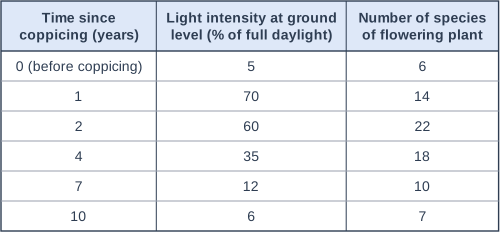
An ecologist measured the light intensity at ground level and counted the species of flowering plant in one area of a hazel wood, before coppicing and for 10 years afterwards.

The table shows the results.

Calculate the percentage increase in the number of species of flowering plant from before coppicing to 2 years after coppicing. Give your answer to 3 significant figures.

Explain the changes in the number of species of flowering plant over the 10 years.

Table with columns "Time since coppicing (years)", "Light intensity at ground level (% of full daylight)", "Number of species of flowering plant". Time since coppicing (years): 0 (before coppicing); Light intensity at ground level (% of full daylight): 5; Number of species of flowering plant: 6 | Time since coppicing (years): 1; Light intensity at ground level (% of full daylight): 70; Number of species of flowering plant: 14 | Time since coppicing (years): 2; Light intensity at ground level (% of full daylight): 60; Number of species of flowering plant: 22 | Time since coppicing (years): 4; Light intensity at ground level (% of full daylight): 35; Number of species of flowering plant: 18 | Time since coppicing (years): 7; Light intensity at ground level (% of full daylight): 12; Number of species of flowering plant: 10 | Time since coppicing (years): 10; Light intensity at ground level (% of full daylight): 6; Number of species of flowering plant: 7.

Model answer

Percentage increase = (22 − 6) ÷ 6 × 100 = 266.7% = 267% (to 3 significant figures)
Before coppicing, the hazel shaded the ground, so only 5% of full daylight reached it. Cutting the hazel removed this shade, so the light intensity at ground level rose to 70%. Light had been limiting photosynthesis, so the ground plants could now photosynthesise faster and make more glucose, and more species could grow and flower: the number of species rose from 6 to 22 in two years. As the hazel grew back, its leaves shaded the ground again, so the light intensity fell to 6% by year 10. Light limited photosynthesis again, so many species could not make enough glucose to grow and flower, and the number fell back to 7. Taller plants growing in the first few years may also have out-competed smaller species for light.

Explanation

Percentage increase = increase ÷ starting value × 100, so divide by 6, not by 22. To explain the trend, link each change in light intensity to the rate of photosynthesis: more light means more glucose for growth and flowering, and less light limits it again. The best answers describe both the rise and the fall and use the light data to support them.

Mark scheme
  1. 1 mark

    (22 − 6) ÷ 6 × 100 / 16 ÷ 6 × 100; or a correct final answer of 267% with no working

    Max 5. Max 3 for marking points 3 to 6. An answer of 267% with no working scores marking points 1 and 2. ALLOW 266.7 or 266.67 for MP1 only (not given to 3 significant figures). ALLOW 1 mark (marking point 2) for 367 (22 ÷ 6 × 100) or 72.7 ((22 − 6) ÷ 22 × 100).

  2. 1 mark

    267 (%)

    The answer must be given to 3 significant figures for this mark. ALLOW this mark for an incorrect value that has been correctly rounded to 3 significant figures (for example 367 or 72.7).

  3. 1 mark

    coppicing removes the shade of the hazel, so the light intensity at ground level increases

    ALLOW the canopy is removed so more light reaches the ground.

  4. 1 mark

    light was limiting (the rate of) photosynthesis, so with more light the ground plants photosynthesise faster / make more glucose, so more species can grow and flower (and seeds in the soil germinate)

    The idea of photosynthesis is needed for this mark.

  5. 1 mark

    as the hazel grows back, it shades the ground again, so the light intensity falls and photosynthesis is limited again, so fewer species survive / flower

    ALLOW plants cannot make enough glucose (for growth / respiration) in low light.

  6. 1 mark

    after the first few years, taller plants (such as brambles) shade / out-compete the smaller species

    ALLOW competition for light between the ground plants reduces the number of species.

Ready to try the rest? Every answer you write is marked against the mark scheme, so you can see exactly where the marks are.

Study Helper Hints first, answers after you try

Stuck on this one? Ask for a hint and I’ll point you in the right direction, without giving the answer away. Once you’ve checked your answer, I’ll show you how the marks are awarded.