
Level:
Correct: 0
Incorrect: 0
Marks: 0/0
Exam Practice
Course:
Topics:
OCR GCSE Biology (Paper 4) Smart practice A mixed round aimed at your weak spots
Avg
score:
–
Topics
done:
0/29

Factors affecting the rate of decomposition

Practise 12 exam-style questions on Factors affecting the rate of decomposition for OCR GCSE Biology (Paper 4). Write your answer as you would in the exam and get it marked in seconds against the mark scheme, point by point, with the Study Helper on hand if you get stuck.

  • 12 questions
  • 1–5 marks each
  • Instant marking
  • No sign-up needed
12 questions, marked as you go

Sample questions with model answers

Here are 4 of the questions in this topic, each with a model answer, an explanation of why it earns the marks and the mark scheme an examiner would use.

Question 1

1 mark

More dead leaves fall each year onto the floor of a tropical rainforest than onto the floor of an oak wood in the UK. However, the layer of dead leaves on the rainforest floor is much thinner.

Which statement explains why?

Choose your answer.

  • A Heavy rain washes most of the fallen leaves into rivers before they can build up.
  • B Rainforest leaves contain no cellulose, so they are digested much more easily than oak leaves.
  • C The high temperature denatures the decomposers' enzymes, so the leaves break down faster.
  • D The warm, moist conditions let decomposers grow and digest leaves soon after they fall.

Model answer

D

Explanation

The thickness of the leaf layer depends on how fast leaves fall and how fast they decompose. In a rainforest the temperature and the water content of the litter are high all year, so decomposers grow fast and their enzymes digest the leaves quickly. Option C confuses a faster rate with denaturing: a denatured enzyme no longer works, so decomposition would slow down.

Mark scheme
  1. 1 mark

    D / The warm, moist conditions let decomposers grow and digest leaves soon after they fall.

    The only correct answer is D: in a tropical rainforest it is warm and wet all year, so the decomposers' enzymes work quickly and the decomposers grow and reproduce quickly; fallen leaves are broken down within a few months, so a thick layer cannot build up. A is not correct because the leaves are not washed away: the litter layer is thin because it is decomposed quickly; B is not correct because the cell walls of all plant leaves contain cellulose; C is not correct because denatured enzymes cannot work, so denaturing would slow decomposition, and rainforest temperatures are not high enough to denature the decomposers' enzymes. ALLOW the letter or the option. If more than one option is given, do not award the mark.
Question 2

2 marks

On some hill farms in Wales the soil is very acidic, with a pH of about 4.5. Dead grass and leaves decompose slowly there, so a thick mat of dead plant material builds up on the surface of the soil.

A farmer spread powdered limestone over one field. Limestone neutralises acids, so the soil pH rose to about 6.5. Over the next three years the mat of dead plant material in this field became much thinner.

Explain why the dead plant material decomposed faster after the limestone was spread.

Model answer

At pH 4.5 the soil is much more acidic than the optimum pH for the enzymes of most decomposers, so the active sites of their enzymes change shape and the enzymes work very slowly. Few bacteria and fungi can grow there, so the dead grass is digested slowly. The limestone raised the pH to 6.5, closer to the optimum, so the decomposers' enzymes worked faster and more decomposers could grow and reproduce. More earthworms could also live in the soil and break the dead material into smaller pieces, so it decomposed faster.

Explanation

pH is one of the factors that affects the rate of decomposition, because decomposers digest dead material with enzymes and each enzyme works fastest at its optimum pH: a pH far from the optimum changes the shape of the active site. The limestone moved the soil pH towards the optimum for most soil decomposers, so decomposition speeded up. Link the pH to the decomposers or their enzymes; 'the acid is bad for them' does not score.

Mark scheme
  1. 1 mark

    pH 6.5 is closer to the optimum pH of the decomposers' enzymes (than pH 4.5 is)

    1 mark for each of these four points, max 2. ALLOW ORA (allow the reverse argument) for marking points 1, 2 and 3: an answer about the acidic soil before the limestone was spread, for example 'at pH 4.5 the soil is far more acidic than the optimum pH of the decomposers' enzymes'. ALLOW pH 6.5 is (closer to) the optimum pH for the decomposers for marking point 1. IGNORE 'the acid kills the decomposers' or 'acid is bad for them' with no reference to their enzymes, growth or numbers. IGNORE the limestone provides minerals / calcium for the decomposers.

  2. 1 mark

    so the decomposers' enzymes work faster / more enzyme-substrate complexes form / the active sites are no longer changed in shape (denatured), so the dead material is digested faster

    ALLOW at pH 4.5 the active sites change shape / the enzymes are denatured / work very slowly, so the dead material is digested slowly.

  3. 1 mark

    more decomposers (bacteria and fungi) can grow and reproduce in the less acidic soil

    ALLOW few decomposers can grow / live in the very acidic soil.

  4. 1 mark

    more earthworms (and other soil animals) can live in the less acidic soil; they feed on the dead material and break it into smaller pieces / pull it into the soil, giving a larger surface area for the microorganisms

    ALLOW detritivores for soil animals.

Question 3

3 marks

Farmers make hay by cutting grass, leaving it to dry in the field for a few days and then pressing it into large, tightly packed bales. Hay that contains less than about 20% water can be stored for more than a year.

If hay is baled while it is still damp, fungi and bacteria grow in it and decompose it. The energy released by their respiration warms the hay, and heat escapes only slowly from the middle of the bale.

A farmer measured the temperature in the middle of a damp bale. It was 18 °C when the hay was baled. It rose by 4 °C on the first day, by 9 °C on the second day and by 15 °C on the third day. On the fifth day it reached about 60 °C, and then it stopped rising.

Explain why the temperature rose faster each day at first, and why it stopped rising at about 60 °C. Use ideas about enzymes in your answer.

Model answer

As the hay warms up, the decomposers' enzymes and their substrate molecules gain kinetic energy and collide more often, so more enzyme-substrate complexes form and the fungi and bacteria digest the hay and respire faster. They also grow and reproduce faster. The faster respiration releases more heat each day, and this heat escapes only slowly, so the temperature rises faster still: the rise was 4 °C, then 9 °C, then 15 °C a day. At about 60 °C the temperature is above the optimum for most of the decomposers' enzymes, so the enzymes are denatured: their active sites change shape. Respiration slows down and many of the decomposers die, so heat is no longer released faster than it escapes, and the temperature stops rising.

Explanation

The heating feeds itself: a warmer bale makes the decomposers' enzymes work faster, so respiration releases heat faster and the bale warms even faster. Above the optimum temperature the enzymes are denatured, so respiration slows and the temperature stops rising. Say that respiration releases energy (it does not make energy), and do not use denaturing to explain the faster rise.

Mark scheme
  1. 1 mark

    as the hay warms up, the decomposers' enzymes and substrate molecules gain kinetic energy and collide more often / more enzyme-substrate complexes form, so the fungi and bacteria digest the hay and respire faster

    ALLOW the enzymes work faster as the temperature rises towards their optimum. DO NOT ALLOW the enzymes are denatured as the reason for the faster rise. IGNORE 'the hay is damp' on its own.

  2. 1 mark

    the faster respiration (by more and more fungi and bacteria, which grow and reproduce faster in the warmer hay) releases more heat each day, so the temperature rises faster still / the heating speeds itself up

    The idea that faster respiration releases more heat, which raises the temperature further, is needed. A statement only that respiration releases heat / warms the hay repeats the question and scores 0. DO NOT ALLOW respiration produces / makes energy.

  3. 1 mark

    at about 60 °C the temperature is above the optimum for most of the decomposers' enzymes, so the enzymes are denatured / their active sites change shape / most of the decomposers are killed, so respiration slows down and heat is no longer released faster than it escapes (so the temperature stops rising)

    Both parts are needed: the enzymes denatured (or the decomposers killed) linked to slower respiration / less heat released. ALLOW the enzymes are past their optimum temperature, so they work more slowly. IGNORE 'the hay has all been used up' (only a small part of the hay decomposes in five days).

Question 4

4 marks

In a project to compare decomposition in different soils, people buried tea bags and dug them up 90 days later. Each bag contained 2.00 g of dried green tea. The bags are made of a fine nylon mesh that lets microorganisms in but does not decompose itself. After 90 days the tea was dried again and weighed.

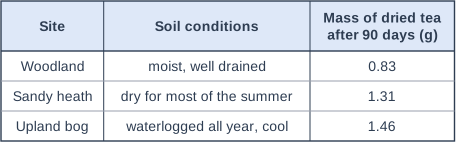
The table shows the results from three sites.

Calculate the mean rate of decomposition of the tea at the woodland site in mg per day.

A student concluded that the tea at the upland bog decomposed more slowly than the tea at the woodland site because the bog soil is waterlogged.

Suggest two reasons why these results alone are not enough to support her conclusion.

Table with columns "Site", "Soil conditions", "Mass of dried tea after 90 days (g)". Site: Woodland; Soil conditions: moist, well drained; Mass of dried tea after 90 days (g): 0.83 | Site: Sandy heath; Soil conditions: dry for most of the summer; Mass of dried tea after 90 days (g): 1.31 | Site: Upland bog; Soil conditions: waterlogged all year, cool; Mass of dried tea after 90 days (g): 1.46.

Model answer

Mass lost = 2.00 − 0.83 = 1.17 g = 1170 mg
Rate = 1170 ÷ 90 = 13 mg per day
The upland bog is also cool, so its lower temperature could have slowed decomposition. Because the bog differs from the woodland in temperature as well as in water content, the results cannot show which of these factors caused the slower decomposition. Also, the table gives only one result from one site of each type, so the difference may not be repeatable or typical of other bogs and woodlands.

Explanation

The rate of decomposition is the mass lost divided by the time, so first subtract the final mass from 2.00 g, then convert grams to milligrams. Using the mass remaining (0.83 g) is a common error. To show that waterlogging is the cause, it must be the only factor that differs between the sites and the result must be repeated at more sites: here the bog is both waterlogged and cool, and there is only one result for each type of site.

Mark scheme
  1. 1 mark

    mass lost = 2.00 − 0.83 = 1.17 g (1170 mg) and 1170 ÷ 90; or a correct final answer of 13 mg per day with no working

    An answer of 13 mg per day with no working scores marking points 1 and 2. ALLOW 1 mark for 0.013 (correct method, but left in g per day). 9.2 mg per day (0.83 ÷ 90: the mass remaining used, not the mass lost) scores 0. Marking points 3, 4 and 5: max 2.

  2. 1 mark

    13 (mg per day)

    ALLOW 13.0.

  3. 1 mark

    the upland bog is also cool / colder than the woodland, so the lower temperature could have slowed decomposition (the decomposers' enzymes work more slowly) / two factors (water content and temperature) differ between the sites, so their effects cannot be separated

    1 mark for each of marking points 3, 4 and 5, max 2. ALLOW 'it is not a fair comparison because the temperature is also different'. IGNORE answers that only explain how waterlogging slows decomposition (for example by reducing oxygen): this is not a problem with the evidence. DO NOT ALLOW the enzymes are denatured by the cold.

  4. 1 mark

    other conditions that were not recorded may differ between the sites and affect decomposition, such as the soil pH (bog soils are acidic) or the types / numbers of decomposers (and soil animals) in the soil

    A named condition other than water content and temperature is needed. ALLOW the plants growing at each site / the altitude. ALLOW the sandy heath is not waterlogged but its tea also decomposed slowly (1.31 g left), so factors other than waterlogging can slow decomposition. IGNORE 'other variables' with no example.

  5. 1 mark

    only one site of each type was tested / the table gives only one result for each site (no repeats), so the difference may not be repeatable / may not be typical of other bogs and woodlands

    ALLOW more bogs and woodlands should be tested / more tea bags should be buried at each site. IGNORE 'not enough results' with no explanation.

Ready to try the rest? Every answer you write is marked against the mark scheme, so you can see exactly where the marks are.

Study Helper Hints first, answers after you try

Stuck on this one? Ask for a hint and I’ll point you in the right direction, without giving the answer away. Once you’ve checked your answer, I’ll show you how the marks are awarded.