
Level:
Correct: 0
Incorrect: 0
Marks: 0/0
Exam Practice
Course:
Topics:
Edexcel GCSE Chemistry (Paper 1) Smart practice A mixed round aimed at your weak spots
Unit 1
Key concepts in chemistry
Unit 2
States of matter and mixtures
Unit 3
Chemical changes
Unit 4
Extracting metals and equilibria
Unit 5
Separate chemistry 1
Avg
score:
–
Topics
done:
0/33

Transition metals, alloys and corrosion

Practise 20 exam-style questions on Transition metals, alloys and corrosion for Edexcel GCSE Chemistry (Paper 1). Write your answer as you would in the exam and get it marked in seconds against the mark scheme, point by point, with the Study Helper on hand if you get stuck.

  • 20 questions
  • 1–6 marks each
  • Instant marking
  • No sign-up needed
20 questions, marked as you go

Sample questions with model answers

Here are 4 of the questions in this topic, each with a model answer, an explanation of why it earns the marks and the mark scheme an examiner would use.

Question 1

1 mark

The electrical connectors in many mobile phones are coated with a thin layer of gold.

Which two properties of gold make it suitable for this use?

Choose your answer.

  • A high density and soft
  • B shiny and high melting point
  • C rare and forms coloured compounds
  • D good conductor and does not corrode

Model answer

D - good conductor and does not corrode.

Explanation

Gold is a good conductor of electricity and is very unreactive, so it does not corrode and a gold-coated connector keeps making good electrical contact. Gold is expensive, so the connectors are only coated with a thin layer of it. The other options are properties of gold or of transition metals, but they are not why gold is used here.

Mark scheme
  1. 1 mark

    D / good conductor and does not corrode (1)

    The only correct answer is D: a connector must conduct electricity well, and gold is so unreactive that it does not corrode (is not oxidised), so the electrical contact stays good for many years. A is not correct because a high density does not help a connector and softness is a disadvantage (the connector wears); B is not correct because a shiny appearance does not matter inside a phone, and a high melting point is not needed at the temperatures inside a phone; C is not correct because being rare makes gold expensive (the reason only a thin layer is used), and the colour of gold compounds has nothing to do with a metal connector. Accept the letter or the option. If more than one option is given, do not award the mark.
Question 2

2 marks

Brass is an alloy of copper and zinc. It is used to make door handles, hinges and locks.

Suggest two properties of brass that make it suitable for these uses.

Model answer

Brass does not rust and is resistant to corrosion, so handles and hinges stay in good condition in damp air. It is also hard and strong, so it does not bend or wear away when the handles and locks are used many times.

Explanation

Brass combines copper's resistance to corrosion with greater hardness and strength, because the zinc atoms disrupt the layers of copper atoms. It also has an attractive gold colour. Properties such as electrical conductivity are true of brass but are not why it is used for door fittings.

Mark scheme
  1. 1 mark

    does not rust / is resistant to corrosion (1)

    Any two from the four points; max 2. accept 'does not corrode easily' / 'unreactive'. ignore 'conducts electricity', 'conducts heat', 'high melting point', 'high density' (not relevant to these uses).

  2. 1 mark

    hard / strong (harder than pure copper), so it does not bend / wear away easily (1)

    accept 'durable / hard-wearing'.

  3. 1 mark

    attractive (gold) colour / shiny appearance (1)

    accept 'looks good / decorative'.

  4. 1 mark

    easily shaped / cast / cut into shape (1)

    accept 'malleable'.

Question 3

3 marks

Heated towel rails for bathrooms are often made of steel that has been electroplated with a thin layer of chromium. Chromium is a hard, shiny metal that resists corrosion, but it costs much more than steel.

Explain why the towel rails are made of chromium-plated steel rather than unplated steel or pure chromium.

Model answer

Steel rusts when it is in contact with water and oxygen, and the air in a bathroom is damp, so an unplated steel rail would soon rust. The chromium layer covers the steel and acts as a barrier, so water and oxygen cannot reach the steel and it does not rust. The chromium also makes the rail shiny and attractive, and it stays shiny because chromium resists corrosion. Pure chromium costs much more than steel, but electroplating uses only a thin layer of chromium, so the rail is much cheaper than one made of pure chromium.

Explanation

Electroplating coats an object with a thin layer of another metal to improve its appearance and/or its resistance to corrosion. Here the chromium layer keeps water and oxygen away from the steel, so the steel cannot rust, and gives a shiny finish, while the cheap steel underneath means that only a little of the expensive chromium is needed. Good answers compare the rail with both alternatives; a common error is to say only that chromium 'protects' the steel without saying how.

Mark scheme
  1. 1 mark

    unplated steel would rust (in the damp bathroom air / because water and oxygen reach it) (1)

    Any three from the four points; max 3. Max 2 if the answer does not refer to both unplated steel and pure chromium. accept 'corrode' for 'rust'. accept 'steel rusts when it is in contact with water and oxygen'.

  2. 1 mark

    the chromium layer covers the steel / acts as a barrier, so water and oxygen cannot reach the steel (and it does not rust) (1)

    accept 'the chromium keeps air and moisture away from the steel'. ignore 'the chromium protects the steel' with no idea of a barrier or of keeping water / oxygen away.

  3. 1 mark

    the chromium makes the rail shiny / attractive / improves its appearance (1)

    accept 'it stays shiny because chromium resists corrosion' / 'it looks better'.

  4. 1 mark

    only a thin layer of chromium is used, so the rail is (much) cheaper than one made of pure chromium (1)

    accept 'it is cheaper than pure chromium' / 'less of the expensive chromium is needed'.

Question 4

4 marks

Overhead power cables carry electricity across the country. Most are made mainly of aluminium, even though copper is a better electrical conductor.

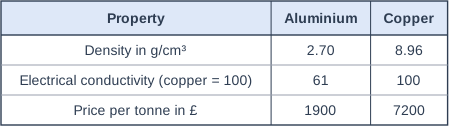
The table shows some information about aluminium and copper. The prices are approximate 2024 values.

Use the information in the table to explain why aluminium is used rather than copper for overhead power cables.

Table with columns "Property", "Aluminium", "Copper". Property: Density in g/cm³; Aluminium: 2.70; Copper: 8.96 | Property: Electrical conductivity (copper = 100); Aluminium: 61; Copper: 100 | Property: Price per tonne in £; Aluminium: 1900; Copper: 7200.

Model answer

Aluminium has a density of 2.70 g/cm³, about a third of the density of copper (8.96 g/cm³), so an aluminium cable is much lighter than a copper cable of the same size. This means the pylons have less weight to support and can be further apart. Aluminium is also much cheaper: about £1900 per tonne compared with £7200 per tonne for copper. Aluminium only conducts about 61% as well as copper, so the aluminium cable must be thicker to carry the same current, but even a thicker aluminium cable is lighter and much cheaper than a copper cable that conducts equally well.

Explanation

The best answers use the data to compare the metals: aluminium's density is about one third of copper's and its price per tonne is about a quarter. Its lower conductivity means a thicker cable is needed (about 1.6 times the cross-section), but that cable still has only about half the mass of an equivalent copper cable. Answers that just say 'aluminium is light and cheap' without comparing values do not use the information.

Mark scheme
  1. 1 mark

    aluminium is less dense (about one third of the density of copper), so an aluminium cable of the same size is lighter (1)

    Any four from the five points; max 4. Max 3 if no data from the table are used (e.g. 2.70 and 8.96 g/cm³, 61, £1900 and £7200, 'about a third', 'about a quarter'). ignore 'aluminium is light' with no comparison.

  2. 1 mark

    (so) the pylons / towers have less weight to support / can be further apart / fewer pylons are needed (1)

    accept 'the cables are less likely to sag or break under their own weight'.

  3. 1 mark

    aluminium is cheaper (per tonne) / costs about a quarter of the price of copper (1)

    accept '£1900 compared with £7200 per tonne'.

  4. 1 mark

    aluminium is a poorer conductor (61% of copper), so an aluminium cable must be thicker to carry the same current (1)

    accept 'needs a larger cross-section / more aluminium to conduct as well as copper'.

  5. 1 mark

    even when it is thicker, an aluminium cable is still lighter / cheaper than a copper cable that conducts equally well (1)

    accept 'it has about half the mass of a copper cable that conducts as well'. This point needs the idea that the aluminium cable is thicker or conducts as well.

Ready to try the rest? Every answer you write is marked against the mark scheme, so you can see exactly where the marks are.

Study Helper Hints first, answers after you try

Stuck on this one? Ask for a hint and I’ll point you in the right direction, without giving the answer away. Once you’ve checked your answer, I’ll show you how the marks are awarded.