
Level:
Correct: 0
Incorrect: 0
Marks: 0/0
Exam Practice
Course:
Topics:
Edexcel GCSE Chemistry (Paper 1) Smart practice A mixed round aimed at your weak spots
Unit 1
Key concepts in chemistry
Unit 2
States of matter and mixtures
Unit 3
Chemical changes
Unit 4
Extracting metals and equilibria
Unit 5
Separate chemistry 1
Avg
score:
–
Topics
done:
0/33

Molar volume of gases and Avogadro's law

Practise 15 exam-style questions on Molar volume of gases and Avogadro's law for Edexcel GCSE Chemistry (Paper 1). Write your answer as you would in the exam and get it marked in seconds against the mark scheme, point by point, with the Study Helper on hand if you get stuck.

  • 15 questions
  • 1–6 marks each
  • Instant marking
  • No sign-up needed
15 questions, marked as you go

Sample questions with model answers

Here are 4 of the questions in this topic, each with a model answer, an explanation of why it earns the marks and the mark scheme an examiner would use.

Question 1

1 mark

How many molecules are there in 12 dm³ of nitrogen gas, N₂, at room temperature and pressure?

(Avogadro constant = 6.02 × 10²³ mol⁻¹; molar volume of any gas at room temperature and pressure = 24 dm³)

Choose your answer.

  • A 3.01 × 10²³
  • B 6.02 × 10²³
  • C 1.204 × 10²⁴
  • D 7.22 × 10²⁴

Model answer

A

moles of N₂ = 12 ÷ 24 = 0.50 mol
number of molecules = 0.50 × 6.02 × 10²³ = 3.01 × 10²³

Explanation

First change the volume into moles using the molar volume, then multiply by the Avogadro constant to get the number of molecules. The question asks for molecules, not atoms, so there is no factor of 2. Dividing the wrong way round or treating dm³ as moles gives the other options.

Mark scheme
  1. 1 mark

    A / 3.01 × 10²³ (1)

    The only correct answer is A: moles of N₂ = 12 ÷ 24 = 0.50 mol, so number of molecules = 0.50 × 6.02 × 10²³ = 3.01 × 10²³. B is not correct because it is the number of nitrogen atoms (each N₂ molecule has two atoms), not molecules. C is not correct because it divides 24 by 12 (2 mol) instead of 12 by 24. D is not correct because it multiplies the volume in dm³ by the Avogadro constant, as if 12 dm³ were 12 mol. Accept the letter or the option. If more than one option is given, do not award the mark.
Question 2

2 marks

Natural gas from some gas fields contains ethane, C₂H₆, as well as methane. Ethane burns completely in oxygen.

2C₂H₆(g) + 7O₂(g) → 4CO₂(g) + 6H₂O(l)

All volumes are measured at room temperature and pressure.

Calculate the volume of oxygen needed to burn 60 cm³ of ethane completely, and the volume of carbon dioxide formed.

Model answer

From the equation, 2 volumes of ethane react with 7 volumes of oxygen and form 4 volumes of carbon dioxide.
Volume of oxygen = 60 × 7 ÷ 2 = 210 cm³
Volume of carbon dioxide = 60 × 4 ÷ 2 = 120 cm³

Explanation

By Avogadro's law, the volumes of gases in a reaction are in the same ratio as the moles in the balanced equation, so there is no need to change into moles. Ethane : oxygen : carbon dioxide = 2 : 7 : 4, so each volume is the ethane volume × 7 ÷ 2 or × 4 ÷ 2. The common errors are multiplying by 7 or 4 without dividing by 2, and counting the water, which is a liquid at room temperature, as a gas.

Mark scheme
  1. 1 mark

    (oxygen = 60 × 7 ÷ 2 =) 210 (cm³) (1)

    An answer of 210 cm³ for oxygen with no working scores 1 mark, and an answer of 120 cm³ for carbon dioxide with no working scores 1 mark. The two answers must be clearly identified (oxygen first, as asked, if not labelled). Accept a method that changes the volumes into moles with the molar volume. Do not accept 420 cm³ (multiplied by 7 without dividing by 2) or 17 cm³ (the ratio used the wrong way round, 60 × 2 ÷ 7).

  2. 1 mark

    (carbon dioxide = 60 × 4 ÷ 2 =) 120 (cm³) (1)

    do not accept 240 cm³ (multiplied by 4 without dividing by 2) or 180 cm³ (that would be water vapour, but the water is a liquid)

Question 3

3 marks

A student adds an excess of zinc granules to 50.0 cm³ of hydrochloric acid with a concentration of 1.00 mol dm⁻³. All of the acid reacts.

Zn(s) + 2HCl(aq) → ZnCl₂(aq) + H₂(g)

(molar volume of any gas at room temperature and pressure = 24 dm³)

Calculate the volume of hydrogen, in cm³, that forms at room temperature and pressure.

Model answer

Moles of HCl = 1.00 × (50.0 ÷ 1000) = 0.0500 mol
The zinc is in excess, so the acid decides how much hydrogen forms.
From the equation, 2 mol of HCl give 1 mol of H₂, so moles of H₂ = 0.0500 ÷ 2 = 0.0250 mol
Volume of H₂ = 0.0250 × 24 = 0.600 dm³ = 600 cm³

Explanation

The acid is the limiting reactant, so its moles (concentration × volume in dm³) control the volume of hydrogen. Two moles of hydrochloric acid give one mole of hydrogen, and 1 mol of gas is 24 dm³, which is 24 000 cm³. Errors come from missing the ratio or leaving the answer in dm³ when cm³ is asked for.

Mark scheme
  1. 1 mark

    (moles of HCl =) 1.00 × 50.0 ÷ 1000 = 0.05(00) (mol) (1)

    An answer of 600 cm³ with no working scores 3 marks. Allow ECF throughout. Max 2 if the 2 : 1 ratio is not used or is used the wrong way round (1200 cm³ or 2400 cm³). An answer of 0.600 (dm³, not changed into cm³) scores 2 marks. Using the zinc (in excess) cannot score, because its mass is not given.

  2. 1 mark

    (moles of H₂ = 0.0500 ÷ 2 =) 0.025(0) (mol) (1)

    for using the 2 : 1 ratio from the equation

  3. 1 mark

    (volume = 0.0250 × 24 = 0.600 dm³ =) 600 (cm³) (1)

    allow ECF from their moles of H₂ × 24 000

Question 4

4 marks

Hydrogen peroxide decomposes when manganese(IV) oxide is added as a catalyst.

2H₂O₂(aq) → 2H₂O(l) + O₂(g)

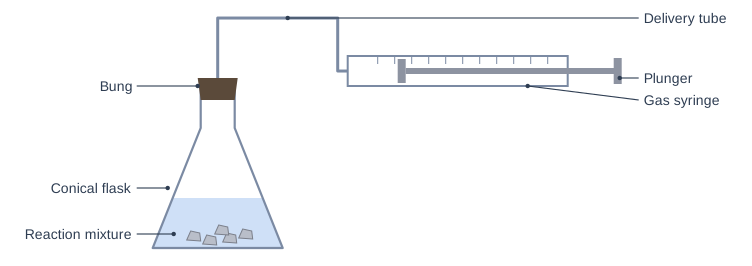
A bottle of hydrogen peroxide solution is labelled 0.200 mol dm⁻³. A student adds manganese(IV) oxide to 20.0 cm³ of the solution, using the apparatus in the diagram. When the reaction has stopped, she has collected 41 cm³ of oxygen at room temperature and pressure.

(molar volume of any gas at room temperature and pressure = 24 000 cm³)

Calculate the concentration of hydrogen peroxide, in mol dm⁻³, that her result gives.

Suggest one reason why her value is lower than the concentration on the label.

Diagram of a reaction in a flask connected to a gas syringe. Labelled parts: Delivery tube, Gas syringe, Plunger, Bung, Conical flask, Reaction mixture.

Model answer

Moles of O₂ = 41 ÷ 24 000 = 0.00171 mol
From the equation, 2 mol of H₂O₂ give 1 mol of O₂, so moles of H₂O₂ = 2 × 0.00171 = 0.00342 mol
Concentration of H₂O₂ = 0.00342 ÷ (20.0 ÷ 1000) = 0.171 mol dm⁻³
Her value is lower than 0.200 mol dm⁻³ probably because some of the hydrogen peroxide in the bottle had already decomposed before the experiment, so the solution really is less concentrated than the label says.

Explanation

Work backwards from the gas: volume ÷ 24 000 gives the moles of oxygen, the equation doubles this for hydrogen peroxide, and moles ÷ volume in dm³ gives the concentration (0.171 mol dm⁻³). A low value means either that less hydrogen peroxide was present than the label says, as when it slowly decomposes in the bottle, or that some oxygen was not measured, such as gas escaping before the bung was fitted. Halving instead of doubling, or dividing by 20.0 instead of 0.0200, are the common errors.

Mark scheme
  1. 1 mark

    (moles of O₂ =) 41 ÷ 24 000 = 0.00171 / 1.71 × 10⁻³ (mol) (1)

    MP1-MP3 are for the calculation: an answer of 0.171 mol dm⁻³ with no working scores 3 marks (MP1-MP3); accept 0.17 to 0.171. Allow ECF throughout. Max 2 for the calculation if the 2 : 1 ratio is not used or is used the wrong way round (0.0854 or 0.0427 mol dm⁻³). Award 2 marks for the calculation for an answer with a power of ten error (e.g. 0.000171 from dividing by 20.0 instead of 0.0200, or 171 from using 24 instead of 24 000). MP4-MP7: any one reason, max 1.

  2. 1 mark

    (moles of H₂O₂ = 2 × 0.00171 =) 0.00342 / 3.42 × 10⁻³ (mol) (1)

    for using the 2 : 1 ratio from the equation

  3. 1 mark

    (concentration = 0.00342 ÷ 0.0200 =) 0.171 (mol dm⁻³) (1)

    allow ECF from their moles of H₂O₂ ÷ 0.0200; accept 0.17 / 0.1708

  4. 1 mark

    some of the hydrogen peroxide had already decomposed (in the bottle) before the experiment, so the solution is really less concentrated than the label says (1)

    Any one reason from MP4-MP7, max 1. Ignore 'human error' or 'the reading was wrong' without a reason; ignore 'some oxygen dissolved' (far too little oxygen dissolves to explain the difference); do not accept 'not all the hydrogen peroxide reacted' (the reaction had stopped and the catalyst is not used up), or a reason that would make the volume of oxygen larger.

  5. 1 mark

    some oxygen escaped before the bung was put in / the apparatus leaked (1)

  6. 1 mark

    the plunger of the gas syringe stuck / friction stopped the plunger moving out fully (1)

  7. 1 mark

    less than 20.0 cm³ of the hydrogen peroxide solution was used (1)

    accept 'the volume of solution measured was too small'; ignore 'the volume of solution was measured inaccurately' with no direction

Ready to try the rest? Every answer you write is marked against the mark scheme, so you can see exactly where the marks are.

Study Helper Hints first, answers after you try

Stuck on this one? Ask for a hint and I’ll point you in the right direction, without giving the answer away. Once you’ve checked your answer, I’ll show you how the marks are awarded.