
Level:
Correct: 0
Incorrect: 0
Marks: 0/0
Exam Practice
Course:
Topics:
Edexcel GCSE Chemistry (Paper 1) Smart practice A mixed round aimed at your weak spots
Unit 1
Key concepts in chemistry
Unit 2
States of matter and mixtures
Unit 3
Chemical changes
Unit 4
Extracting metals and equilibria
Unit 5
Separate chemistry 1
Avg
score:
–
Topics
done:
0/33

Mendeleev and the periodic table

Practise 14 exam-style questions on Mendeleev and the periodic table for Edexcel GCSE Chemistry (Paper 1). Write your answer as you would in the exam and get it marked in seconds against the mark scheme, point by point, with the Study Helper on hand if you get stuck.

  • 14 questions
  • 1–6 marks each
  • Instant marking
  • No sign-up needed
14 questions, marked as you go

Sample questions with model answers

Here are 4 of the questions in this topic, each with a model answer, an explanation of why it earns the marks and the mark scheme an examiner would use.

Question 1

1 mark

Which statement about the modern periodic table is correct?

Choose your answer.

  • A groups are horizontal rows
  • B similar elements share a period
  • C order is by relative atomic mass
  • D similar elements share a group

Model answer

D (similar elements share a group)

Explanation

In the periodic table the elements are in order of increasing atomic number in rows called periods, and elements with similar properties are in the same vertical columns, called groups. Students often mix up groups and periods: groups go down the table and periods go across it.

Mark scheme
  1. 1 mark

    D / similar elements share a group (1)

    The only correct answer is D. Elements with similar chemical properties are placed in the same vertical column, called a group. A is not correct because groups are vertical columns; the horizontal rows are called periods. B is not correct because the properties of the elements change across a period, from metals on the left to non-metals on the right. C is not correct because the modern table is in order of increasing atomic number; some pairs, such as argon and potassium, are not in order of relative atomic mass. Accept the letter or the option. If more than one option is given, do not award the mark.
Question 2

2 marks

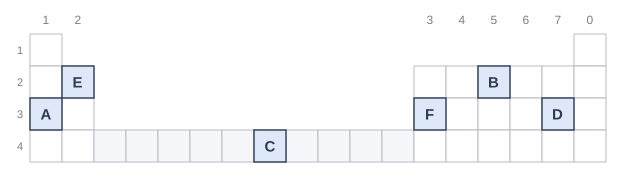
Figure 1 shows an outline of the periodic table. Six elements are labelled A, B, C, D, E and F.

Give the letters of the two elements that are non-metals.

Outline of the periodic table (groups 1-7 and 0 numbered across the top, periods down the side) with these boxes filled in: A in period 3, group 1; B in period 2, group 5; C in period 4, transition metal block column 8; D in period 3, group 7; E in period 2, group 2; F in period 3, group 3.

Model answer

B and D

Explanation

Non-metals are found on the right of the periodic table, to the right of the stepped line that runs down from boron; B (group 5) and D (group 7) are non-metals. The common error is F: it is in group 3, but in period 3 it is aluminium, a metal on the left of the stepped line.

Mark scheme
  1. 1 mark

    B (1)

    The letters may be given in either order. If more than two letters are given, each incorrect letter cancels one correct letter.

  2. 1 mark

    D (1)

    B is in group 5, period 2 (nitrogen) and D is in group 7, period 3 (chlorine). A (group 1), C (transition metals), E (group 2) and F (group 3, period 3: aluminium) are metals.

Question 3

3 marks

In 1871 Mendeleev predicted the properties of a missing element in the gap below silicon in his table. He called it eka-silicon (symbol Es). In 1886 Clemens Winkler discovered the element germanium.

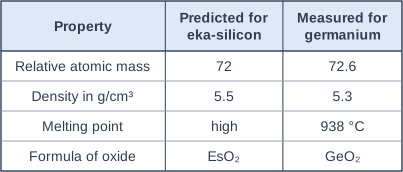
The table shows some of Mendeleev's predictions for eka-silicon and the measured properties of germanium.

Explain how the discovery of germanium supported Mendeleev's periodic table.

Table with columns "Property", "Predicted for eka-silicon", "Measured for germanium". Property: Relative atomic mass; Predicted for eka-silicon: 72; Measured for germanium: 72.6 | Property: Density in g/cm³; Predicted for eka-silicon: 5.5; Measured for germanium: 5.3 | Property: Melting point; Predicted for eka-silicon: high; Measured for germanium: 938 °C | Property: Formula of oxide; Predicted for eka-silicon: EsO₂; Measured for germanium: GeO₂.

Model answer

Mendeleev left a gap in his table below silicon for an element that had not yet been discovered. He used the properties of the elements around the gap to predict the properties of this element. When germanium was discovered, its properties were very close to his predictions: its relative atomic mass was 72.6 compared with the predicted 72, and its oxide had the predicted formula, GeO₂. This showed that the patterns in his table were correct, so germanium fitted the gap and other scientists began to accept his periodic table.

Explanation

The strength of Mendeleev's table was that it made predictions that could be tested: it showed where undiscovered elements should go and what they should be like. Good answers compare at least one predicted and measured property; weak answers only say that germanium was discovered, without saying that it matched the predictions.

Mark scheme
  1. 1 mark

    Mendeleev had left a gap (in his table) for an element that had not been discovered (1)

    An explanation linking any three from the four points; max 3. Allow 'he left a space below silicon'.

  2. 1 mark

    he predicted its properties from the properties of the elements around the gap / of the other elements in the same group (1)

    Allow 'from the patterns / trends in his table'; allow 'from silicon and the elements next to it'.

  3. 1 mark

    the measured properties of germanium were (very) close to / matched the predicted properties (1)

    Accept a general statement that the measured properties were very close to the predictions, or a correct comparison of at least one property, e.g. relative atomic mass 72.6 compared with 72 / density 5.3 compared with 5.5 g/cm³ / oxide formula GeO₂ matching EsO₂ / a high melting point (938 °C) as predicted. Do not accept 'all the values were exactly the same'.

  4. 1 mark

    (so) germanium fitted the gap / this showed that the patterns in his table were correct / other scientists began to accept his table (1)

    Allow 'his predictions were shown to be correct'; allow 'proved his table was right'. Ignore 'germanium was discovered' on its own.

Question 4

4 marks

In the modern periodic table, nickel (Ni) is placed after cobalt (Co), even though nickel has a lower relative atomic mass than cobalt.

The table shows information about cobalt and nickel.

Explain why nickel is placed after cobalt in the modern periodic table, and why nickel has a lower relative atomic mass than cobalt.

Table with columns "Element", "Atomic number", "Relative atomic mass", "Isotopes and their abundances". Element: cobalt; Atomic number: 27; Relative atomic mass: 58.93; Isotopes and their abundances: cobalt-59: 100% | Element: nickel; Atomic number: 28; Relative atomic mass: 58.69; Isotopes and their abundances: nickel-58: 68.1%; nickel-60: 26.2%; others: 5.7%.

Model answer

The modern periodic table is arranged in order of increasing atomic number. Nickel has atomic number 28, so each nickel atom has 28 protons, one more than a cobalt atom (27), and nickel must come after cobalt. The relative atomic mass of an element is the mean mass of its atoms, which depends on the masses and abundances of its isotopes. All cobalt atoms are cobalt-59, with 59 - 27 = 32 neutrons, but 68.1% of nickel atoms are nickel-58, with only 58 - 28 = 30 neutrons. So the mean mass of a nickel atom is lower than that of a cobalt atom, even though nickel atoms have more protons.

Explanation

The order in the periodic table depends on the number of protons (atomic number), but relative atomic mass also depends on the number of neutrons and on how common each isotope is. Nickel's most abundant isotope is light, so its mean atomic mass is below cobalt's. Pairs like this (and tellurium and iodine, or argon and potassium) are why Mendeleev's ordering by relative atomic mass did not always work.

Mark scheme
  1. 1 mark

    the (modern) periodic table is in order of (increasing) atomic number (1)

    An explanation linking any four from the five points; max 4. Do not accept 'in order of relative atomic mass' for this point.

  2. 1 mark

    a nickel atom has one more proton than a cobalt atom / nickel atoms have 28 protons and cobalt atoms have 27 (1)

    The answer must refer to protons: 'nickel has a higher atomic number' alone does not score this point (the atomic numbers are given in the table). Reject 'nickel has fewer protons'.

  3. 1 mark

    relative atomic mass depends on the masses and the (relative) abundances of the isotopes of the element (1)

    Allow 'relative atomic mass is the mean mass of the atoms / of all the isotopes, taking their abundance into account'.

  4. 1 mark

    most nickel atoms are nickel-58, which have 30 neutrons, fewer than the 32 neutrons in cobalt-59 atoms (1)

    Allow 'the most abundant isotope of nickel (nickel-58) has a lower mass number than cobalt's only isotope (cobalt-59)'; allow 'most nickel atoms have fewer neutrons than cobalt atoms'.

  5. 1 mark

    (so) the mean mass of a nickel atom is less than the mass of a cobalt atom (1)

    Allow 'on average nickel atoms are lighter / have fewer neutrons than cobalt atoms'. Ignore references to electrons.

Ready to try the rest? Every answer you write is marked against the mark scheme, so you can see exactly where the marks are.

Study Helper Hints first, answers after you try

Stuck on this one? Ask for a hint and I’ll point you in the right direction, without giving the answer away. Once you’ve checked your answer, I’ll show you how the marks are awarded.
