
Level:
Correct: 0
Incorrect: 0
Marks: 0/0
Exam Practice
Course:
Topics:
Edexcel GCSE Chemistry (Paper 1) Smart practice A mixed round aimed at your weak spots
Unit 1
Key concepts in chemistry
Unit 2
States of matter and mixtures
Unit 3
Chemical changes
Unit 4
Extracting metals and equilibria
Unit 5
Separate chemistry 1
Avg
score:
–
Topics
done:
0/33

States of matter

Practise 14 exam-style questions on States of matter for Edexcel GCSE Chemistry (Paper 1). Write your answer as you would in the exam and get it marked in seconds against the mark scheme, point by point, with the Study Helper on hand if you get stuck.

  • 14 questions
  • 1–6 marks each
  • Instant marking
  • No sign-up needed
14 questions, marked as you go

Sample questions with model answers

Here are 4 of the questions in this topic, each with a model answer, an explanation of why it earns the marks and the mark scheme an examiner would use.

Question 1

1 mark

Solid carbon dioxide is sometimes called 'dry ice'. At atmospheric pressure it changes straight from a solid into a gas at -78 °C, without forming a liquid.

What is the name of this change of state?

Choose your answer.

  • A boiling
  • B condensing
  • C evaporating
  • D sublimation

Model answer

D - sublimation.

Explanation

Sublimation is the change of state from a solid directly into a gas. Boiling and evaporating both start from a liquid, and condensing is the reverse change, gas to liquid. Like all changes of state, sublimation is a physical change: the gas is still carbon dioxide. The opposite change, from a gas directly to a solid (for example frost forming from water vapour), is sometimes called deposition.

Mark scheme
  1. 1 mark

    D / sublimation (1)

    The only correct answer is D. A is not correct because boiling is a liquid changing into a gas throughout the liquid at its boiling point; B is not correct because condensing is a gas changing into a liquid; C is not correct because evaporating is a liquid changing into a gas at its surface, and dry ice is never a liquid here. Accept the letter or the option. If more than one option is given, do not award the mark.
Question 2

2 marks

On a warm, humid day, a can of drink is taken out of a fridge. After a few minutes, droplets of water appear on the outside of the can.

Use ideas about particles to explain how the droplets of water form.

Model answer

Water vapour particles in the warm air touch the cold surface of the can and transfer energy to it, so they lose energy and slow down. The particles move close together and are held together by forces of attraction, so the water vapour condenses into liquid water droplets on the can.

Explanation

The water comes from water vapour in the air, not from inside the can. The cold can takes energy from the water vapour particles, which slow down and come close together so the gas condenses to a liquid. Answers that only say 'condensation' without describing the particles score at most 1 mark.

Mark scheme
  1. 1 mark

    water vapour (particles) in the air (touch the cold can and) lose energy / are cooled (1)

    An explanation linking two points. The water must come from the air: do not accept 'the drink leaks / passes through the can' or 'the can sweats'. Allow 'water molecules in the air transfer energy to the cold can'.

  2. 1 mark

    the particles slow down and move close together / are held together by forces of attraction, so the water vapour condenses (to liquid water) (1)

    Allow 'the gas turns into a liquid because the particles move closer together'. 'Condensation' alone, with no particle idea, does not score this point.

Question 3

3 marks

In a foundry, molten aluminium at 750 °C is poured into a mould and left to cool until it is a solid at room temperature.

Aluminium melts at 660 °C.

Explain the changes in the arrangement, movement and energy of the aluminium particles as the molten aluminium cools and becomes solid.

Model answer

As the molten aluminium cools, its particles lose energy and slow down. When the temperature falls to 660 °C, the aluminium freezes: the forces of attraction between the particles hold them in fixed positions, so instead of moving around each other the particles can only vibrate. The particles change from a random arrangement in the liquid to a regular arrangement (lattice) in the solid.

Explanation

Freezing is the reverse of melting: the particles lose energy, the forces of attraction between them hold them in fixed positions, and their random arrangement becomes a regular lattice in which they only vibrate. A common error is to say the particles stop moving altogether - particles in a solid still vibrate.

Mark scheme
  1. 1 mark

    the particles lose (kinetic) energy / slow down (as the aluminium cools) (1)

    An explanation including any three from the four points; max 3. Allow 'transfer energy to the surroundings / the mould'. Do not accept 'the particles lose all their energy' or 'the particles stop moving completely'.

  2. 1 mark

    (at 660 °C) the forces of attraction hold the particles in fixed positions (1)

    Allow 'the attraction between the particles holds them in place'. The idea of forces of attraction holding the particles is needed for this point; 'the particles become fixed' on its own scores only the next point.

  3. 1 mark

    the particles change from moving around each other to (only) vibrating (about fixed positions) (1)

    Allow 'the particles stop sliding past each other and just vibrate'. A description of the solid only ('the particles vibrate') scores this point.

  4. 1 mark

    the particles change from a random arrangement to a regular arrangement / lattice / rows (1)

    Allow 'become ordered'. A description of the solid only ('the particles are in a regular pattern') scores this point. Ignore 'the particles move closer together' (the change in spacing on freezing is small).

Question 4

4 marks

Titan is the largest moon of the planet Saturn. The temperature at the surface of Titan is about -179 °C.

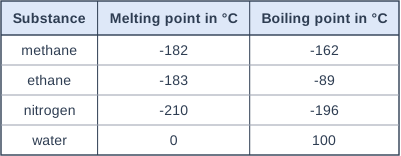
The table shows the melting points and boiling points of four substances found on Titan. Assume these values are the same on Titan as on Earth.

Explain which of the substances in the table could form lakes of liquid on the surface of Titan.

Table with columns "Substance", "Melting point in °C", "Boiling point in °C". Substance: methane; Melting point in °C: -182; Boiling point in °C: -162 | Substance: ethane; Melting point in °C: -183; Boiling point in °C: -89 | Substance: nitrogen; Melting point in °C: -210; Boiling point in °C: -196 | Substance: water; Melting point in °C: 0; Boiling point in °C: 100.

Model answer

Methane and ethane could form lakes. -179 °C is above the melting point of methane (-182 °C) and below its boiling point (-162 °C), and above the melting point of ethane (-183 °C) and below its boiling point (-89 °C), so both are liquids on Titan. Nitrogen would be a gas, because -179 °C is above its boiling point of -196 °C. Water would be a solid (ice), because -179 °C is far below its melting point of 0 °C.

Explanation

A substance is a liquid when the temperature is between its melting point and its boiling point. The common error is with negative numbers: -179 °C is higher (warmer) than -182 °C and -196 °C but lower than -162 °C. Titan really does have lakes and seas of liquid methane and ethane.

Mark scheme
  1. 1 mark

    methane and ethane (1)

    An explanation linking four points. Both substances needed and no others for this point.

  2. 1 mark

    -179 °C is above the melting points and below the boiling points of methane and ethane (1)

    Allow 'the temperature is between their melting and boiling points'. Allow the argument made separately for each: methane between -182 °C and -162 °C; ethane between -183 °C and -89 °C.

  3. 1 mark

    nitrogen would be a gas because -179 °C is above its boiling point (-196 °C) (1)

    The state and the reason are both needed. Do not accept 'nitrogen is a solid / liquid'.

  4. 1 mark

    water would be a solid / ice because -179 °C is below its melting point (0 °C) (1)

    The state and the reason are both needed. Allow 'water would be frozen'.

Ready to try the rest? Every answer you write is marked against the mark scheme, so you can see exactly where the marks are.

Study Helper Hints first, answers after you try

Stuck on this one? Ask for a hint and I’ll point you in the right direction, without giving the answer away. Once you’ve checked your answer, I’ll show you how the marks are awarded.