Level:
Correct: 0
Incorrect: 0
Marks: 0/0
Exam Practice
Course:
Topics:
Edexcel GCSE Chemistry (Paper 1) Smart practice A mixed round aimed at your weak spots
Unit 1
Key concepts in chemistry
Unit 2
States of matter and mixtures
Unit 3
Chemical changes
Unit 4
Extracting metals and equilibria
Unit 5
Separate chemistry 1
Avg
score:
–
Topics
done:
0/33

Preparing soluble salts

Practise 16 exam-style questions on Preparing soluble salts for Edexcel GCSE Chemistry (Paper 1). Write your answer as you would in the exam and get it marked in seconds against the mark scheme, point by point, with the Study Helper on hand if you get stuck.

  • 16 questions
  • 1–6 marks each
  • Instant marking
  • No sign-up needed
16 questions, marked as you go

Sample questions with model answers

Here are 4 of the questions in this topic, each with a model answer, an explanation of why it earns the marks and the mark scheme an examiner would use.

Question 1

1 mark

A student prepares lithium nitrate crystals. She uses a titration to find the volume of dilute nitric acid needed to neutralise an alkali.

Name the alkali she uses.

Model answer

Lithium hydroxide solution.

Explanation

The salt's name comes from the metal in the alkali and the acid used: lithium from the alkali, nitrate from nitric acid. An alkali is a soluble base, so the alkali is lithium hydroxide. Because both reactants are soluble, a titration is needed to mix them in the correct proportions.

Mark scheme
  1. 1 mark

    lithium hydroxide (solution) (1)

    accept LiOH. Do not accept lithium oxide / lithium carbonate / lithium / sodium hydroxide.

Question 2

2 marks

Explain why universal indicator is not used as the indicator in a titration.

Model answer

Universal indicator changes colour gradually through a range of colours as the pH changes. This means there is no sudden colour change, so it is difficult to see exactly when the end point is reached.

Explanation

A titration indicator needs one sharp, clear colour change at the end point, such as phenolphthalein (pink to colourless as acid is added to alkali) or methyl orange (yellow to red). Universal indicator is a mixture of indicators that changes colour gradually, so the exact volume at neutralisation is hard to judge. 'It is not accurate' is too vague without the reason.

Mark scheme
  1. 1 mark

    universal indicator changes colour gradually / through a range of (many) colours (1)

    An explanation linking. accept 'it has many colours, not just two' / 'it does not have a sudden colour change'.

  2. 1 mark

    so it is difficult to see the exact end point / exactly when the solution becomes neutral (1)

    accept the reverse argument: 'methyl orange / phenolphthalein has a sharp single colour change that shows the end point clearly'. Ignore 'it is not accurate' on its own.

Question 3

3 marks

Sam wants to make sodium chloride crystals. He adds an excess of sodium hydroxide solution to some dilute hydrochloric acid. He then evaporates the water from the mixture.

Explain why Sam's crystals will not be pure sodium chloride.

Model answer

Sodium hydroxide is soluble, so the excess cannot be removed by filtering, as an insoluble solid could be. The excess sodium hydroxide stays dissolved in the solution with the sodium chloride, so when the water is evaporated the crystals are contaminated with sodium hydroxide. Sam should use a titration to find the exact volume of sodium hydroxide solution that neutralises the acid, so that the solution contains only sodium chloride and water.

Explanation

The 'add excess and filter' method only works when the excess reactant is insoluble. With a soluble reactant, the acid and alkali must be mixed in exactly the correct proportions, found by titration, so that nothing but the salt and water remains. Simply saying 'he added too much' without explaining why it cannot be removed gains little credit.

Mark scheme
  1. 1 mark

    sodium hydroxide is soluble / is in solution, so the excess cannot be removed by filtering (1)

    An explanation including any three from the four points; max 3. accept 'the excess alkali cannot be separated from the salt solution'.

  2. 1 mark

    the excess sodium hydroxide stays (dissolved) in the solution (with the sodium chloride) (1)

    accept 'the solution contains sodium hydroxide as well as sodium chloride and water'.

  3. 1 mark

    so when the water evaporates, the crystals contain / are contaminated with sodium hydroxide (1)

    accept 'solid sodium hydroxide is left with the sodium chloride'.

  4. 1 mark

    a titration should be used to find the exact volume of alkali that neutralises the acid / to mix them in the correct proportions (1)

    accept 'he should add just enough sodium hydroxide to neutralise the acid, found using an indicator'.

Question 4

4 marks

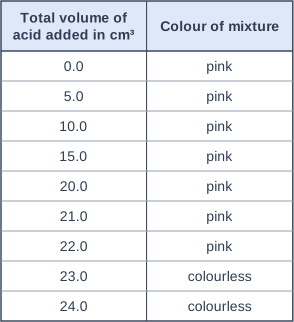
Maya wants to make potassium chloride. She puts 25.0 cm³ of potassium hydroxide solution and a few drops of phenolphthalein into a conical flask. She adds dilute hydrochloric acid from a burette and records the colour of the mixture after each addition.

The table shows her results.

Maya concludes that exactly 23.0 cm³ of acid is needed to neutralise the potassium hydroxide solution.

Evaluate Maya's conclusion and describe how she could find the volume of acid needed more precisely.

Table with columns "Total volume of acid added in cm³", "Colour of mixture". Total volume of acid added in cm³: 0.0; Colour of mixture: pink | Total volume of acid added in cm³: 5.0; Colour of mixture: pink | Total volume of acid added in cm³: 10.0; Colour of mixture: pink | Total volume of acid added in cm³: 15.0; Colour of mixture: pink | Total volume of acid added in cm³: 20.0; Colour of mixture: pink | Total volume of acid added in cm³: 21.0; Colour of mixture: pink | Total volume of acid added in cm³: 22.0; Colour of mixture: pink | Total volume of acid added in cm³: 23.0; Colour of mixture: colourless | Total volume of acid added in cm³: 24.0; Colour of mixture: colourless.

Model answer

Maya's conclusion is not justified. The phenolphthalein was still pink at 22.0 cm³ and had turned colourless at 23.0 cm³, so the end point is somewhere between 22.0 and 23.0 cm³. 23.0 cm³ may be more acid than is needed, so the mixture may contain excess acid.

To find the volume more precisely, she should repeat the titration with a fresh 25.0 cm³ of alkali, adding the acid quickly up to about 21 cm³ and then one drop at a time, swirling the flask on a white tile after each drop. She should stop as soon as the pink colour just disappears and read the burette at eye level. She should repeat the titration to check that the volumes agree.

Explanation

The results only show that the colour change happened somewhere in the last 1 cm³ addition, so 23.0 cm³ is an upper limit, not the exact volume. Adding the acid drop by drop near the end point, with swirling, finds the volume to within one drop. This matters for making a salt, because any excess acid would contaminate the potassium chloride.

Mark scheme
  1. 1 mark

    the colour change / end point happened somewhere between 22.0 cm³ and 23.0 cm³ (the mixture was still pink at 22.0 cm³ and colourless at 23.0 cm³) (1)

    Evaluation: MP1 and MP2. Improvement: any three from MP3 to MP8; max 3 for the improvement. Max 4 overall. accept 'the end point could be anywhere from just over 22.0 to 23.0 cm³'. Ignore 'the conclusion is wrong' with no reason.

  2. 1 mark

    so 23.0 cm³ is only an upper limit / the exact volume needed is not known / 23.0 cm³ may be more acid than is needed, so the acid could be in excess (1)

    accept 'the conclusion is not valid / not precise because the acid was added 1 cm³ at a time near the end point'. Do not accept 'she should have used 22.0 cm³' (the mixture was still alkaline at 22.0 cm³).

  3. 1 mark

    add the acid drop by drop near the end point / add it quickly to about 21 cm³ and then drop by drop (1)

    accept 'add much smaller volumes at a time near the end point'.

  4. 1 mark

    swirl the flask after each addition (1)

    accept 'mix the solutions after each addition'.

  5. 1 mark

    place the flask on a white tile (so the colour change is easier to see) (1)

    accept 'white paper under the flask'.

  6. 1 mark

    stop as soon as the pink colour just disappears (permanently) and record the burette reading (1)

    accept 'stop at the first permanent colour change'.

  7. 1 mark

    read the burette at eye level / at the bottom of the meniscus (before and after) (1)

    accept 'read the burette to the nearest 0.05 cm³'.

  8. 1 mark

    repeat the titration to check that the volumes agree (1)

    accept 'repeat until the results are consistent / concordant'. Ignore 'repeat it' with no reason.

Ready to try the rest? Every answer you write is marked against the mark scheme, so you can see exactly where the marks are.

Study Helper Hints first, answers after you try

Stuck on this one? Ask for a hint and I’ll point you in the right direction, without giving the answer away. Once you’ve checked your answer, I’ll show you how the marks are awarded.