
Level:
Correct: 0
Incorrect: 0
Marks: 0/0
Exam Practice
Course:
Topics:
Edexcel GCSE Chemistry (Paper 1) Smart practice A mixed round aimed at your weak spots
Unit 1
Key concepts in chemistry
Unit 2
States of matter and mixtures
Unit 3
Chemical changes
Unit 4
Extracting metals and equilibria
Unit 5
Separate chemistry 1
Avg
score:
–
Topics
done:
0/33

Recycling metals and life-cycle assessment

Practise 15 exam-style questions on Recycling metals and life-cycle assessment for Edexcel GCSE Chemistry (Paper 1). Write your answer as you would in the exam and get it marked in seconds against the mark scheme, point by point, with the Study Helper on hand if you get stuck.

  • 15 questions
  • 1–6 marks each
  • Instant marking
  • No sign-up needed
15 questions, marked as you go

Sample questions with model answers

Here are 4 of the questions in this topic, each with a model answer, an explanation of why it earns the marks and the mark scheme an examiner would use.

Question 1

1 mark

A company carries out a life-cycle assessment (LCA) for an aluminium saucepan.

The energy used by a cooker to heat food in the saucepan is included in one stage of the LCA.

Which stage?

Choose your answer.

  • A obtaining the raw materials
  • B manufacturing the product
  • C using the product
  • D disposing of the product

Model answer

C - using the product.

Explanation

An LCA considers the effect on the environment of obtaining the raw materials, manufacturing the product, using the product and disposing of it. Energy used while the product does its job - here, heating food on a cooker - belongs to the 'using the product' stage.

Mark scheme
  1. 1 mark

    C / using the product (1)

    The only correct answer is C: heating food in the saucepan happens while the product is being used. A is not correct because obtaining the raw materials covers mining the bauxite ore and extracting the aluminium. B is not correct because manufacturing covers making the saucepan from the aluminium, before it is sold. D is not correct because disposal covers what happens to the saucepan when it is no longer useful (landfill or recycling). Accept the letter or the option. If more than one option is given, do not award the mark.
Question 2

2 marks

Recycling aluminium saves about 95% of the energy needed to produce aluminium from its ore. Recycling iron saves a smaller percentage of the energy needed to produce iron from its ore.

Explain why recycling aluminium saves a larger percentage of energy than recycling iron.

Model answer

Aluminium is above carbon in the reactivity series, so it has to be extracted by electrolysis of molten aluminium oxide, which uses a huge amount of electrical energy. Recycling only needs the aluminium metal to be melted, which uses much less energy, so most of the energy is saved. Iron is extracted by heating with carbon, which needs less energy in the first place, so the saving from recycling iron is a smaller percentage.

Explanation

This links recycling to extraction: the energy saved by recycling depends on how much energy extraction needs. Very reactive metals such as aluminium need electrolysis, so recycling them saves the most; less reactive metals such as iron are cheaper to extract with carbon, so the saving is smaller. Saying 'aluminium is easier to recycle' is not enough.

Mark scheme
  1. 1 mark

    aluminium is extracted (from its ore) by electrolysis, which uses a lot of (electrical) energy (1)

    An explanation linking; any two from the three points; max 2. Accept 'aluminium is very reactive / above carbon so it needs electrolysis, which uses a lot of electricity / heat to melt the ore'.

  2. 1 mark

    recycling only needs the aluminium to be melted (and recast), which uses much less energy (1)

    Accept 'recycled aluminium is already the metal, so no energy is needed to remove oxygen from it'.

  3. 1 mark

    iron is extracted by heating (its oxide) with carbon, which uses less energy than electrolysis, so there is less energy to save (1)

    Accept 'iron is less reactive, so less energy is needed to extract it'. Do not accept 'iron is extracted by electrolysis'.

Question 3

3 marks

Producing 1 tonne of aluminium from its ore uses 186 GJ of energy. Producing 1 tonne of aluminium by recycling uses 8.3 GJ of energy. (Data from the International Aluminium Institute, 2019.)

A recycling plant recycles 1200 tonnes of aluminium in one year.

Calculate the energy saved in one year by recycling this aluminium instead of producing it from ore.

Model answer

Energy saved per tonne = 186 - 8.3 = 177.7 GJ
Energy saved in one year = 177.7 × 1200 = 213 240 GJ (about 2.13 × 10⁵ GJ)

Explanation

Find the energy saved for each tonne, then multiply by the number of tonnes; working out the total for each method and subtracting gives the same answer. Recycling aluminium needs only about 4.5% of the energy needed to make it from ore, because the metal only has to be melted. A common error is to multiply 186 by 1200 without subtracting the energy used for recycling.

Mark scheme
  1. 1 mark

    (energy saved per tonne =) 186 - 8.3 = 177.7 (GJ) (1)

    213 240 GJ (or 2.13 × 10⁵ GJ) with or without working scores 3. Allow ECF throughout. Alternative method: 186 × 1200 = 223 200 (MP1) and 8.3 × 1200 = 9960 (MP2), then 223 200 - 9960 = 213 240 (MP3).

  2. 1 mark

    177.7 × 1200 (1)

    Allow ECF for MP2 from an incorrectly calculated subtraction in MP1 (e.g. 186 - 8.3 worked out wrongly), multiplied by 1200.

  3. 1 mark

    213 240 (GJ) (1)

    Accept 213 240 rounded correctly to 2 or more significant figures, e.g. 213 000, 2.13 × 10⁵, 2.1 × 10⁵. 223 200 or 9960 given as the final answer (nothing subtracted) scores 1 mark only, for that correct step of the alternative method.

Question 4

4 marks

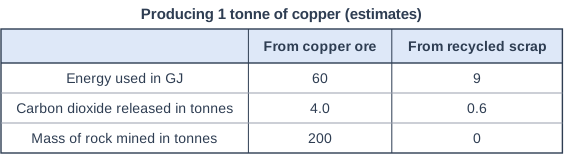
The table shows estimates for producing 1 tonne of copper from copper ore and from recycled copper scrap.

Evaluate the advantages of recycling copper. Use the information in the table and your own knowledge.

Producing 1 tonne of copper (estimates). Table with columns (row headings), "From copper ore", "From recycled scrap". Energy used in GJ; From copper ore: 60; From recycled scrap: 9 | Carbon dioxide released in tonnes; From copper ore: 4.0; From recycled scrap: 0.6 | Mass of rock mined in tonnes; From copper ore: 200; From recycled scrap: 0.

Model answer

Recycling copper uses much less energy than producing it from ore (9 GJ instead of 60 GJ per tonne, about 85% less), so fewer fossil fuels are burned and it costs less. It releases 0.6 t of carbon dioxide instead of 4.0 t, so it contributes far less to climate change. No rock has to be mined, whereas 200 t of rock are mined for each tonne of copper from ore, so habitats are not destroyed and less waste rock is produced; the finite copper ore reserves also last longer. However, the scrap has to be collected, transported and sorted, which costs money and uses some energy. Overall, recycling copper is much better because the savings in energy, carbon dioxide and mining are far greater than the costs of collecting the scrap.

Explanation

An evaluation uses the data to compare the two routes and links each difference to a consequence for the environment, the economy or the supply of raw materials. A strong answer also mentions a limitation, such as the cost of collecting and sorting scrap, and ends with a supported judgement. Answers that only say 'recycling is better for the environment' score little.

Mark scheme
  1. 1 mark

    recycling uses much less energy (9 GJ compared with 60 GJ), so fewer fossil fuels are burned / it is cheaper (1)

    Any four from the six points; max 4. Max 3 if the answer gives only advantages (no disadvantage or limitation and no judgement). Each advantage needs the data or a consequence, not just 'better'. Accept '85% less energy'.

  2. 1 mark

    recycling releases less carbon dioxide (0.6 t compared with 4.0 t), so it contributes less to climate change / global warming (1)

    Accept 'less greenhouse gas'.

  3. 1 mark

    no rock needs to be mined (compared with 200 t), so less damage to habitats / landscape / less waste rock, noise or dust (1)

    Accept 'less land used for mining and waste heaps'.

  4. 1 mark

    copper ores are finite, so recycling preserves the supply of copper ore / makes reserves last longer (1)

    Accept 'conserves raw materials'.

  5. 1 mark

    disadvantage / limitation: the scrap has to be collected, transported and sorted, which costs money and uses energy / there is not enough scrap to meet all demand (1)

    Accept 'separating copper from other materials can be difficult'.

  6. 1 mark

    judgement: recycling is better overall because the savings in energy, carbon dioxide and mining far outweigh the costs of collection (1)

    A judgement supported by at least one piece of evidence from the table. Do not award for a judgement with no reason.

Ready to try the rest? Every answer you write is marked against the mark scheme, so you can see exactly where the marks are.

Study Helper Hints first, answers after you try

Stuck on this one? Ask for a hint and I’ll point you in the right direction, without giving the answer away. Once you’ve checked your answer, I’ll show you how the marks are awarded.