Has science and technology been the main factor in providing clean water and removing waste in Britain since c1000?
Explain your answer with reference to science and technology and other factors. Use a range of examples from across your study of Health and the people: c1000 to the present day.
[16 marks] [SPaG 4 marks]
Model answer
Science and technology made it possible to provide clean water and remove waste on a large scale, through pipes, pumps, filters and sewers. However, the technology was often available long before it was used, and it was government, pushed by individuals and by chance, that decided when it would be used for the whole population. So I think government was more important than science and technology.
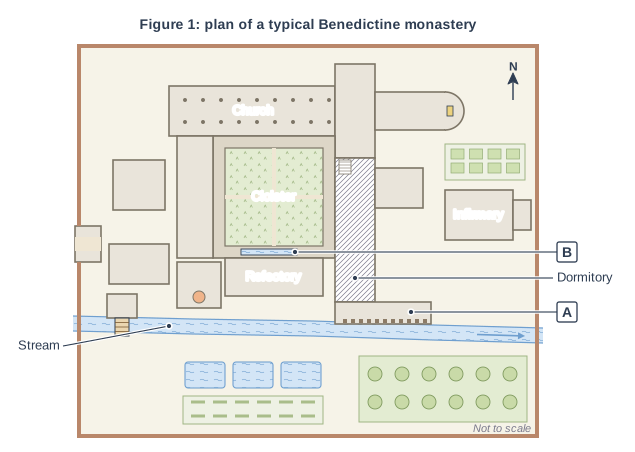
In the Middle Ages, the technology existed on a small scale. Monasteries piped fresh water from springs through lead pipes and settling tanks, as shown in the plan of Christ Church Priory at Canterbury of about 1165, and built latrines over running water. But this depended on their wealth, organisation and religious rules, not on new technology. Towns had the same knowledge of pipes, yet most relied on wells, polluted rivers and cesspits, because their councils lacked the money and authority to build such systems. London built a few conduits, such as the Great Conduit in Cheapside, but the 1388 Act against dumping filth in rivers was hardly enforced.
From the sixteenth century, new technology slowly improved water supply. A waterwheel under London Bridge pumped water from the Thames in 1582, the New River brought fresh water to London in 1613, and steam pumps and sand filters, first used by the Chelsea Waterworks in 1829, improved supplies. The flushing water closet was designed in the eighteenth century. Yet in the early nineteenth century industrial towns still had overflowing cesspits and polluted water, and cholera killed thousands, because nobody forced towns to use this technology.
The decisive changes came when individuals, chance and government combined with technology. John Snow showed in 1854 that cholera spread through dirty water. The Great Stink of 1858 forced Parliament to fund Joseph Bazalgette's intercepting sewers, completed by 1875, which used engineering and steam pumping stations to carry London's sewage away from the Thames. Government made the crucial decisions: the Metropolis Water Act of 1852 required London's water to be filtered, and the 1875 Public Health Act forced every council to provide clean water and sewers. In Birmingham, Joseph Chamberlain took over the water supply in the 1870s. Science explained why this mattered once germ theory was accepted after 1861 and Koch identified the cholera bacterium in 1883, and in 1905 Lincoln began adding chlorine to water after a typhoid outbreak.
In conclusion, science and technology gave Britain the means to provide clean water and remove waste, and without engineering there could be no sewers or water supply. But much of the technology was available long before it was used, and it was only used across the country when government compelled councils to act, pushed by individuals like Snow and Chadwick and by chance events like the Great Stink. Government was therefore the main factor, with science and technology providing the tools.
Explanation
Technology (pipes, pumps, filters, sewers, chlorination) made clean water possible, but it was used widely only when government acted (1852, 1875), pushed by individuals (Snow, Bazalgette, Chamberlain) and chance (the Great Stink); medieval monasteries show wealth and organisation mattered too. Level 4 needs a sustained judgement weighing these.