Level:
Correct: 0
Incorrect: 0
Marks: 0/0
Exam Practice
Subject:
Topics:
Avg
score:
–
Topics
done:
0/12

Dealing with disease

Practise 35 exam-style questions on Dealing with disease for AQA GCSE History (Health and the people). Write your answer as you would in the exam and get it marked in seconds against the mark scheme, point by point, with an AI tutor on hand if you get stuck.

  • 35 questions
  • 1–20 marks each
  • Instant marking
  • No sign-up needed
20 questions, marked as you go

Sample questions with model answers

Here are 4 of the questions in this topic, each with a model answer, an explanation of why it earns the marks and the mark scheme an examiner would use.

Question 1

2 marks

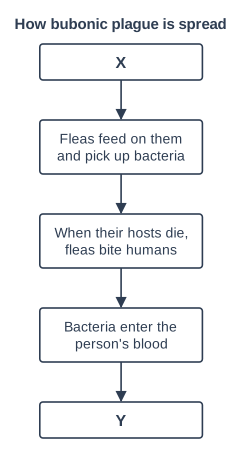
Figure 1 shows how bubonic plague is spread, which nobody understood in 1665. What should replace X and Y?

How bubonic plague is spread. Flow chart of 5 boxes joined by arrows, read from top to bottom. The first box is box X, which leads to "Fleas feed on them and pick up bacteria", which leads to "When their hosts die, fleas bite humans", which leads to "Bacteria enter the person's blood", which leads to box Y.

Model answer

X is black rats, which carry the plague bacteria. Y is buboes, the painful swellings in the armpits, groin or neck that gave bubonic plague its name.

Explanation

Bubonic plague is caused by bacteria carried by fleas living on black rats. In 1665 people blamed miasma (bad air), the planets or God's anger, so measures such as killing cats and dogs, which ate rats, could even make things worse.

Mark scheme
  1. 1 mark

    X: black rats.

    Accept 'rats'.

  2. 1 mark

    Y: buboes (painful swellings in the armpits, groin or neck).

    Accept 'swellings', 'lumps' or 'boils', or symptoms such as fever and death if buboes are not named.

Question 2

8 marks

Source A: from the rules of a voluntary hospital in an English county town, printed in 1760 for the people who paid subscriptions to support it. (Written for practice.)
'No patient shall be admitted without a letter of recommendation from a subscriber. No woman big with child, no child under seven years of age (except for accidents), and no person having the smallpox, the itch or any other infectious distemper, or thought to be incurable or dying, shall be admitted. Patients shall attend prayers in the chapel each day, and any patient found swearing, gaming or drinking spirits shall be discharged.'

How useful is Source A to an historian studying hospitals in the 18th century? Explain your answer using Source A and your contextual knowledge.

Model answer

Source A is useful because it shows how 18th-century voluntary hospitals were organised. It shows that patients could only be admitted with a letter from a subscriber. From my own knowledge, voluntary hospitals such as Guy's Hospital (1721) and the many county infirmaries founded later in the century were charities paid for by wealthy subscribers, who in return could recommend 'deserving' poor people for treatment. The rule excluding anyone with smallpox or another infectious disease, or who was incurable or dying, is also typical: hospitals wanted to protect their other patients and to keep their death rates low so that subscribers would go on supporting them. The rules on daily prayers and on swearing, gaming and drinking show that these hospitals had a strong religious and moral purpose, reflecting the Christian charity that motivated many founders.

The provenance affects its usefulness. The rules were printed for subscribers, so they show the image the hospital wanted to present: respectable, orderly and moral. This makes it good evidence of what hospitals intended, but it may hide problems, since rules do not tell us whether they were actually followed.

The source also has important gaps. It says nothing about what treatment patients received, which was still mostly based on bleeding and purging, or about conditions on the wards, where infections often spread. It does not mention the physicians and surgeons who gave their time to these hospitals, gaining experience and teaching students who 'walked the wards', which was one of the most important results of the growth of hospitals. Overall, Source A is useful for showing how voluntary hospitals were funded and whom they would and would not treat, but much less useful for understanding what life and treatment in them were really like.

Explanation

Voluntary hospitals were charities run on subscribers' recommendations, excluding infectious and incurable patients and stressing religion and discipline. Level 4 weighs what the rules reveal about organisation against their limits as official rules printed for subscribers.

Mark scheme
  1. 8 marks

    Levels of response (8 marks).
    Level 4 (7-8 marks): Complex evaluation of Source A with a sustained judgement about its usefulness for studying 18th-century hospitals, based on both content and provenance and supported by contextual knowledge, e.g. it is useful because it shows how voluntary hospitals were funded by subscribers, whom they admitted and excluded, and their religious and moral character, but rules show what was intended rather than what actually happened, and it says nothing about treatment, doctors, teaching or conditions on the wards.
    Level 3 (5-6 marks): Developed evaluation of Source A based on content and/or provenance, supported by contextual knowledge, e.g. explains why hospitals excluded infectious and incurable patients, or explains why rules printed for subscribers present the hospital in a particular way.
    Level 2 (3-4 marks): Simple evaluation of Source A based on content and/or provenance, e.g. it is useful because it shows who could go into hospital.
    Level 1 (1-2 marks): Basic analysis of Source A: paraphrases it, or makes general statements about its provenance with little or no contextual knowledge.
    0 marks: nothing worthy of credit.

    Indicative content (not a checklist; credit other valid points): Content: funding by subscription and admission by a subscriber's letter of recommendation - voluntary hospitals were charities paid for by wealthy subscribers, who chose the 'deserving poor' to be treated; exclusion of infectious and incurable patients - to protect other patients and keep death rates (and the hospital's reputation with subscribers) good; exclusion of pregnant women and young children - they were usually cared for at home; daily prayers and strict discipline - Christian charity and moral improvement were part of the purpose. Context: the growth of voluntary hospitals in the 18th century - Westminster (1719), Guy's (1721), St George's (1733), the London Hospital (1740), the Middlesex (1745) in London, and infirmaries in towns such as Edinburgh (1729), Bristol (opened 1737), Manchester (1752) and Cambridge (Addenbrooke's, 1766); before this, most medieval hospitals run by the Church had closed with the dissolution of the monasteries (1536-1540), leaving only a few such as St Bartholomew's and St Thomas'; physicians and surgeons gave their time free, gaining status, experience and fee-paying students who 'walked the wards'; the rich were treated at home. Provenance: printed for subscribers, so it shows how the hospital wanted to be seen - respectable, moral, well run - and may hide problems; rules are typical of many voluntary hospitals; it is a practice source. Limits: does not show what treatment patients received (still largely based on bleeding and purging), the cleanliness of the wards, infection ('hospital fever'), death rates, or the role of hospitals in training; one hospital. Judgement: useful for how hospitals were organised and who they served, less useful for what happened inside them.

Question 3

8 marks

Explain the significance of changes in the training of surgeons in the 17th and 18th centuries for the status of surgeons.

Model answer

Changes in training were significant because they made surgeons more skilled and more scientific, which raised their status. At the start of the period surgeons were craftsmen, trained by apprenticeship and joined with barbers in the Company of Barber-Surgeons, created in 1540. They had far lower status than physicians, who had university degrees. Over the 17th and 18th centuries, their training improved. The 1540 Act had given the Company four executed criminals' bodies a year for dissection, and in the 18th century private anatomy schools, such as William Hunter's in London, allowed students to dissect bodies themselves. Students also 'walked the wards' of the new voluntary hospitals, such as Guy's and St George's, learning from experienced surgeons, and textbooks in English, such as William Cheselden's anatomy of 1713, made knowledge more widely available.

This improved training raised surgeons' reputations. Famous surgeons such as Cheselden, who could remove a bladder stone in about a minute, and John Hunter, who taught a scientific, experimental approach at St George's and became surgeon to George III, won public respect. As a result, in 1745 the surgeons broke away from the barbers to form the Company of Surgeons, and in 1800 it received a royal charter as the Royal College of Surgeons, which examined new surgeons.

However, the significance had limits. Surgeons were still called 'Mr' rather than 'Dr' and ranked below physicians. Operations were still very dangerous because of pain, infection and blood loss, which were not overcome until the 1840s and 1860s. The reliance of anatomy schools on body-snatchers also damaged their reputation.

In the long term, these changes were very significant. The Medical Act of 1858 put qualified surgeons and physicians on the same register, and once anaesthetics and antiseptics made complex operations possible, surgeons became among the most respected members of the medical profession. The improved training of the 17th and 18th centuries laid the foundation for this.

Explanation

Dissection, anatomy schools, hospital teaching and Hunter's scientific surgery raised surgeons' skills and status, leading to the Company of Surgeons (1745) and the Royal College of Surgeons (1800), though they still ranked below physicians. Level 4 explains how these aspects of significance relate.

Mark scheme
  1. 8 marks

    Levels of response (8 marks).
    Level 4 (7-8 marks): Complex explanation of aspects of the significance of changes in surgeons' training for their status, explaining the relationship between them (e.g. dissection, anatomy schools, hospital training and a more scientific approach turned surgery from a craft into a respected profession, shown by the separation from the barbers in 1745 and the Royal College of Surgeons in 1800, although surgeons still ranked below physicians and surgery remained limited by pain and infection), supported by a range of specific, accurate knowledge.
    Level 3 (5-6 marks): Developed explanation of aspects of significance, e.g. explains with examples how dissection and hospital teaching improved surgeons' skills and reputation.
    Level 2 (3-4 marks): Simple explanation of one aspect of significance, e.g. surgeons learned more anatomy, so they were more respected.
    Level 1 (1-2 marks): Basic explanation of significance: general statements with little specific knowledge.
    0 marks: nothing worthy of credit.

    Indicative content (not a checklist; credit other valid points): Before: surgeons were craftsmen trained by apprenticeship, joined with barbers in the Company of Barber-Surgeons (1540), with much lower status than university-trained physicians. Changes in training: the 1540 Act gave four executed criminals' bodies a year for dissection; private anatomy schools in the 18th century, such as William Hunter's in London, let students dissect for themselves (bodies often supplied by body-snatchers); textbooks in English, e.g. William Cheselden's anatomy (1713); students 'walked the wards' of the new voluntary hospitals (Guy's, St George's and others) and learned from hospital surgeons; army and navy service gave practical experience; John Hunter's scientific, experimental surgery and teaching at St George's (from 1768). Significance for status: surgeons became more skilled and scientific; famous surgeons such as Cheselden (who could remove a bladder stone in about a minute) and John Hunter (surgeon to George III) won public respect and royal posts; in 1745 surgeons separated from the barbers to form the Company of Surgeons; in 1800 it received a royal charter as the Royal College of Surgeons, which examined surgeons. Limits: surgeons were still called 'Mr', not 'Dr', and ranked below physicians; operations were still limited by pain, infection and bleeding until the 1840s-1860s; body-snatching damaged the reputation of anatomists. Long term: the Medical Act (1858) put qualified surgeons and physicians on the same register; with anaesthetics and antiseptics surgeons became among the most respected doctors. Credit judgements.

Question 4

20 marks

Has science and technology been the main factor in improving understanding of the causes of disease in Britain?

Explain your answer with reference to science and technology and other factors. Use a range of examples from across your study of Health and the people: c1000 to the present day.

[16 marks] [SPaG 4 marks]

Model answer

Science and technology have been the most important factor in improving understanding of the causes of disease, because the decisive breakthrough, germ theory, depended on new scientific methods and equipment. However, individuals were needed to use them, and for centuries religion and tradition held understanding back.

For most of the period, understanding of the causes of disease hardly changed. In the Middle Ages people believed disease could be a punishment from God, or caused by the planets, by an imbalance of the four humours or by miasma. The Black Death of 1348-49 was blamed on God's anger, the alignment of the planets and bad air. Remarkably, the same ideas were used to explain the Great Plague of 1665. Even Thomas Sydenham, who observed diseases carefully in the 17th century, thought epidemics were caused by the atmosphere. This shows that without the right technology, careful observation alone could not reveal the true causes.

Science and technology transformed this. Leeuwenhoek saw tiny 'animalcules' through his microscopes in the 1670s, but nobody linked them to disease. Improved microscope lenses from the 1830s made bacteria much clearer. In 1861 Louis Pasteur published his germ theory, based on experiments showing that microbes in the air caused decay. Robert Koch then used dyes, photography and new ways of growing bacteria to identify the microbes causing specific diseases, including tuberculosis in 1882 and cholera in 1883. In the 20th century electron microscopes revealed viruses, and the discovery of the structure of DNA in 1953 and the Human Genome Project, completed in 2003, showed how genes can cause disease. Statistical methods also revealed new causes, such as the link between smoking and lung cancer shown by Richard Doll and Austin Bradford Hill in 1950.

However, individuals were essential. Technology had to be used by people with the skill and determination to design experiments, such as Pasteur and Koch. John Snow proved in 1854 that cholera was spread by water, by mapping deaths around the Broad Street pump, before germs had been identified, which shows that a talented individual could make progress even with simple methods.

Other factors played a part. Religion and superstition held back understanding for centuries, because supernatural explanations discouraged people from looking for natural causes, and the Church supported Galen's ideas. War encouraged progress, since rivalry between France and Germany after the war of 1870-71 drove Pasteur and Koch to compete. Communication spread their findings, and government funded research and collected statistics on deaths from 1837.

Overall, science and technology has been the main factor in improving understanding of the causes of disease. Ideas barely changed between 1348 and 1665, and the transformation only came when microscopes and laboratory methods allowed germs to be seen and tested. Individuals such as Pasteur and Koch were vital, but their achievements depended on the technology they used.

Explanation

Supernatural, humoral and miasma explanations lasted from 1348 to 1665 and beyond; microscopes, laboratory methods and genetics produced germ theory and later understanding, used by individuals such as Pasteur, Koch and Snow. Level 4 needs a sustained judgement across the whole period.

Mark scheme
  1. 16 marks

    Levels of response (16 marks).
    Level 4 (13-16 marks): Complex explanation of the role of science and technology and of other factors (e.g. individuals, religion and superstition, communication, war, government) in understanding the causes of disease, leading to a sustained judgement about whether science and technology was the main factor; uses a range of accurate, detailed examples from across the whole period, c1000 to the present day, and may show how individuals used new technology or how other factors held understanding back.
    Level 3 (9-12 marks): Developed explanation of science and technology and other factors, with specific examples from more than one period; a judgement may be reached but is not fully sustained.
    Level 2 (5-8 marks): Simple explanation of science and technology and/or other factors, with some relevant examples, perhaps from a narrow part of the period.
    Level 1 (1-4 marks): Basic explanation of one or more factors, with limited knowledge; may be descriptive or general.
    0 marks: nothing worthy of credit.

    Indicative content (not a checklist; credit other valid points): Medieval and early modern ideas: God's punishment, astrology, the four humours, miasma; the Black Death blamed on God, the planets and bad air; in 1665 plague still blamed on miasma and God. Science and technology: microscopes - Leeuwenhoek saw 'animalcules' (1670s) but nobody linked them to disease; improved microscope lenses (1830) made bacteria clearer; Pasteur's experiments (germ theory, 1861) disproved spontaneous generation; Koch used dyes, photography and culture methods to identify specific bacteria (anthrax 1876, TB 1882, cholera 1883); electron microscopes revealed viruses in the 20th century; genetics - the structure of DNA (1953) and the Human Genome Project (2003) showed genetic causes of disease; statistical studies linked smoking to lung cancer (Doll and Hill, 1950). Individuals: Sydenham's observation (17th century); John Snow's investigation of cholera (1854), using mapping and statistics; Pasteur, Koch; Crick, Watson and Rosalind Franklin. Religion and superstition held back understanding in the Middle Ages and after (supernatural explanations; Church support for Galen). Communication: printing and journals spread new ideas; Pasteur's and Koch's work published and debated. War: rivalry between France and Germany after 1870-71 spurred Pasteur and Koch. Government: funding research (e.g. the Medical Research Council in the 20th century); the General Register Office's statistics (from 1837). Possible judgements: science and technology was the main factor because understanding only changed decisively when microscopes and laboratory methods allowed germs to be seen and tested; or individuals were more important because they designed the experiments; religion and tradition explain why understanding changed so little before 1800.

  2. 4 marks

    SPaG. High performance (4 marks): spells and punctuates with consistent accuracy; uses rules of grammar with effective control of meaning overall; uses a wide range of specialist terms as appropriate.
    Intermediate performance (2-3 marks): spells and punctuates with considerable accuracy; uses rules of grammar with general control of meaning overall; uses a good range of specialist terms as appropriate.
    Threshold performance (1 mark): spells and punctuates with reasonable accuracy; uses rules of grammar with some control of meaning and any errors do not significantly hinder meaning overall; uses a limited range of specialist terms as appropriate.
    0 marks: the student writes nothing, or the response does not relate to the question, or errors severely hinder meaning.

    SPaG marks are awarded only if the answer relates to the question.

Ready to try the rest? Every answer you write is marked against the mark scheme, so you can see exactly where the marks are.

AI Tutor Hints first, answers after you try

Hi! Stuck? Ask me for a hint and I’ll help you work it out. Once you’ve checked your answer I can explain exactly where the marks are.