Has science and technology been the main factor in the development of ways to prevent disease?
Explain your answer with reference to science and technology and other factors. Use a range of examples from across your study of Health and the people: c1000 to the present day.
[16 marks] [SPaG 4 marks]
Model answer
Science and technology has been the most important factor in developing ways to prevent disease since the mid-19th century, when germ theory explained what caused infectious diseases. However, some of the most important early methods came from folk practice and the observations of individuals rather than from science, and government was needed to make prevention work for everyone.
In the Middle Ages, ideas about prevention were based on religion and the miasma theory. People prayed, carried sweet-smelling herbs and tried to clean the streets, as Edward III ordered in 1349. None of this was based on science, and it could not stop the Black Death.
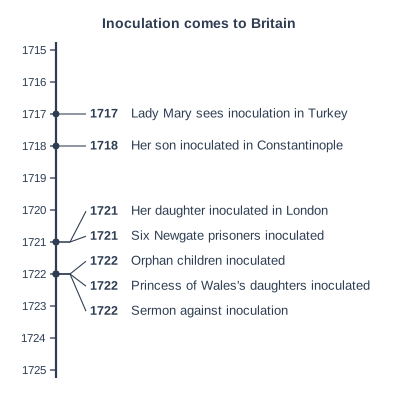
The first effective methods of preventing smallpox did not come from science either. Inoculation was a folk practice that Lady Mary Wortley Montagu saw in Constantinople and introduced to Britain in 1721. Jenner's vaccination of 1796 began with a country belief about milkmaids and cowpox, which he tested by experiment, but he had no idea why it worked. John Snow's discovery in 1854 that cholera spread through water came from mapping deaths around the Broad Street pump, not from laboratory science.
From 1861, however, science and technology transformed prevention. Pasteur's germ theory showed that microbes caused disease, and Robert Koch used microscopes, dyes and new ways of growing bacteria to identify the germs behind tuberculosis in 1882 and cholera in 1883. Pasteur developed vaccines against anthrax (1881) and rabies (1885), and in the 20th century scientists produced vaccines against diphtheria, tuberculosis, polio and measles, while technology allowed them to be mass-produced. Scientific research also identified new causes of disease, such as Richard Doll and Austin Bradford Hill's work linking smoking to lung cancer in 1950. In 2020 vaccines against COVID-19 were developed in less than a year.
Government was essential in turning these methods into prevention for the whole population. The Vaccination Acts made vaccination free in 1840 and compulsory in 1853, the Public Health Act of 1875 forced councils to provide clean water and sewers, and the NHS, created in 1948, provided free immunisation for every child. Laws such as the Clean Air Act of 1956 and the smoking ban of 2007 prevented disease on a large scale.
Other factors played a part. Communication spread new methods, from Jenner's Inquiry to modern health campaigns, and war created urgency, as with the national diphtheria immunisation campaign begun in 1940. Chance also helped, as when Pasteur found that an old culture of chicken cholera protected chickens.
Overall, science and technology has been the main factor in the development of ways to prevent disease, because since germ theory almost every new method, from vaccines to clean water, has come from scientific research. However, before 1861 the key breakthroughs came from folk practice and individuals, and in every period it was government action that made prevention effective for ordinary people. Science and technology developed the methods, but it worked alongside individuals and government.