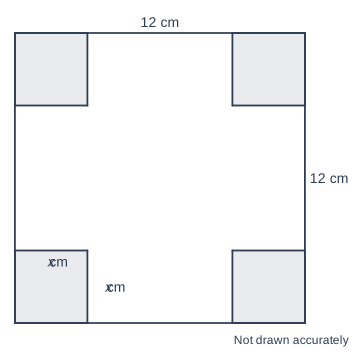
Question 1
2 marks\(T = 2x + \dfrac{27}{x^2}\), \(x > 0\)
Show that \(T\) has a stationary value when \(x = 3\)
Model answer
\(T = 2x + 27x^{-2}\)
\(\dfrac{dT}{dx} = 2 - 54x^{-3} = 2 - \dfrac{54}{x^3}\)
When \(x = 3\): \(\dfrac{dT}{dx} = 2 - \dfrac{54}{27} = 2 - 2 = 0\)
The gradient is 0, so T has a stationary value when \(x = 3\)
Explanation
Write the fraction as a negative power, \(27x^{-2}\), before differentiating: multiply by the power and reduce the power by 1 to get \(-54x^{-3}\). A stationary value is where the derivative is zero, so substitute x = 3 into the derivative, not into T. A common error is to differentiate \(\dfrac{27}{x^2}\) as \(\dfrac{27}{2x}\).
Mark scheme
-
1 mark
M1 for \(2\) or \(-54x^{-3}\) seen as a term of \(\dfrac{dT}{dx}\)
either term correct; accept \(-\dfrac{54}{x^3}\). \(27x^{-2}\) must be differentiated as a negative power: \(\dfrac{27}{2x}\) is not a method.
-
1 mark
A1 for \(\dfrac{dT}{dx} = 2 - \dfrac{54}{x^3}\) and \(2 - \dfrac{54}{27} = 0\) (or \(2 - 2 = 0\)) when \(x = 3\), with a conclusion that T is stationary
Alternative: \(2 - \dfrac{54}{x^3} = 0\) leading to \(x^3 = 27\) so \(x = 3\). This is a 'show that' question: an answer that only restates the result scores 0; every step must be shown. Substituting x = 3 into T (giving 9) is not a method.