
Level:
Correct: 0
Incorrect: 0
Marks: 0/0
Exam Practice
Course:
Topics:
AQA Level 2 Further Maths (Non-calculator) Smart practice A mixed round aimed at your weak spots
Unit 1
Number
Unit 2
Algebra
Unit 3
Coordinate Geometry (2 dimensions only)
Unit 4
Calculus
Unit 5
Matrix Transformations
Unit 6
Geometry
Avg
score:
–
Topics
done:
0/43

The equation of a straight line

Practise 17 exam-style questions on The equation of a straight line for AQA Level 2 Further Maths (Non-calculator). Write your answer as you would in the exam and get it marked in seconds against the mark scheme, point by point, with the Study Helper on hand if you get stuck.

  • 17 questions
  • 1–6 marks each
  • Instant marking
  • No sign-up needed
17 questions, marked as you go

Sample questions with model answers

Here are 4 of the questions in this topic, each with a model answer, an explanation of why it earns the marks and the mark scheme an examiner would use.

Question 1

2 marks

The line \(4x + 3y = 24\) crosses the \(x\)-axis at A and the \(y\)-axis at B.

Work out the coordinates of A and B.
Give the coordinates of each point, typed as (x, y).

Model answer

On the \(x\)-axis, \(y = 0\): \(4x = 24\), so \(x = 6\)
A is \((6, 0)\)
On the \(y\)-axis, \(x = 0\): \(3y = 24\), so \(y = 8\)
B is \((0, 8)\)

Explanation

Every point on the x-axis has y = 0, and every point on the y-axis has x = 0, so substitute each in turn and solve. These two points are the quickest way to place a line written in the form ax + by = c. A common error is to swap the intercepts, dividing 24 by the wrong coefficient.

Mark scheme
  1. 1 mark

    B1 for A \(= (6, 0)\)

    accept x = 6, y = 0

  2. 1 mark

    B1 for B \(= (0, 8)\)

    accept x = 0, y = 8. Both points correct but with the labels A and B swapped scores B1 only. \((8, 0)\) and \((0, 6)\) are B0B0. Each mark may be awarded with no working.
Question 2

2 marks

Here are the equations of four straight lines.

Line A: \(y = 3x - 2\)
Line B: \(6x - 2y = 5\)
Line C: \(3y = x + 4\)
Line D: \(x + 3y = 6\)

Which two lines are parallel?
Show working to support your answer.

Model answer

Line A: gradient 3
Line B: \(2y = 6x - 5\), so \(y = 3x - \dfrac{5}{2}\), gradient 3
Line C: \(y = \dfrac{1}{3}x + \dfrac{4}{3}\), gradient \(\dfrac{1}{3}\)
Line D: \(3y = -x + 6\), so \(y = -\dfrac{1}{3}x + 2\), gradient \(-\dfrac{1}{3}\)
Lines A and B both have gradient 3, so lines A and B are parallel.

Explanation

Parallel lines have equal gradients, so rearrange each equation into the form y = mx + c and compare the values of m. Line D is perpendicular to lines A and B (3 × (−1/3) = −1), which is a common distractor. Another common error is to read the gradient of B as 6 without making y the subject.

Mark scheme
  1. 1 mark

    M1 for the gradients of at least two of lines B, C and D, from correct rearrangements

    B: \(y = 3x - \dfrac{5}{2}\), gradient 3; C: \(y = \dfrac{1}{3}x + \dfrac{4}{3}\), gradient \(\dfrac{1}{3}\); D: \(y = -\dfrac{1}{3}x + 2\), gradient \(-\dfrac{1}{3}\). Condone the gradient written with x, eg \(3x\), for this mark only

  2. 1 mark

    A1 for lines A and B, with both gradients shown to be 3

    the answer must be supported by working: A and B with no working is M0A0. Do not accept gradients written with x for this mark. A and D, or C and D, are A0.

Question 3

3 marks

The lines \(2x + 3y = 12\) and \(kx - 6y = 5\) are perpendicular.

Work out the value of \(k\).

Model answer

\(3y = -2x + 12\), so gradient \(= -\dfrac{2}{3}\)
\(6y = kx - 5\), so gradient \(= \dfrac{k}{6}\)
Perpendicular: \(-\dfrac{2}{3} \times \dfrac{k}{6} = -1\)
\(-\dfrac{2k}{18} = -1\)
\(k = 9\)

Explanation

Write each gradient (the second in terms of k), then use the fact that perpendicular gradients multiply to −1. The second gradient must be 3/2, the negative reciprocal of −2/3, so k/6 = 3/2. Common errors are sign slips when dividing by −6 and setting the gradients equal, which is the condition for parallel lines.

Mark scheme
  1. 1 mark

    M1 for both gradients, \(-\dfrac{2}{3}\) and \(\dfrac{k}{6}\)

    oe eg \(y = -\dfrac{2}{3}x + 4\) and \(y = \dfrac{k}{6}x - \dfrac{5}{6}\)

  2. 1 mark

    M1dep for \(-\dfrac{2}{3} \times \dfrac{k}{6} = -1\) or \(\dfrac{k}{6} = \dfrac{3}{2}\) oe

  3. 1 mark

    A1 for \(k = 9\)

    \(k = -4\) (from making the gradients equal) is M1M0A0. A fully correct answer with no working scores full marks.

Question 4

5 marks

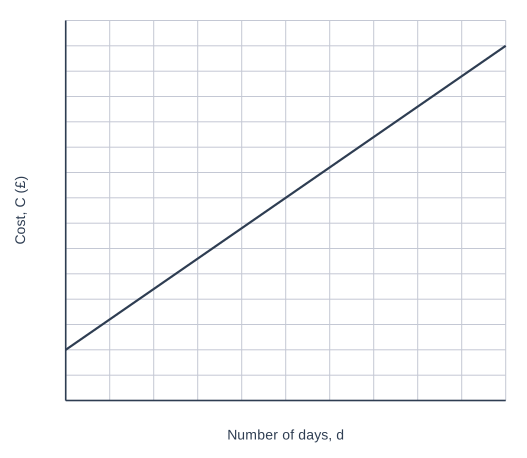
The graph shows the cost, \(C\) pounds, of hiring a carpet cleaner for \(d\) days.

The equation of the line is \(C = ad + b\)

Work out the values of \(a\) and \(b\).
Give the meaning of \(a\) and of \(b\) in this context.

A graph of Cost, C (£) (vertical axis, 0 to 150, marked every 10) against Number of days, d (horizontal axis, 0 to 10, marked every 1), on a grid. The graph is a straight line; its values can be read from the grid.

Model answer

The line passes through \((0, 20)\) and \((10, 140)\)
\(a = \dfrac{140 - 20}{10 - 0} = \dfrac{120}{10} = 12\)
The line meets the \(C\)-axis at 20, so \(b = 20\)
\(C = 12d + 20\)
\(a = 12\) is the cost, in pounds, of each day of hire.
\(b = 20\) is a fixed charge of £20 that is paid however many days the cleaner is hired for.

Explanation

In C = ad + b, a is the gradient (the increase in cost for each extra day) and b is the value of C when d = 0 (the fixed charge). Read two points where the line crosses grid intersections exactly to find the gradient. Interpretations must refer to the context, with units: 'gradient' or 'intercept' alone is not enough.

Mark scheme
  1. 1 mark

    M1 for a gradient calculation from two points read correctly from the line, eg \(\dfrac{140 - 20}{10 - 0}\)

    oe eg \(\dfrac{80 - 20}{5}\); the line passes through \((0, 20)\), \((5, 80)\) and \((10, 140)\)

  2. 1 mark

    A1 for \(a = 12\)

    accept 12 as the coefficient of \(d\) in their equation, eg \(C = 12d + 20\). \(a = 12\) with no working scores M1A1

  3. 1 mark

    B1 for \(b = 20\)

    the value of \(C\) where the line meets the \(C\)-axis (\(d = 0\)); accept \(C = 12d + 20\). Marked independently of \(a\)

  4. 1 mark

    B1 for \(a\): the cost of each day of hire is £12

    oe eg the cost per day, or the cost goes up by £12 for each extra day. 'The gradient' or 'how steep the line is' on its own is B0

  5. 1 mark

    B1 for \(b\): a fixed charge of £20

    oe eg the cost before any days are added, a one-off booking fee, a deposit or delivery charge of £20. 'The y-intercept' or 'where the line starts' on its own is B0

Ready to try the rest? Every answer you write is marked against the mark scheme, so you can see exactly where the marks are.

Study Helper Hints first, answers after you try

Stuck on this one? Ask for a hint and I’ll point you in the right direction, without giving the answer away. Once you’ve checked your answer, I’ll show you how the marks are awarded.