
Level:
Correct: 0
Incorrect: 0
Marks: 0/0
Exam Practice
Course:
Topics:
AQA Level 2 Further Maths (Non-calculator) Smart practice A mixed round aimed at your weak spots
Unit 1
Number
Unit 2
Algebra
Unit 3
Coordinate Geometry (2 dimensions only)
Unit 4
Calculus
Unit 5
Matrix Transformations
Unit 6
Geometry
Avg
score:
–
Topics
done:
0/43

30°, 60°, 90° and 45°, 45°, 90° triangles

Practise 16 exam-style questions on 30°, 60°, 90° and 45°, 45°, 90° triangles for AQA Level 2 Further Maths (Non-calculator). Write your answer as you would in the exam and get it marked in seconds against the mark scheme, point by point, with the Study Helper on hand if you get stuck.

  • 16 questions
  • 1–6 marks each
  • Instant marking
  • No sign-up needed
16 questions, marked as you go

Sample questions with model answers

Here are 4 of the questions in this topic, each with a model answer, an explanation of why it earns the marks and the mark scheme an examiner would use.

Question 1

2 marks

The diagram shows a right-angled triangle ABC.
Angle ABC = 90°, angle CAB = 30° and AC = 12 cm.

Work out the exact value of \(x\).
Give your answer as a surd in its simplest form.

Type square roots as sqrt( ), for example 2sqrt(3).
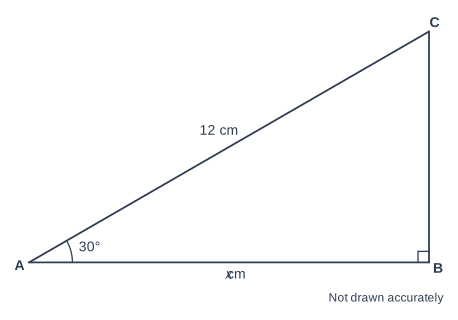
Geometry diagram, marked "Not drawn accurately". Triangle ABC. Angle ABC is marked as a right angle (90°). Angle CAB is marked 30°. Side AC is labelled 12 cm. Side AB is labelled x cm.

Model answer

\(\cos 30^\circ = \dfrac{x}{12}\)
\(x = 12\cos 30^\circ = 12 \times \dfrac{\sqrt{3}}{2} = 6\sqrt{3}\)

Explanation

AB is adjacent to the 30° angle and AC is the hypotenuse, so x = 12 cos 30°. Alternatively, the sides of a 30°, 60°, 90° triangle are in the ratio 1 : √3 : 2, so with hypotenuse 12 one part is 6 and AB = 6√3. A common error is to use sin 30°, giving 6, which is BC.

Mark scheme
  1. 1 mark

    M1 for \(12\cos 30^\circ\) or \(12 \times \dfrac{\sqrt{3}}{2}\) oe

    oe eg BC = 6 (from the ratio 1 : √3 : 2) and \(\sqrt{12^2 - 6^2}\), or \(x = 6\sqrt{3}\) from 6 × √3

  2. 1 mark

    A1 for \(6\sqrt{3}\)

    \(\sqrt{108}\) is A0 (not in its simplest form); decimals are A0. A fully correct answer with no working scores full marks.
Question 2

3 marks

Work out the exact value of
\(\dfrac{\sin 60^\circ + \cos 30^\circ}{\tan 45^\circ + \tan 60^\circ}\)

Give your answer in the form \(\dfrac{a - \sqrt{b}}{c}\) where \(a\), \(b\) and \(c\) are integers.

Type square roots as sqrt( ), for example 2sqrt(3).
Type fractions with /, for example (x + 1)/(x - 2).

Model answer

\(\sin 60^\circ = \cos 30^\circ = \dfrac{\sqrt{3}}{2}\), \(\tan 45^\circ = 1\) and \(\tan 60^\circ = \sqrt{3}\)
\(\dfrac{\frac{\sqrt{3}}{2} + \frac{\sqrt{3}}{2}}{1 + \sqrt{3}} = \dfrac{\sqrt{3}}{1 + \sqrt{3}}\)
\(\dfrac{\sqrt{3}}{1 + \sqrt{3}} \times \dfrac{\sqrt{3} - 1}{\sqrt{3} - 1} = \dfrac{3 - \sqrt{3}}{3 - 1} = \dfrac{3 - \sqrt{3}}{2}\)

Explanation

Replace each ratio by its exact value from the 1 : √3 : 2 and 1 : 1 : √2 triangles, then rationalise the denominator 1 + √3 by multiplying the top and bottom by √3 − 1, since (√3 + 1)(√3 − 1) = 3 − 1 = 2. Common errors are tan 45° = √2/2 (confusing it with sin 45°) and slips expanding √3(√3 − 1).

Mark scheme
  1. 1 mark

    B1 for numerator \(\sqrt{3}\) and denominator \(1 + \sqrt{3}\)

    oe eg \(\dfrac{\frac{\sqrt{3}}{2} + \frac{\sqrt{3}}{2}}{1 + \sqrt{3}}\)

  2. 1 mark

    M1 for \(\dfrac{\sqrt{3}}{1 + \sqrt{3}} \times \dfrac{\sqrt{3} - 1}{\sqrt{3} - 1}\) oe

    rationalising their denominator of the form \(p + q\sqrt{3}\); oe eg multiplying by \(\dfrac{1 - \sqrt{3}}{1 - \sqrt{3}}\)

  3. 1 mark

    A1 for \(\dfrac{3 - \sqrt{3}}{2}\)

    accept a = 3, b = 3, c = 2, or an equivalent fraction in the required form, eg \(\dfrac{6 - \sqrt{12}}{4}\). \(\dfrac{\sqrt{3}}{1 + \sqrt{3}}\) is A0. A fully correct answer with no working scores full marks.

Question 3

3 marks

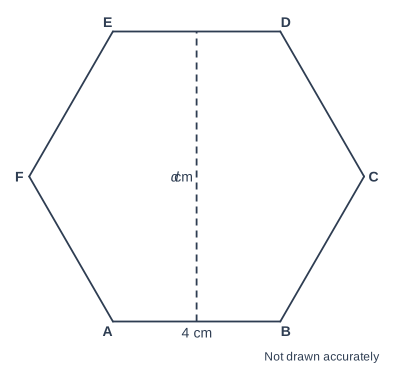
The diagram shows a regular hexagon ABCDEF with sides of length 4 cm.
The dashed line joins the midpoints of the opposite sides AB and DE.
Its length is \(d\) cm.

Work out the exact value of \(d\).
Give your answer as a surd in its simplest form.

Type square roots as sqrt( ), for example 2sqrt(3).

Geometry diagram, marked "Not drawn accurately". Regular hexagon ABCDEF. A dashed vertical line with no labelled ends is drawn; it crosses AB and crosses DE. Side AB is labelled 4 cm. The line between the midpoint of AB and the midpoint of DE is labelled d cm.

Model answer

Joining the centre to each vertex splits the hexagon into six equilateral triangles of side 4 cm
The dashed line passes through the centre and is two heights of these triangles
Height of one triangle \(= 4\sin 60^\circ = 4 \times \dfrac{\sqrt{3}}{2} = 2\sqrt{3}\)
\(d = 2 \times 2\sqrt{3} = 4\sqrt{3}\)

Explanation

A regular hexagon splits into six equilateral triangles, and each height splits an equilateral triangle into two 30°, 60°, 90° triangles with sides 2, 2√3 and 4. The distance between opposite sides is two of these heights. A common error is to give 8, the distance between opposite vertices.

Mark scheme
  1. 1 mark

    M1 for \(4\sin 60^\circ\) or \(\sqrt{4^2 - 2^2}\) or \(2\sqrt{3}\) (the height of an equilateral triangle of side 4)

    oe; the hexagon split into six equilateral triangles of side 4 may be seen on a diagram or in words

  2. 1 mark

    M1dep for \(2 \times 2\sqrt{3}\) oe

    oe eg the short diagonal BD found as \(2 \times 4\sin 60^\circ\), or \(BD^2 = 4^2 + 4^2 - 2 \times 4 \times 4\cos 120^\circ\), with BD identified as equal to d

  3. 1 mark

    A1 for \(4\sqrt{3}\)

    \(\sqrt{48}\) is A0 (not in its simplest form). 8 (the distance between opposite vertices) is A0. A fully correct answer with no working scores full marks.

Question 4

5 marks

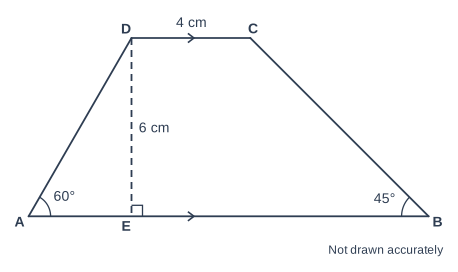
The diagram shows a trapezium ABCD.
AB is parallel to DC.
E is the point on AB such that DE is perpendicular to AB.
Angle DAB = 60°, angle ABC = 45°, DC = 4 cm and DE = 6 cm.

Work out the exact perimeter of the trapezium.
Give your answer in the form \(a + b\sqrt{2} + c\sqrt{3}\) where \(a\), \(b\) and \(c\) are integers.

Type square roots as sqrt( ), for example 2sqrt(3).

Geometry diagram, marked "Not drawn accurately". Trapezium ABCD. Dashed line segment DE is drawn. E lies on side AB. Angle DAB is marked 60°. Angle ABC is marked 45°. Side DC is labelled 4 cm. DE is labelled 6 cm. Angle DEB is marked as a right angle (90°). AB and DC are each marked with an arrowhead (parallel lines).

Model answer

Triangle AED: DE = 6 is opposite 60°, so AE : DE : AD \(= 1 : \sqrt{3} : 2\)
\(AE = \dfrac{6}{\sqrt{3}} = 2\sqrt{3}\) and \(AD = 2 \times 2\sqrt{3} = 4\sqrt{3}\)
The perpendicular from C to AB makes a 45°, 45°, 90° triangle with shorter sides 6, so its horizontal side is 6 and \(BC = 6\sqrt{2}\)
\(AB = 2\sqrt{3} + 4 + 6 = 10 + 2\sqrt{3}\)
Perimeter \(= (10 + 2\sqrt{3}) + 6\sqrt{2} + 4 + 4\sqrt{3} = 14 + 6\sqrt{2} + 6\sqrt{3}\) cm

Explanation

The two sloping sides are hypotenuses of right-angled triangles of height 6 cm: a 30°, 60°, 90° triangle on the left (ratio 1 : √3 : 2) and a 45°, 45°, 90° triangle on the right (ratio 1 : 1 : √2). AB is made of the two horizontal pieces plus the 4 cm under DC. Common errors are forgetting the 4 cm in AB and taking AE = 6√3 instead of 6/√3.

Mark scheme
  1. 1 mark

    M1 for \(AD = \dfrac{6}{\sin 60^\circ}\) or \(AE = \dfrac{6}{\tan 60^\circ}\) oe

    oe eg using the ratio \(1 : \sqrt{3} : 2\) in triangle AED with DE (opposite 60°) as the \(\sqrt{3}\) part

  2. 1 mark

    A1 for \(AD = 4\sqrt{3}\) and \(AE = 2\sqrt{3}\)

    oe eg \(\dfrac{12}{\sqrt{3}}\) and \(\dfrac{6}{\sqrt{3}}\) for this mark

  3. 1 mark

    B1 for \(BC = 6\sqrt{2}\)

    oe eg \(\dfrac{6}{\sin 45^\circ}\) or \(\sqrt{72}\) for this mark; the horizontal distance from the foot of the perpendicular from C to B is 6

  4. 1 mark

    M1 for \(AB = \text{their } AE + 4 + 6\) oe

    oe eg \(AB = 10 + 2\sqrt{3}\)

  5. 1 mark

    A1 for \(14 + 6\sqrt{2} + 6\sqrt{3}\)

    accept a = 14, b = 6, c = 6. Surds must be simplified for this mark (eg 12/√3 or √72 in the final answer is A0). A fully correct answer with no working scores full marks.

Ready to try the rest? Every answer you write is marked against the mark scheme, so you can see exactly where the marks are.

Study Helper Hints first, answers after you try

Stuck on this one? Ask for a hint and I’ll point you in the right direction, without giving the answer away. Once you’ve checked your answer, I’ll show you how the marks are awarded.