Question 1
2 marks\(\mathbf{R}\) is the matrix that represents a reflection in the line \(y = -x\)
\(\mathbf{I}\) is the 2 × 2 identity matrix.
Show that \(\mathbf{R}^2 = \mathbf{I}\)
Model answer
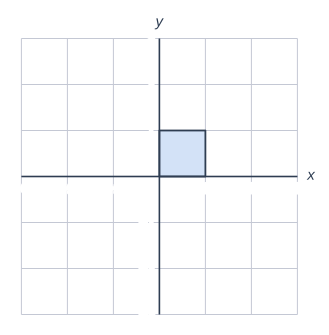
Reflection in \(y = -x\) maps (1, 0) to (0, −1) and (0, 1) to (−1, 0)
\(\mathbf{R} = \begin{pmatrix} 0 & -1 \\ -1 & 0 \end{pmatrix}\)
\(\mathbf{R}^2 = \begin{pmatrix} 0 & -1 \\ -1 & 0 \end{pmatrix}\begin{pmatrix} 0 & -1 \\ -1 & 0 \end{pmatrix} = \begin{pmatrix} 0 + 1 & 0 + 0 \\ 0 + 0 & 1 + 0 \end{pmatrix} = \begin{pmatrix} 1 & 0 \\ 0 & 1 \end{pmatrix} = \mathbf{I}\)
Explanation
R² means the reflection applied twice. Reflecting a point in the same line twice brings it back to where it started, so R² must be the identity matrix; the matrix product proves it. A common error is to use the matrix for a reflection in y = x, which also squares to I but is not the matrix asked for.
Mark scheme
-
1 mark
M1 for \(\mathbf{R} = \begin{pmatrix} 0 & -1 \\ -1 & 0 \end{pmatrix}\) and \(\begin{pmatrix} 0 & -1 \\ -1 & 0 \end{pmatrix}\begin{pmatrix} 0 & -1 \\ -1 & 0 \end{pmatrix}\)
the correct matrix for R, multiplied by itself
-
1 mark
A1 for \(\begin{pmatrix} 1 & 0 \\ 0 & 1 \end{pmatrix}\) and a statement that this is \(\mathbf{I}\)
must see the identity matrix written out. This is a 'show that' question: an answer that only restates the result scores 0; a geometric argument alone (reflecting twice returns every point to where it started) without the matrix product is M0A0.