
Level:
Correct: 0
Incorrect: 0
Marks: 0/0
Exam Practice
Course:
Topics:
AQA Level 2 Further Maths (Non-calculator) Smart practice A mixed round aimed at your weak spots
Unit 1
Number
Unit 2
Algebra
Unit 3
Coordinate Geometry (2 dimensions only)
Unit 4
Calculus
Unit 5
Matrix Transformations
Unit 6
Geometry
Avg
score:
–
Topics
done:
0/43

Sine and cosine rules; area of a triangle

Practise 19 exam-style questions on Sine and cosine rules; area of a triangle for AQA Level 2 Further Maths (Non-calculator). Write your answer as you would in the exam and get it marked in seconds against the mark scheme, point by point, with the Study Helper on hand if you get stuck.

  • 19 questions
  • 1–6 marks each
  • Instant marking
  • No sign-up needed
19 questions, marked as you go

Sample questions with model answers

Here are 4 of the questions in this topic, each with a model answer, an explanation of why it earns the marks and the mark scheme an examiner would use.

Question 1

2 marks

The diagram shows triangle PQR.
\(PQ = 5\) cm, \(PR = 3\) cm and angle QPR = 120°

Sine rule: \(\dfrac{a}{\sin A} = \dfrac{b}{\sin B} = \dfrac{c}{\sin C}\)   Cosine rule: \(a^2 = b^2 + c^2 - 2bc\cos A\)   Area of triangle \(= \dfrac{1}{2}ab\sin C\)

Work out the length of QR.
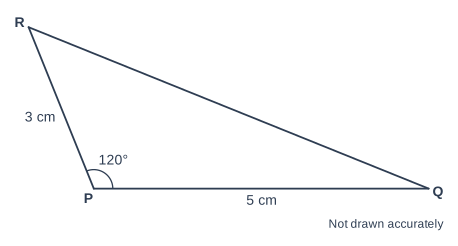
Geometry diagram, marked "Not drawn accurately". Triangle PQR. Side PQ is labelled 5 cm. Side PR is labelled 3 cm. Angle QPR is marked 120°.

Model answer

\(QR^2 = 5^2 + 3^2 - 2 \times 5 \times 3 \times \cos 120^\circ\)
\(\cos 120^\circ = -\dfrac{1}{2}\)
\(QR^2 = 25 + 9 + 15 = 49\)
\(QR = 7\) cm

Explanation

Two sides and the angle between them are known, so the cosine rule gives the third side. Because the angle is obtuse its cosine is negative, \(\cos 120^\circ = -\dfrac{1}{2}\), so the last term is added. Using \(+\dfrac{1}{2}\) is the common sign error.

Mark scheme
  1. 1 mark

    M1 for \(5^2 + 3^2 - 2 \times 5 \times 3 \times \cos 120^\circ\) oe

    A fully correct substitution. Implied by \(25 + 9 + 15\) or 49. Using \(\cos 120^\circ = \dfrac{1}{2}\) (giving \(\sqrt{19}\)) is M0A0.

  2. 1 mark

    A1 for \(7\)

    Condone missing units. ±7 is A0. A fully correct answer with no working scores full marks.
Question 2

3 marks

The sides of a triangle have lengths 7 cm, 8 cm and 13 cm.

Sine rule: \(\dfrac{a}{\sin A} = \dfrac{b}{\sin B} = \dfrac{c}{\sin C}\)   Cosine rule: \(a^2 = b^2 + c^2 - 2bc\cos A\)   Area of triangle \(= \dfrac{1}{2}ab\sin C\)

Work out the size of the largest angle of the triangle.

Model answer

The largest angle \(\theta\) is opposite the longest side, 13 cm.
\(\cos\theta = \dfrac{7^2 + 8^2 - 13^2}{2 \times 7 \times 8}\)
\(= \dfrac{49 + 64 - 169}{112} = \dfrac{-56}{112} = -\dfrac{1}{2}\)
\(\theta = 120^\circ\)

Explanation

The largest angle is opposite the longest side, and the cosine rule rearranged for \(\cos\theta\) gives it from the three sides. A negative cosine means the angle is obtuse: \(\cos\theta = -\dfrac{1}{2}\) gives 120°, not 60°. Putting 13 in the wrong place in the formula finds a different angle.

Mark scheme
  1. 1 mark

    M1 for \(\cos\theta = \dfrac{7^2 + 8^2 - 13^2}{2 \times 7 \times 8}\) or \(13^2 = 7^2 + 8^2 - 2 \times 7 \times 8 \times \cos\theta\)

    The largest angle is opposite the 13 cm side. Any letter for the angle.

  2. 1 mark

    M1dep for \(\cos\theta = -\dfrac{56}{112}\) or \(-\dfrac{1}{2}\)

    oe eg \(112\cos\theta = -56\)

  3. 1 mark

    A1 for \(120\)

    Condone a missing degree sign. 60 (from \(\cos\theta = \dfrac{1}{2}\), a sign error) is M1M0A0. A fully correct answer with no working scores full marks.

Question 3

3 marks

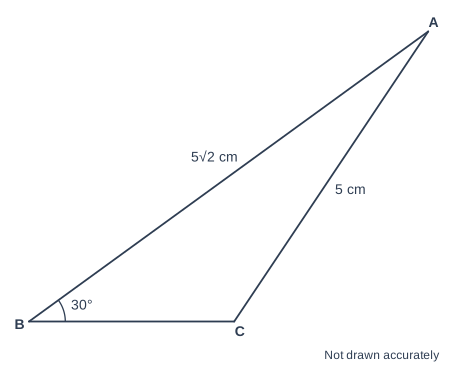
The diagram shows triangle ABC.
\(AB = 5\sqrt{2}\) cm and \(AC = 5\) cm.
Angle ABC = 30°
Angle ACB is obtuse.

Sine rule: \(\dfrac{a}{\sin A} = \dfrac{b}{\sin B} = \dfrac{c}{\sin C}\)   Cosine rule: \(a^2 = b^2 + c^2 - 2bc\cos A\)   Area of triangle \(= \dfrac{1}{2}ab\sin C\)

Work out the size of angle ACB.

Geometry diagram, marked "Not drawn accurately". Triangle ABC. Side AB is labelled 5√2 cm. Side AC is labelled 5 cm. Angle ABC is marked 30°.

Model answer

\(\dfrac{\sin C}{AB} = \dfrac{\sin B}{AC}\)
\(\dfrac{\sin C}{5\sqrt{2}} = \dfrac{\sin 30^\circ}{5}\)
\(\sin C = \dfrac{5\sqrt{2} \times \dfrac{1}{2}}{5} = \dfrac{\sqrt{2}}{2}\)
\(C = 45^\circ\) or \(C = 180^\circ - 45^\circ = 135^\circ\)
Angle ACB is obtuse, so angle ACB = 135°

Explanation

The sine rule gives \(\sin C = \dfrac{\sqrt{2}}{2}\), and two angles between 0° and 180° have this sine: 45° and 135°. Both would make a possible triangle here, which is why the question says the angle is obtuse. Giving 45° ignores that information.

Mark scheme
  1. 1 mark

    M1 for \(\dfrac{\sin C}{5\sqrt{2}} = \dfrac{\sin 30^\circ}{5}\) oe

    oe eg \(\dfrac{5}{\sin 30^\circ} = \dfrac{5\sqrt{2}}{\sin C}\)

  2. 1 mark

    A1 for \(\sin C = \dfrac{\sqrt{2}}{2}\) or \(\dfrac{1}{\sqrt{2}}\)

    oe eg \(\dfrac{5\sqrt{2}}{10}\)

  3. 1 mark

    A1 for \(135\)

    Condone a missing degree sign. 45 is M1A1A0. 45 and 135 both given as the answer is A0. A fully correct answer with no working scores full marks.

Question 4

5 marks

In triangle ABC, \(AB = 8\) cm and angle BAC = 60°
The area of the triangle is \(14\sqrt{3}\) cm²

Sine rule: \(\dfrac{a}{\sin A} = \dfrac{b}{\sin B} = \dfrac{c}{\sin C}\)   Cosine rule: \(a^2 = b^2 + c^2 - 2bc\cos A\)   Area of triangle \(= \dfrac{1}{2}ab\sin C\)

Work out the length of BC.
Give your answer as a surd.

Type square roots as sqrt( ), for example 2sqrt(3).

Model answer

\(\dfrac{1}{2} \times 8 \times AC \times \sin 60^\circ = 14\sqrt{3}\)
\(4 \times AC \times \dfrac{\sqrt{3}}{2} = 14\sqrt{3}\)
\(2\sqrt{3} \times AC = 14\sqrt{3}\), so \(AC = 7\) cm
\(BC^2 = 8^2 + 7^2 - 2 \times 8 \times 7 \times \cos 60^\circ\)
\(= 64 + 49 - 56 = 57\)
\(BC = \sqrt{57}\) cm

Explanation

The area and the angle at A give the other side next to A, AC = 7 cm. Then two sides and the included angle give BC by the cosine rule. The \(\sqrt{3}\) cancels in the first step; students who substitute a decimal for \(\sin 60^\circ\) make the arithmetic much harder.

Mark scheme
  1. 1 mark

    M1 for \(\dfrac{1}{2} \times 8 \times AC \times \sin 60^\circ = 14\sqrt{3}\) oe

    oe eg \(2\sqrt{3} \times AC = 14\sqrt{3}\)

  2. 1 mark

    A1 for \(AC = 7\)

  3. 1 mark

    M1 for \(8^2 + 7^2 - 2 \times 8 \times 7 \times \cos 60^\circ\)

    ft their AC (a positive value)

  4. 1 mark

    M1dep for \(64 + 49 - 56\) or \(57\)

    ft their AC, with \(\cos 60^\circ = \dfrac{1}{2}\) used

  5. 1 mark

    A1 for \(\sqrt{57}\)

    Accept sqrt(57). Exact value only: 7.55 is A0. A fully correct answer with no working scores full marks.

Ready to try the rest? Every answer you write is marked against the mark scheme, so you can see exactly where the marks are.

Study Helper Hints first, answers after you try

Stuck on this one? Ask for a hint and I’ll point you in the right direction, without giving the answer away. Once you’ve checked your answer, I’ll show you how the marks are awarded.